
Evaluating Industrial Circuit Breaker Manufacturers: What Evidence to Request

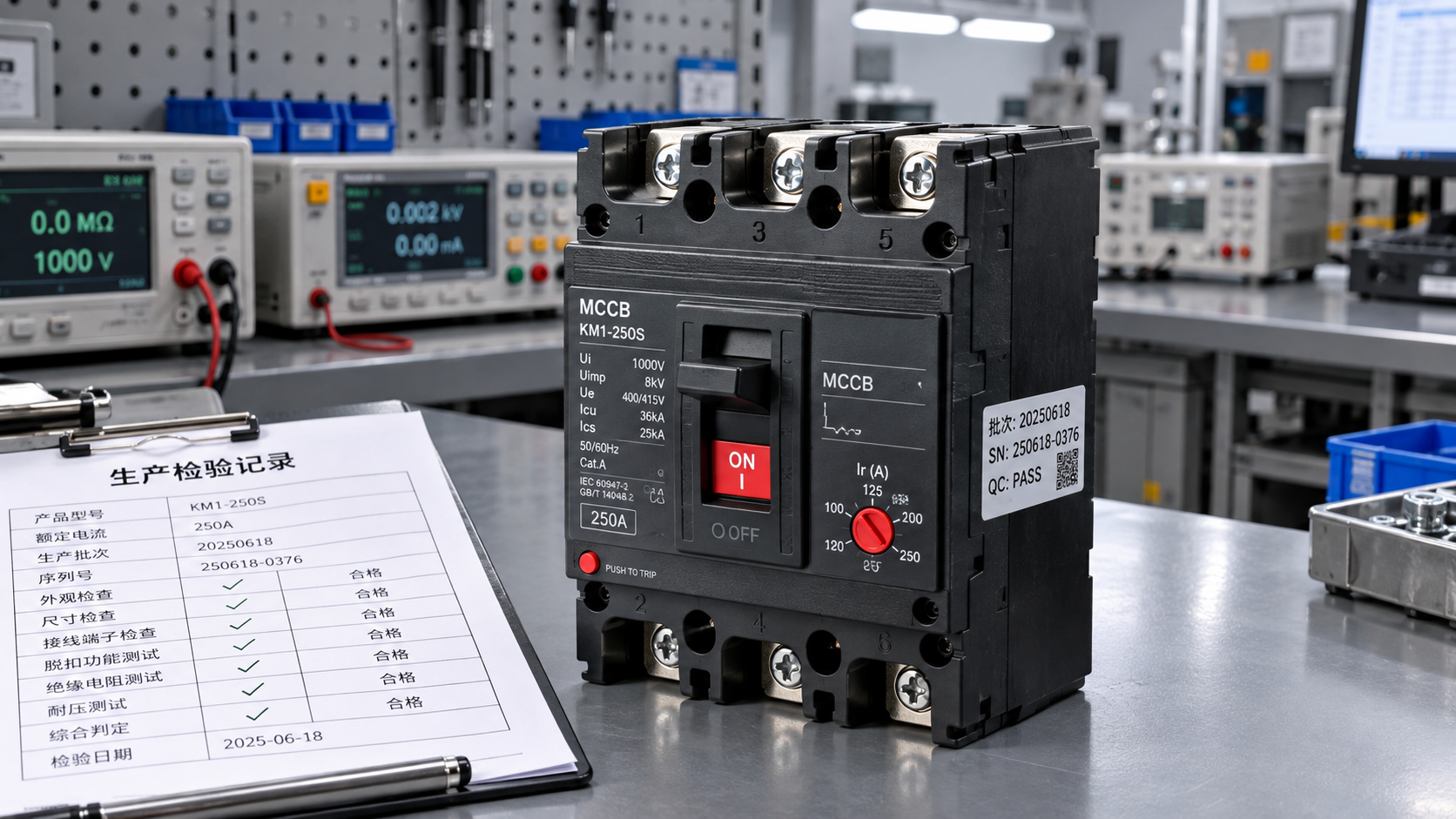
A circuit breaker manufacturer’s industrial expertise is demonstrated by a traceable connection between the product offered, its verified performance, and the conditions in which it will operate. A certification logo or a high interrupting-capacity figure does not establish that connection. The strongest evidence identifies the exact breaker configuration, explains its application limits, and shows how production controls preserve the tested design.
Supplier approval should therefore distinguish three questions: Is the breaker acceptable for the destination market? Does its documented performance suit the electrical system? Can the manufacturer consistently deliver that same configuration? A gap in any one of these areas can outweigh an attractive price or delivery promise.
Define the application before requesting evidence
A document package is only useful against a defined requirement. Without the operating voltage, prospective short-circuit current, installation arrangement, and applicable product standard, even an authentic test report may prove little about suitability.
The inquiry should identify AC or DC service, frequency where relevant, pole arrangement, load characteristics, ambient temperature, enclosure conditions, and any altitude or environmental constraints. Include required accessories, communications functions, and coordination with upstream or downstream protective devices. Where the fault level is not yet established, engineering confirmation remains an approval condition—not something the supplier’s maximum catalog rating can replace.
Specify whether the breaker will be installed in machinery, a distribution panel, a switchboard, or another assembly. Component compliance does not automatically establish compliance of the complete installation. The manufacturer should be able to explain where its product evidence ends and where assembly verification or system-level assessment is still required.
Request certification records that identify the actual product
Ask for the certificate, listing, or other conformity documentation relevant to the destination and application, together with its scope and model schedule. The important details are the manufacturer’s legal identity, covered production locations where identified, product designation, applicable standard and edition, ratings, and any conditions of acceptance.
For low-voltage industrial circuit breakers, IEC 60947-2 is a central product standard. In North American applications, UL 489 and UL 1077 address different product categories: a supplementary protector evaluated under UL 1077 is not a substitute for a UL 489 branch-circuit breaker where that protection is required. A supplier that treats these designations as interchangeable has not resolved the application requirement.
Check third-party certification claims through the issuing organization’s official records where available. Match the offered catalog number—not merely the brand or product-family name—to the documented scope. A private-label arrangement needs a clear link between the selling brand, the approved product identity, and the manufacturer responsible for production.
CE marking should not be treated as equivalent to independent product certification. Where applicable, request the EU Declaration of Conformity and check that it identifies the product and relevant legislation and standards. Likewise, an IECEE CB Test Certificate and associated report can support conformity assessment, but do not automatically provide every national approval required by the destination market.
A certificate covering a related series is not necessarily invalid evidence. However, the supplier must explain why the proposed variant falls within its scope. An unexplained difference in pole count, frame size, trip unit, or rating is a reason to hold approval.
Read test evidence against the rating being purchased
A full laboratory report may contain confidential design information. A reasonable evidence request can therefore begin with the report number, issuing laboratory, tested model identification, relevant results, and a documented route for reviewing restricted material. Confidentiality is manageable; an unverifiable claim is not.
The report or supporting technical schedule should connect the quoted breaker to the tested design. Request clarification when one report is used to support several frame sizes or trip-unit options. Product-family coverage can be legitimate under applicable assessment rules, but the basis for that coverage should be documented rather than inferred from similar housings.
Under IEC 60947-2, distinguish rated ultimate short-circuit breaking capacity, Icu, from rated service short-circuit breaking capacity, Ics. Both concern interruption performance, but their test sequences and post-test requirements differ. An Icu figure alone does not establish the same service capability represented by Ics. The specification should identify which ratings matter to the installation rather than accepting whichever number is largest.
Voltage deserves particular attention. A breaker may have different breaking capacities at different operational voltages. DC applications also require explicit confirmation of the permitted voltage, pole connections, and polarity restrictions where applicable. An AC rating cannot be carried across to DC service by assumption.
Where selective coordination or backup protection is required, request manufacturer-supported tables or studies identifying the exact device combinations, voltage, settings, and limits. Two individually compliant breakers do not automatically form a verified coordinated combination. Similarly, a breaker’s interrupting rating does not by itself establish the short-circuit current rating of an entire panel.
Check whether the evidence follows the product through production
Type testing establishes performance of a design under specified conditions. Production controls address a different question: whether delivered units remain consistent with that design. Both are necessary, and neither substitutes for the other.
Request a production control plan or an appropriately redacted summary. It should identify incoming-material checks, critical assembly controls, routine verification, handling of nonconforming units, and release authorization. Depending on the design, relevant controls can include contact assembly, operating mechanisms, trip-unit configuration, terminal assembly, and dielectric testing.
Ask the manufacturer to demonstrate traceability using a sample unit or an anonymized production record. Starting from the serial number or batch marking, it should be possible to identify the product configuration, production period, relevant inspection records, and controlled component information. A printed batch code has little value if the underlying records cannot be retrieved.
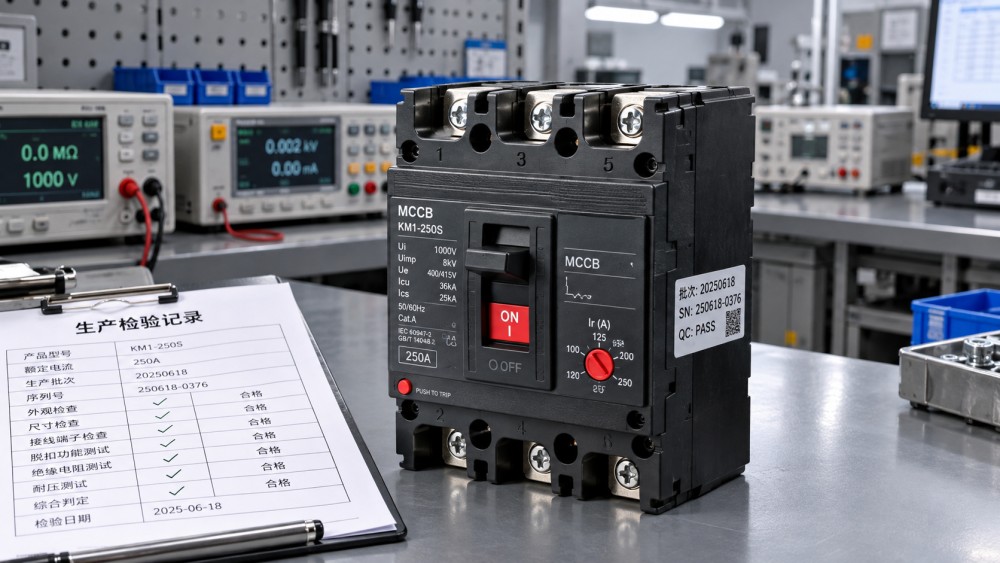
Routine test records should state the method, acceptance criteria, equipment identification, and result. Clarify whether a check applies to every unit or to a sample, and how failures affect the rest of the batch. “100% tested” is incomplete unless the supplier specifies what is tested. Routine production checks do not mean every breaker undergoes destructive short-circuit testing.
An ISO 9001 certificate can support confidence in the quality-management system, provided its scope and site are relevant. It does not certify the breaker’s electrical performance. A factory audit should connect the documented procedures to actual records, equipment calibration, component control, and segregation of rejected material.
Use application questions to test industrial competence
Relevant experience is best demonstrated through technical reasoning supported by records, not customer logos alone. Ask for anonymized application references that identify the electrical duty, installation conditions, supplied configuration, and any limitations discovered during selection or commissioning. Commercial confidentiality need not prevent disclosure of the engineering basis.
A useful assessment is to submit a defined operating scenario and request a written selection rationale. For a hot enclosure, the response should address applicable derating and installation conditions. For a motor feeder, it should explain the relationship between starting current, protective settings, and the other devices in the circuit. For an inverter-fed application, it should identify the installation position and relevant waveform or frequency constraints rather than treating all circuits alike.
The quality of the questions returned matters. A manufacturer that asks for fault level, earthing arrangement, conductor details, or load behavior is identifying missing selection inputs. An immediate recommendation based only on rated current leaves essential assumptions untested.
Also request installation instructions and accessory compatibility records before ordering. Terminal capacity, tightening torque, conductor requirements, mounting orientation, and accessory combinations can determine whether a nominally suitable breaker is usable in the intended assembly. These details should be controlled product information, not informal assurances in a sales message.
Make change control and delivery evidence part of approval
A satisfactory sample does not protect subsequent orders if the manufacturer can change critical components or production arrangements without notice. Request its engineering-change procedure and agree which changes require notification, technical review, or renewed approval. Changes to contact materials, arc-control components, trip electronics, insulating materials, or manufacturing locations may affect the validity of existing evidence.
The purchase specification should identify the approved model, trip-unit version where relevant, accessories, ratings, markings, and required shipment records. Prohibit unapproved substitutions. For configurable electronic products, record the agreed settings or configuration and define responsibility for final adjustment and verification.
Delivery capability should be assessed at configuration level. Stock of a base frame does not establish availability of the required trip unit, auxiliary contacts, motor operator, or terminal kit. Request lead times for the complete bill of materials and clarify which items are manufactured internally, purchased, or supplied through another factory. Where delivery is critical, seek evidence supporting the promised schedule rather than relying on nominal catalog availability.
Ask for the warranty procedure, failure-analysis process, and a redacted example of a closed corrective-action record. The useful evidence shows how a returned unit was identified, investigated, and linked to corrective action. A replacement policy alone does not demonstrate the ability to contain a recurring defect.
Separate missing paperwork from unresolved product risk
Not every documentation gap warrants rejection. A restricted report may be reviewed under a confidentiality agreement; a missing installation drawing may be supplied before design release. Approval should depend on whether the gap can be closed with verifiable evidence before it affects the order or installation.
Other gaps are more fundamental: an untraceable certificate, a model outside the documented scope, an interrupting rating quoted at the wrong voltage, or refusal to identify the actual manufacturer. These prevent a defensible suitability decision and should remain approval blockers.
Record the basis of acceptance in a controlled approval file, including the exact configuration, supporting documents, unresolved conditions, and agreed change-notification requirements. The decisive question is not whether a manufacturer can produce an impressive document package. It is whether every consequential claim about the breaker being ordered can be traced to applicable evidence—and whether that evidence will still describe the units delivered.
Related News
- Electrical Components for Control Panels: Choosing the Right Circuit BreakersTime : Oct 27, 2026
- Evaluating Industrial Circuit Breaker Manufacturers: What Evidence to RequestTime : Oct 31, 2026
- Electrical Compliance Certification for Circuit Breakers: Tests and DocumentsTime : Oct 24, 2026