
GCC Adopts Dual Certification Rule for Connectors

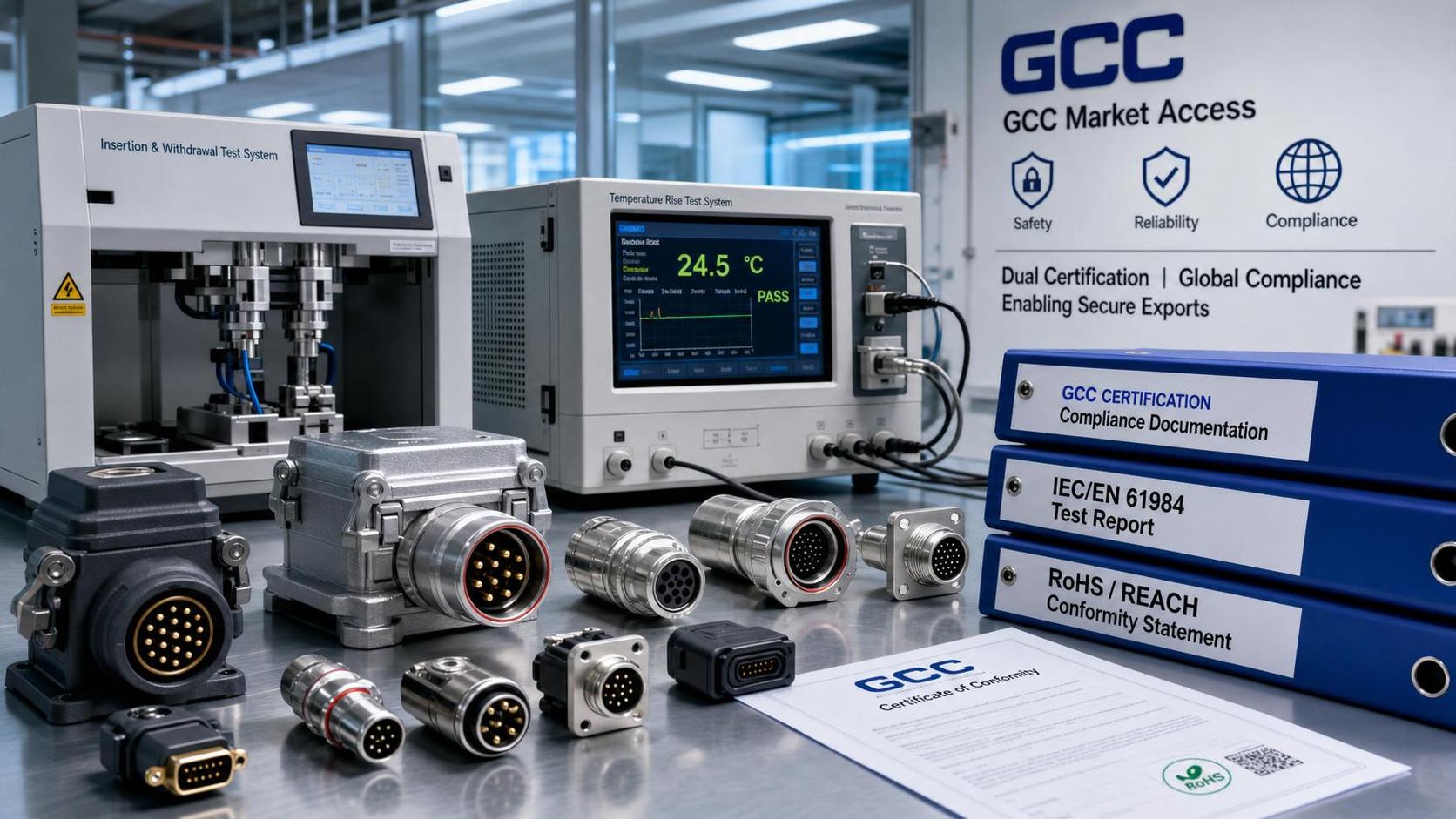
On December 1, 2026, a new market-entry requirement takes effect for industrial electrical connectors shipped into GCC markets. Under the framework announced on July 11, 2026 by GSO together with Saudi SASO and UAE ESMA, covered power and signal connectors must hold both GCC certification and compliance with the updated IEC 62196-2:2026 durability and temperature-rise testing requirements. This is worth close attention because it changes the compliance basis for export, procurement, testing, and delivery, especially for suppliers that have relied on a single certification path.
What the new requirement formally changes
The confirmed change is a dual-certification requirement for industrial electrical connectors entering GCC countries. The announcement states that, from December 1, 2026, these products must meet GCC certification requirements and also pass the updated IEC 62196-2:2026 tests covering plug-in durability and temperature rise.
The scope described in the announcement includes industrial-grade electrical connectors for both power and signal applications. The summary also states that products holding only a single certification will be phased out under the new rule. For Chinese connector manufacturers exporting to GCC markets, testing programs will need to be upgraded in parallel with this change.
Where the pressure is likely to appear first
Export shipments move from single-path approval to dual compliance review
From an industry perspective, exporters are likely to feel the impact first because product access is now tied to two parallel compliance conditions rather than one. The practical effect is not only a technical testing question, but also a documentation and shipment-readiness issue. What deserves closer attention is whether product files, certification records, and test reports are aligned before goods are committed for delivery.
Manufacturing and product qualification may need to be re-sequenced
Analysis shows that manufacturers may need to revisit product qualification flows for industrial connectors covered by the rule. Because the updated IEC 62196-2:2026 requirement specifically refers to plug-in durability and temperature-rise testing, the affected stage is likely to be the transition from design validation to export compliance release. For companies serving GCC demand, the main concern is whether current qualified products still match the new access condition after the single-certification route is no longer accepted.
Procurement and sourcing teams face a supplier screening issue
Observably, procurement teams and buyers may need to tighten supplier qualification checks. If incoming products were previously accepted on the basis of one certification only, the new framework changes the minimum compliance threshold for future orders into GCC markets. The issue is not limited to pricing or lead time; it also reaches bid specifications, purchase terms, and the review of test documentation attached to supplied connector models.
Testing and certification service providers may see demand shift toward updated verification work
It is more appropriate to understand this as a signal for renewed compliance workload among certification-related firms and testing service providers. The summary does not provide execution detail beyond the announced requirement, but the immediate implication is that companies involved in conformity assessment will be drawn into product review, test-plan updates, and verification of whether existing evidence remains usable under the new framework.
What companies should review now
Check which exported connector lines are still relying on a single certificate
Analysis shows that the first practical step is to identify affected industrial connector products, including both power and signal categories, and determine whether any export line for GCC markets still depends on a single-certification basis. This matters because the announcement explicitly indicates that single-certified products will be phased out under the new rule.
Re-examine testing plans against the updated IEC 62196-2:2026 focus areas
What deserves closer attention is the testing side of compliance readiness. The confirmed summary points directly to plug-in durability and temperature-rise testing, so technical and quality teams should review whether their current verification plans, supporting reports, and product technical files are consistent with that updated requirement. Where testing programs have not yet been upgraded, this becomes a timing and delivery risk rather than only a laboratory matter.
Review contract documents, bid files, and shipment paperwork for compliance references
From an industry perspective, commercial teams should also examine whether quotations, tender documents, technical attachments, and shipment files still reference an older or single-path certification basis. The summary does not provide a detailed enforcement mechanism, so this should be treated as a compliance watchpoint rather than a confirmed procedural outcome. Even so, mismatched documentation could become a problem if market-entry checks or buyer reviews begin to reflect the dual-standard requirement more strictly.
Continue monitoring how the requirement is expressed in market practice
Observably, companies should keep tracking how the new framework appears in formal compliance reviews, customer specifications, and supplier qualification requests after December 1, 2026. The available input confirms the rule change and effective date, but does not provide detailed operational guidance. For that reason, businesses should avoid assuming that all implementation points are already uniform across every transaction stage.
Why this looks like an execution signal, not just a policy headline
Analysis shows that this development is better understood as an implemented market-access change than as a distant policy discussion, because the announcement includes a defined effective date and a concrete dual-certification condition. At the same time, it should not yet be treated as a fully transparent execution framework, since the provided information does not set out detailed review procedures, documentation formats, or handling practices in procurement and customs-facing processes.
What deserves closer attention is the interaction between formal certification requirements and real transaction behavior. In many compliance-driven product categories, the market response is often visible not only in official language but also in tender clauses, supplier onboarding checks, and acceptance criteria applied by buyers and intermediaries. That part still requires continued observation here.
How this update is best understood at this stage
At this stage, the rule change is most appropriately read as a confirmed tightening of entry requirements for industrial electrical connectors entering GCC markets. The core shift is clear: single-certification positioning is no longer sufficient where the new dual requirement applies. For exporters, manufacturers, buyers, and compliance teams, the immediate issue is preparation of testing, documentation, and qualification workflows against that new baseline.
A neutral reading is that the announcement already carries operational significance, while some details of market execution still warrant continued monitoring. That makes this less a general policy signal and more a live compliance adjustment with follow-through needed in export and procurement practice.
Basis of this article and what still needs verification
This article is based on the user-provided news title, event date, and event summary. For developments of this type, relevant source categories typically include official announcements, releases from regulatory authorities, information from trade or customs-related authorities, industry association notices, standards organization documents, and reporting by established professional media.
No specific official source link was provided in the input, so the underlying official publication path still needs to be verified on an ongoing basis. Further observation should focus on any detailed implementation language, certification enforcement practice, changes in tender documents, market feedback, and how companies are adjusting testing and export compliance procedures after the effective date.
Related News