
Which Anchor Bolt Coating Lasts Longer in Coastal Projects?

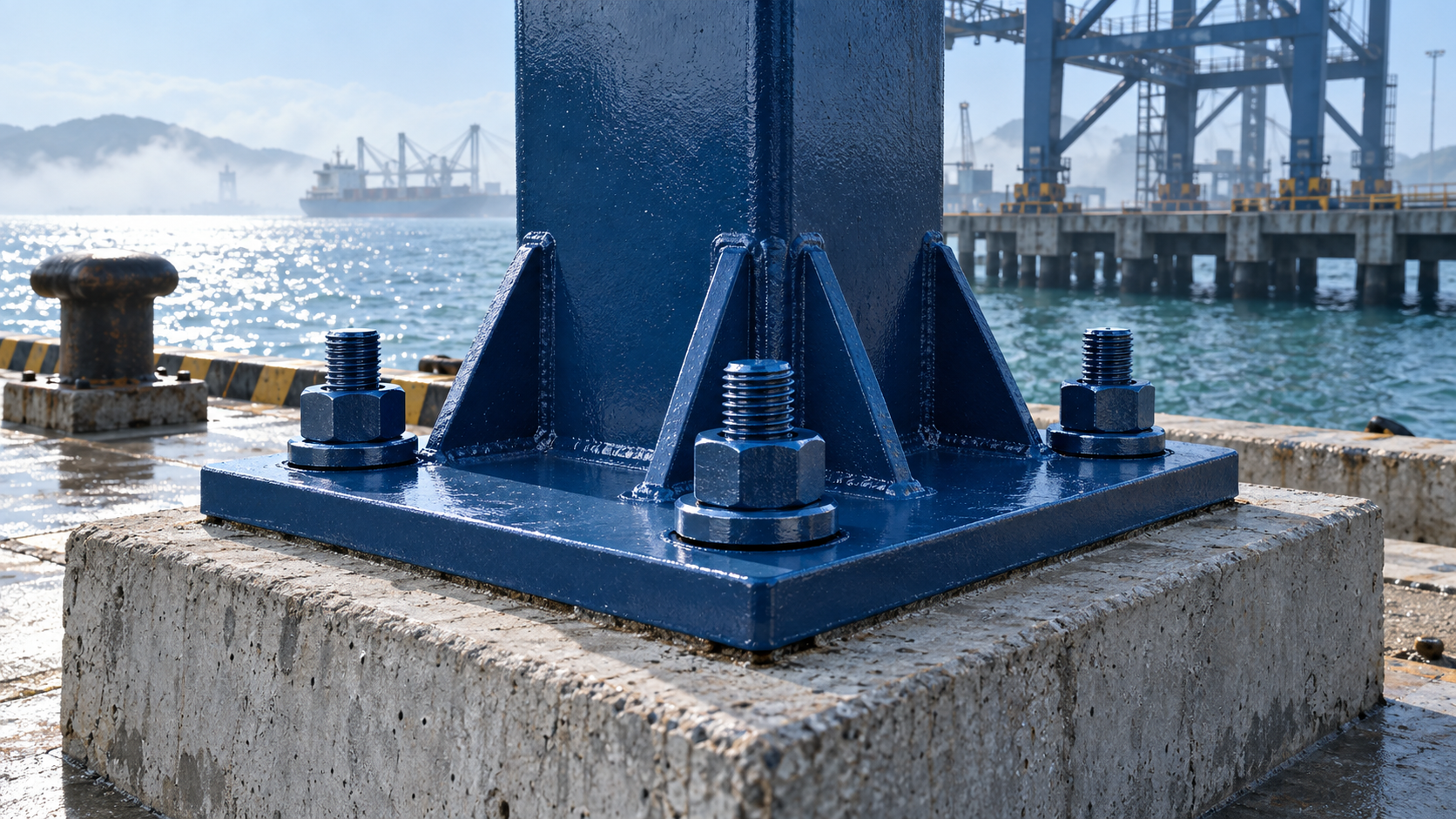
Which Anchor Bolt Coating Lasts Longer in Coastal Projects?
Which anchor bolt coating lasts longer in coastal projects? There is no responsible one-line answer, because “coastal” can mean anything from a sheltered warehouse several kilometres inland to a splash-zone jetty exposed to daily saltwater, wind-driven spray, trapped moisture, and abrasion. Yet for most structural anchor applications, the practical ranking is clear: a properly specified duplex system—hot-dip galvanizing followed by a compatible paint or epoxy-based topcoat—usually provides the longest service life among conventional carbon-steel options. Where the exposure is severe, access for maintenance is poor, or failure consequences are high, suitably selected stainless steel or duplex stainless steel may be the more durable route.
The important distinction is that a coating does not solve every corrosion problem by itself. Anchor bolts fail at vulnerable details: exposed threads, nut-bearing surfaces, concrete interfaces, damaged coating around installation tools, water-holding pockets below base plates, and connections where dissimilar metals create galvanic effects. A long-lasting solution begins with understanding the whole assembly, not simply choosing the thickest coating in a supplier quotation.
Why coastal anchor bolts corrode faster than expected
Salt is not only a surface contaminant. Chlorides attract and retain moisture, allowing an electrolyte film to remain active even when a bolt appears dry. Cycles of wetting and drying concentrate salts, while wind can carry marine aerosol well beyond the shoreline. High humidity, elevated temperature, industrial pollutants, poor drainage, and crevice conditions can all make a nominally “coastal” project much more aggressive than another one nearby.
Anchor bolts are especially awkward because they cross several environments at once. One portion is embedded in concrete, another may sit beneath grout or a steel base plate, and the exposed threaded end must accept washers and nuts without compromising preload. Corrosion at the concrete-air interface is often more concerning than uniform rust along an accessible shank. If water enters the gap between a base plate and concrete pedestal, the bolt may corrode out of view for years.
For this reason, project teams should classify the actual micro-environment rather than rely only on a broad coastal label. Atmospheric corrosivity guidance such as ISO 9223 can help frame the discussion, but it does not replace a project-specific assessment of distance from surf, chloride deposition, shelter, drainage, inspection access, design life, and local code requirements.
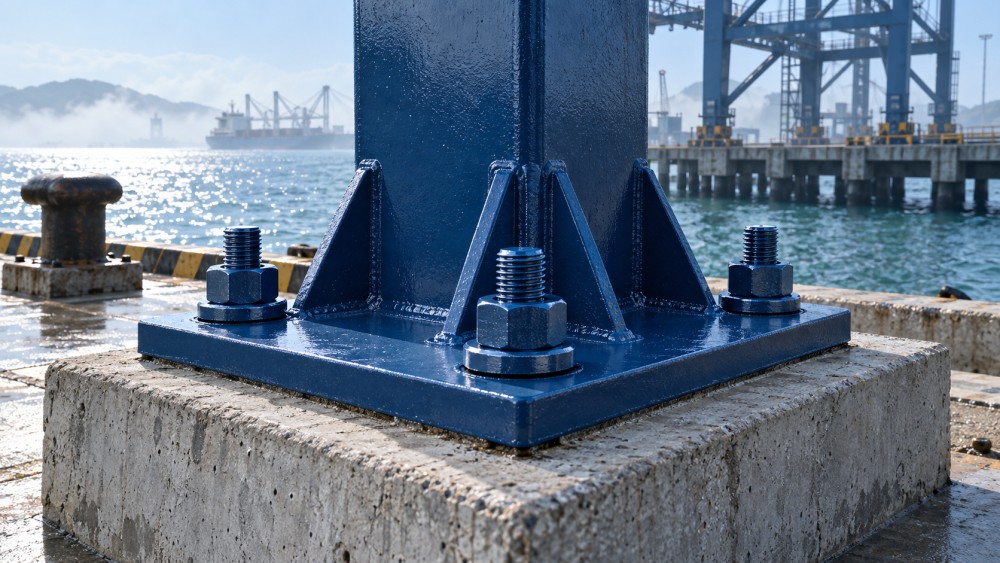
How the main protection options compare
Hot-dip galvanizing remains the default choice for many outdoor anchor bolts because it is robust, widely available, and protects steel in two ways. The zinc coating forms a barrier, and it can provide sacrificial protection at small scratches or cut edges. For fabricated bolts, the relevant requirements are commonly reviewed against standards such as ASTM F2329/F2329M or EN ISO 10684, depending on the market and contract. The applicable standard, thread allowance, coating thickness requirements, and inspection method should be agreed before manufacture rather than assumed afterward.
In a mild or moderately exposed coastal atmosphere, hot-dip galvanized carbon-steel anchor bolts can be a sensible, economical answer when drainage and detailing are good. Its limitation is that zinc is consumed over time. In salt-heavy exposure, at crevices, and where wet deposits remain on the connection, consumption can accelerate. Galvanizing is durable, but it is not a lifetime guarantee for a poorly detailed base connection.
Zinc flake coatings are another common option, particularly for high-strength threaded fasteners. These thin, non-electrolytically applied systems can offer strong corrosion protection while avoiding hydrogen embrittlement concerns associated with some electroplating processes. They may also provide controlled friction characteristics where tightening performance matters. However, zinc flake is not automatically superior to hot-dip galvanizing for every large anchor bolt. Its performance depends heavily on the approved coating system, number of coats, curing control, surface preparation, handling damage, and whether the product is intended for the exact outdoor exposure involved. Procurement teams should ask for the specified coating system and test basis, not accept “zinc flake” as a complete technical description.
Epoxy and other organic coating systems create a high-performance barrier when surface preparation, film build, edge coverage, and curing are controlled. They are widely used on structural steel and can be effective on anchor assemblies, particularly as part of a duplex arrangement. Their weakness is mechanical damage. A wrench slipping on a nut, thread engagement, field cutting, or rough installation can open a local path to the steel. Once under-film corrosion begins in a salt environment, repairs need to be timely and compatible with the original system.
Stainless steel is often mentioned alongside coatings, although it is a material choice rather than a coating. Grade selection matters greatly. Stainless grades commonly used in general outdoor applications may offer better resistance than galvanized carbon steel, but chloride-rich marine conditions can still cause tea staining, crevice corrosion, or pitting—especially beneath washers, inside sleeves, or where deposits stay wet. In harsher locations, engineers may evaluate higher-alloy stainless or duplex stainless options. That choice must also account for load capacity, thread galling, compatibility with connected metals, availability in the required diameter and length, and the applicable structural design rules.
Why duplex protection often lasts the longest
For carbon-steel anchor bolts in a demanding marine atmosphere, a duplex system generally offers the strongest long-term logic. The galvanized layer protects the steel and can offer sacrificial action at small defects. The topcoat reduces the rate at which the zinc layer is consumed. The two layers therefore do more than simply add their individual expected lives together.
That statement has an important qualification: coating an assembled anchor bolt is not always practical or desirable. Threads must still function, nuts must be installed, and the specified tightening method must remain valid. Some projects protect the embedded and exposed shank while using compatible treatment, caps, sealants, or other engineered detailing around the accessible threaded portion. The design approach should be set by the engineer and coordinated with the fastener manufacturer, coating applicator, and installer.
A duplex approach also requires disciplined quality control. Zinc surfaces need appropriate preparation before overcoating. Coating thickness must be verified at meaningful locations. Sharp edges, bolt ends, and transition areas deserve special attention because coatings naturally pull away from edges during application. A generic note saying “paint after galvanizing” is not enough for a critical coastal structure.
The hidden decision points: threads, strength grade, and installation
The coating decision cannot be separated from anchor-bolt mechanics. Hot-dip galvanizing adds thickness to threads, so oversized tapped nuts may be required to ensure proper assembly. Changing thread fit, lubrication, or surface finish can change the relationship between applied torque and bolt tension. If the connection is designed around a specified pretensioning procedure, the fastening method needs review after any coating change.
High-strength bolts require additional care. Certain manufacturing, cleaning, or electroplating routes may raise hydrogen embrittlement concerns. That does not mean every coated high-strength bolt is unsuitable; it means the coating process, steel strength, heat treatment, and supplier controls must be reviewed as a package. A corrosion-resistant finish is not a valid improvement if it introduces uncertainty into mechanical reliability.
Field changes are another recurring source of trouble. Cutting an anchor rod after installation, chasing damaged threads, welding near coated steel, or substituting a plain-carbon-steel nut can defeat an otherwise sound specification. The drawing should identify permitted repair methods and who is responsible for checking them. A repaired area may be acceptable in some situations, but it should not be treated as equivalent to an original factory-applied system without review.
Choose by exposure zone, not by price per bolt
For a building frame near the coast but protected from direct spray, hot-dip galvanized anchors with good base-plate drainage and accessible inspection may offer the best balance of cost and durability. For rooftop equipment, coastal utility installations, open industrial platforms, or ports where salt deposits and condensation are routine, a duplex coating system deserves serious consideration. At splash-zone, tidal, submerged, or heavily contaminated sites, atmospheric-coating assumptions no longer apply; material selection and corrosion control should be developed as part of a broader marine design strategy.
The lowest initial price can be misleading when replacement requires shutting down equipment, breaking grout, lifting structural steel, or working in a restricted operating area. Conversely, specifying premium stainless or a complex duplex system for a sheltered, inspectable connection may add cost without a proportionate benefit. The right question is not “Which coating is best?” but “What protection system meets the required service period in this precise exposure, with realistic installation and maintenance conditions?”
A practical specification checklist
Before releasing anchor bolts for production, the project team should confirm several items in writing:
- The exposure description, including proximity to surf, sheltered areas, wet-dry cycling, and chemical contamination.
- Bolt material, strength grade, diameter, thread form, and any restrictions on coating processes.
- The exact coating or material system, applicable standard, inspection requirements, and permitted repair method.
- Nut, washer, sleeve, grout, base-plate, and connected-metal compatibility.
- Drainage and sealing details that prevent standing water around the anchor interface.
- Whether the specified tightening method remains valid for the finished threaded assembly.
This level of detail reduces a common procurement error: comparing offers that all say “coated anchor bolts” but are technically different products. Coating process, thread treatment, inspection scope, packaging, and transport protection can all affect what arrives on site.
The answer in practical terms
If the question is limited to coated carbon-steel anchor bolts in a severe coastal atmosphere, a properly engineered duplex system will usually outlast galvanizing alone. If the project is exceptionally aggressive, difficult to maintain, or structurally critical, stainless or duplex stainless steel may justify its higher initial cost—but only after checking crevice conditions and galvanic compatibility. Zinc flake coatings can be an excellent answer for suitable threaded fastener systems, yet their real-world durability should be evaluated against the specified exposure and coating documentation rather than assumed from the coating name.
For engineers and buyers comparing anchors, the most useful next step is to request a complete system description: base material, coating process, thread treatment, test and inspection requirements, installation method, and intended exposure. GHTN’s fastener and industrial-component coverage is built around this kind of practical comparison—connecting product knowledge with manufacturing, standards, applications, and sourcing questions that determine whether a component performs as expected after it leaves the catalogue.