
EU Tightens Compliance for Metal Fasteners from May 2026

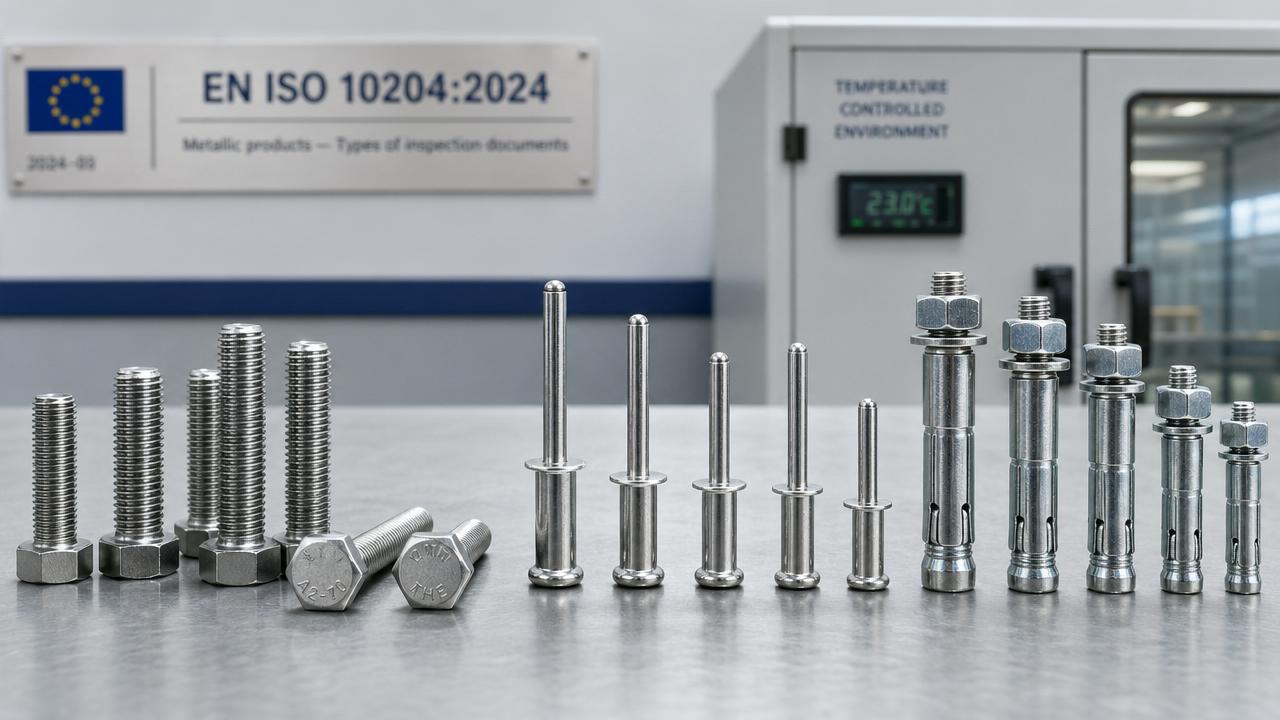
Starting 1 May 2026, all metal fasteners—including bolts & screws, anchors, and rivets—imported into the European Union must be accompanied by a third-party inspection report conforming to EN ISO 10204:2024 Type 3.1 or 3.2. This requirement directly affects manufacturers, exporters, and importers in the construction, automotive, machinery, and industrial equipment sectors, where traceability and material compliance are critical to market access.
Event Overview
The European Commission has officially announced that, effective 1 May 2026, imported metal fasteners placed on the EU market must carry documentation verifying conformity with EN ISO 10204:2024, specifically Type 3.1 (manufacturer’s declaration supported by internal quality records) or Type 3.2 (third-party verified declaration including inspection of materials, heat treatment processes, and batch traceability). The standard strengthens requirements for material origin verification, thermal processing documentation, and full batch-level traceability. No further transitional provisions or grace periods have been published as of the announcement date.
Which Sub-Sectors Are Affected
Direct Trading Enterprises
Exporters and importers handling fasteners under their own brand or as consignees face immediate documentation liability. Under EU customs and market surveillance rules, non-compliant shipments may trigger delays at border control, requests for retroactive certification, or rejection and return—especially where physical verification of heat treatment logs or mill test reports is required upon entry.
Raw Material Procurement Entities
Suppliers sourcing steel wire, rod, or forgings for fastener production must ensure upstream vendors provide granular data compatible with EN ISO 10204:2024’s enhanced traceability framework—including heat number linkage across melting, rolling, and heat treatment stages. Absence of such data at the raw material level renders downstream Type 3.1/3.2 certification unattainable.
Manufacturing & Processing Firms
Fastener producers—particularly those applying heat treatment in-house—must now maintain auditable, time-stamped records of furnace parameters, soak times, cooling rates, and post-treatment testing per batch. EN ISO 10204:2024 explicitly requires these records to be retained and made available to third-party inspectors validating Type 3.2 declarations.
Distribution & Channel Operators
Wholesalers and distributors holding inventory for EU resale must verify that incoming stock carries valid EN ISO 10204:2024-compliant documentation prior to warehousing or dispatch. Lack of documentation cannot be remedied post-import; re-labeling or retroactive certification is not permitted under current EU regulatory interpretation.
What Relevant Enterprises or Practitioners Should Focus On and How to Respond Now
Monitor official EU guidance updates closely
While the regulation takes effect 1 May 2026, the European Commission or national market surveillance authorities may issue interpretative notices—e.g., on acceptable digital formats for heat treatment logs or recognition of specific third-party bodies. Subscribing to notifications from the EU’s NANDO database and national notified body portals is advised.
Prioritise high-volume, high-risk product categories
Not all fasteners carry equal scrutiny. Structural bolts (e.g., EN 15048, EN 14399), anchor systems used in façade or seismic applications, and stainless steel fasteners subject to corrosion testing are most likely to undergo documentary review at EU borders. Focus initial compliance efforts on these lines.
Distinguish between policy signal and operational readiness
The announcement confirms a mandatory deadline—not a voluntary recommendation. However, enforcement intensity may vary initially by member state. That said, Type 3.2 certification requires lead time for third-party engagement, audit scheduling, and record system alignment; waiting until Q1 2026 risks capacity bottlenecks with accredited inspection bodies.
Align procurement contracts and supplier communications now
Update purchase orders and supplier agreements to explicitly require EN ISO 10204:2024 Type 3.1 or 3.2 documentation—specifying retention period, language (English or official EU language), and format (PDF with embedded metadata or certified hard copy). Request sample declarations from key suppliers before mid-2025 to assess readiness gaps.
Editorial Perspective / Industry Observation
Observably, this requirement reflects an ongoing shift in EU regulatory practice: from end-product conformity assessment toward upstream process accountability. EN ISO 10204:2024 does not introduce new performance criteria but significantly raises evidentiary thresholds for provenance and manufacturing control. Analysis shows it functions less as an isolated technical update and more as a signal of tightening due diligence expectations across industrial supply chains—particularly where mechanical integrity and long-term safety are mission-critical. From an industry perspective, the 2026 deadline should be understood not as a distant compliance checkpoint, but as a catalyst for reviewing documentation infrastructure, supplier qualification protocols, and internal quality record management systems.
Concluding, this regulation marks a procedural inflection point—not a technical overhaul—for metal fastener stakeholders engaged with the EU. Its significance lies not in introducing novel testing methods, but in formalising expectations around verifiable process discipline. Current understanding should treat it as an enforceable obligation with tangible operational consequences, rather than a conditional or advisory measure.
Source: European Commission Official Announcement (publication reference pending; status confirmed via EU regulatory bulletin, April 2024). Note: Recognition criteria for third-party inspection bodies under EN ISO 10204:2024 remain under observation and will be updated as national authorities publish implementation guidance.
Related News