Fasteners for Industrial Automation: Where Loosening Starts

In automated production, failures rarely begin with major components. They often start at small interfaces where vibration, heat, motion, and load work against joint integrity.
That is why fasteners for industrial automation deserve more attention than they usually receive. A loose screw, stud, nut, or washer can disrupt alignment, signal accuracy, and machine safety.
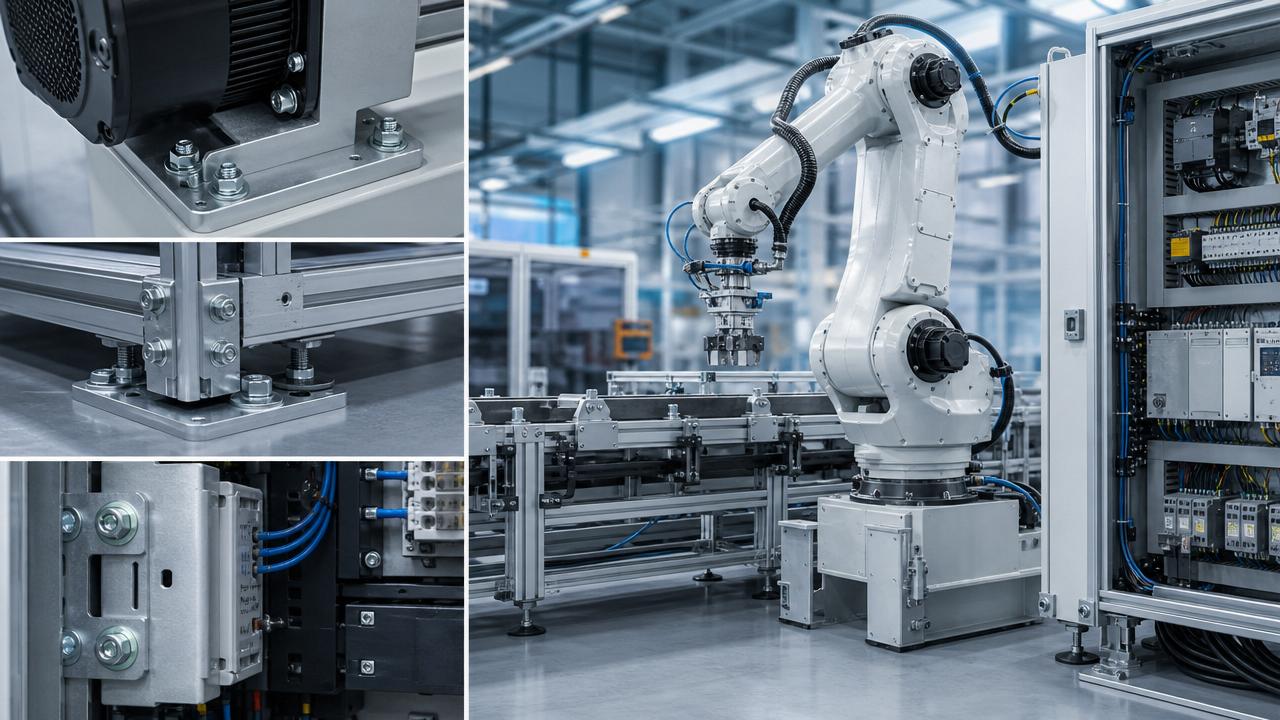
Across conveyor systems, robotic cells, electrical enclosures, pneumatic assemblies, and precision tooling, the first signs of instability often appear at fastening points.
For industrial systems, loosening is not only a maintenance issue. It is a process control issue, a quality issue, and sometimes a compliance issue.
GHTN follows this topic closely because underlying components shape system reliability. In modern manufacturing, every durable connection supports uptime, precision, and predictable output.
Understanding Fasteners for Industrial Automation
Fasteners for industrial automation include bolts, machine screws, nuts, washers, studs, rivets, inserts, and locking elements used in automated equipment.
They secure structural frames, motors, sensors, guarding panels, cable trays, pneumatic manifolds, servo brackets, and mold-related subassemblies.
Their job is simple in theory. They maintain clamp load and positional stability under repeated stress, dynamic movement, and changing environmental conditions.
In practice, fasteners for industrial automation must survive vibration, cyclic loading, thermal expansion, chemical exposure, and installation variation.
When clamp force drops below the required threshold, relative movement begins. That small movement is often where loosening starts.
Where loosening typically begins
- Insufficient preload during assembly
- Surface settling after first machine cycles
- Transverse vibration across joint interfaces
- Mismatched materials with different expansion rates
- Contamination, lubrication errors, or damaged threads
- Joint design that relies on friction alone
Industry Signals Behind Growing Attention
The need for better fasteners for industrial automation is increasing because automated lines are becoming faster, lighter, and more densely integrated.
Higher acceleration creates stronger dynamic loads. Smaller components reduce tolerance for displacement. Continuous operation leaves less room for unnoticed degradation.
At the same time, global production environments are more diverse. Equipment may face humidity, washdown cycles, dust, coolants, solvents, or elevated temperatures.
This explains why fasteners for industrial automation are now evaluated as engineered components, not generic hardware.
Why Loosening Creates Broader Operational Risk
A loose joint rarely stays isolated. It usually triggers secondary effects that spread across mechanical, electrical, and control layers.
On a robotic axis, slight bracket movement can alter repeatability. On a conveyor, frame relaxation can shift belt tracking. In enclosures, loosening can affect grounding continuity.
For precision mold handling or tool-changing systems, even small displacement can increase wear, reduce fit quality, and shorten service life.
Common consequences
- Unexpected downtime and emergency maintenance
- Sensor drift and false readings
- Noise, resonance, and fatigue cracking
- Reduced product consistency
- Safety guarding instability
- Higher total lifecycle cost
In this sense, fasteners for industrial automation influence both uptime and process confidence. The smallest connection can shape the largest production outcome.
Typical Application Areas and Risk Profiles
Not all fastening points fail for the same reason. Risk depends on motion type, access conditions, material pairing, and maintenance frequency.
Selecting fasteners for industrial automation should therefore begin with load path analysis, not only with thread size or base material.
Selection Factors That Directly Affect Joint Stability
Material strength matters, but it is only one variable. Stable joints depend on the combined performance of geometry, surface condition, preload, and locking method.
Core evaluation points
- Required clamp load versus operating load
- Thread engagement length and substrate strength
- Resistance to vibration loosening
- Corrosion behavior in actual environment
- Thermal expansion compatibility
- Assembly accessibility and torque consistency
For example, stainless steel may support corrosion resistance, yet galling risk must be controlled. High-strength alloy steel may improve preload retention, yet coating choice remains critical.
Washers, prevailing torque nuts, wedge-lock systems, thread-forming screws, and threadlockers all serve different design purposes. Substitution without validation can reduce reliability.
That is why fasteners for industrial automation should be matched to joint function, service access, and lifecycle expectations.
Practical Measures to Prevent Loosening
Prevention begins before installation. Joint design, hole quality, contact surfaces, and tightening procedure all influence the final result.
- Define load cases clearly, including shock, vibration, and heat.
- Choose fasteners for industrial automation based on real operating conditions.
- Use calibrated tools to achieve repeatable preload.
- Control lubrication, coating, and thread cleanliness.
- Apply suitable locking features where vibration is unavoidable.
- Inspect critical joints after initial run-in cycles.
- Document torque values, revisions, and failure history.
Where available, digital maintenance systems can link fastening records with machine condition data. This helps identify recurring weak points before visible failure appears.
A More Reliable Next Step for Automation Systems
Fasteners for industrial automation should be reviewed as part of system architecture, not as late-stage consumables. Reliability starts at the interface level.
A focused review can examine high-vibration joints, thermal zones, repeated-access panels, and precision mounting points across lines and tooling stations.
GHTN supports this approach by connecting component-level insight with broader manufacturing logic. From materials to compliance trends, the goal is practical clarity.
For stronger uptime and safer output, start with the locations where loosening begins. Better decisions on fasteners for industrial automation can protect the entire production chain.
Related News