
EU REACH Tightens Nickel Release Rules for Rivets

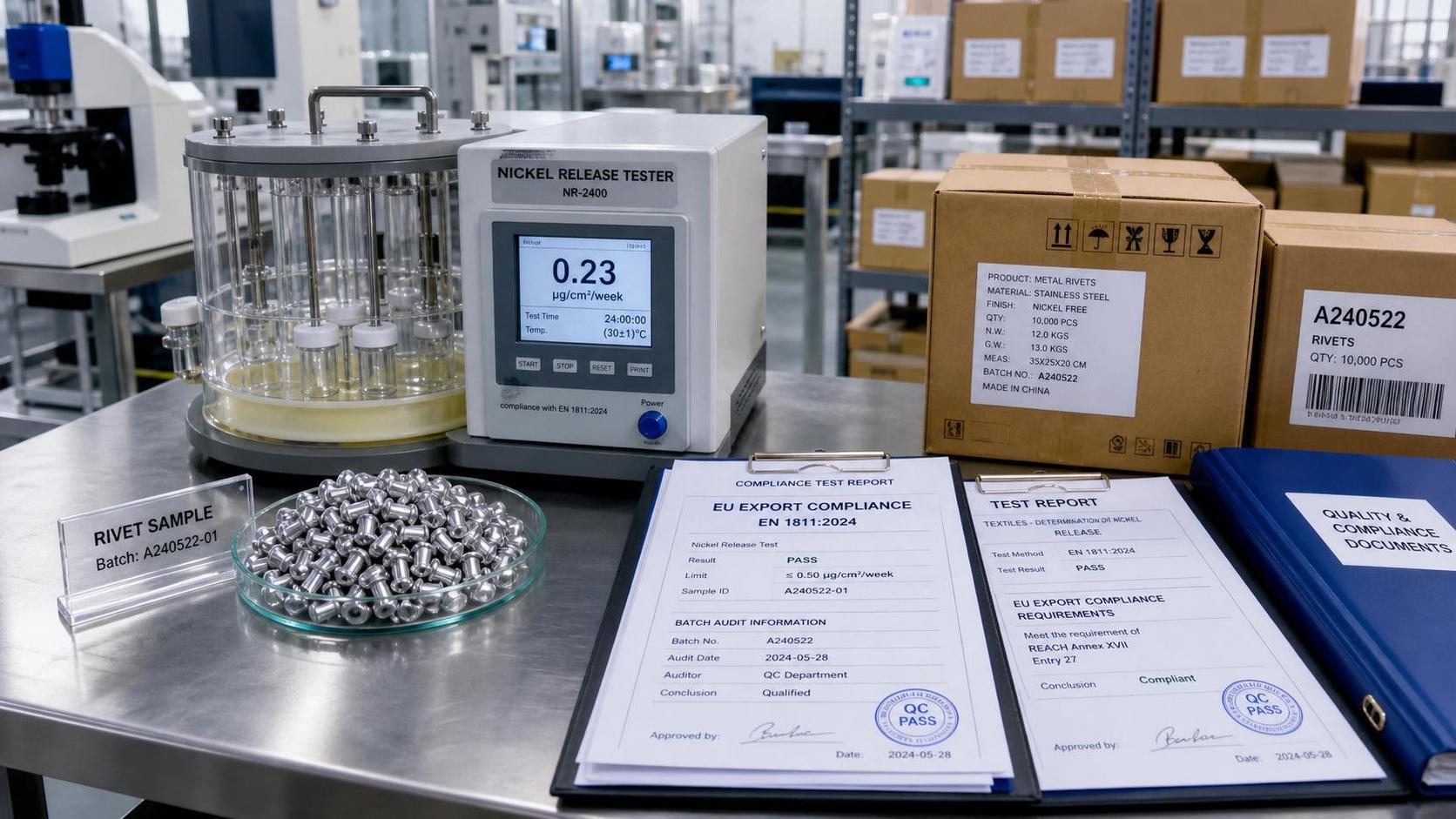
On July 15, 2026, a new EU REACH Appendix XVII restriction took effect for nickel-containing rivets used in products intended for prolonged skin contact, requiring compliance with a nickel release limit of 0.5μg/cm²/week. The change matters immediately for rivet exporters, importers, buyers, compliance teams, and testing service providers, because batches that do not pass EN 1811:2024 testing may be refused entry by EU customs, turning product conformity and document readiness into an active trade issue rather than a routine compliance check.
What the new restriction formally changes
According to the information provided, the European Commission issued Regulation (EU) 2026/1382 on June 29, 2026, extending nickel release limit requirements to all rivet products intended for prolonged skin contact, including stainless steel rivets. The restriction became mandatory on July 15, 2026.
The applicable migration limit is 0.5μg/cm²/week. The same information also states that batches failing EN 1811:2024 testing will be rejected by EU customs.
The measure directly affects compliance certification and testing arrangements for Chinese rivet exporters, while global rivet buyers are expected to re-check supplier nickel release reports and the qualifications of third-party testing bodies.
Where the pressure is likely to appear first
Export-facing rivet suppliers face an immediate shipment risk
From an industry perspective, suppliers shipping rivets into the EU are likely to feel the impact first because the rule is already in force and customs enforcement is explicitly referenced in the provided information. The most exposed business links are pre-shipment compliance review, batch testing, and export documentation. What deserves closer attention is whether existing reports clearly correspond to the relevant rivet products and whether they meet the EN 1811:2024 requirement cited in the event summary.
Buyers and sourcing teams need to recheck approval logic
For procurement teams and international buyers, the issue is not only product selection but also supplier approval. Analysis shows that supplier reports on nickel release and the credentials of third-party laboratories now become part of basic purchasing due diligence for rivets intended for prolonged skin contact. The effect is likely to show up in supplier review, order confirmation, and incoming compliance file checks.
Testing and compliance service providers move closer to the transaction
Observably, the restriction also gives a more operational role to testing and compliance service providers. Their work is no longer limited to background certification support; it may affect whether goods can clear customs. For this group, the key business link is the credibility, scope, and timing of test documentation used by exporters and buyers.
What companies should verify now
Check whether affected rivet categories have been correctly identified
The practical starting point is to confirm which rivet products fall within the scope described in the provided information: rivets intended for prolonged skin contact, including stainless steel rivets. Companies should avoid treating this as a narrow material issue alone, because the stated trigger is use in prolonged skin contact products.
Review nickel release reports against the named test standard
What deserves closer attention is whether existing reports are current, product-specific, and aligned with EN 1811:2024 as referenced in the event summary. A report that exists in principle may not be sufficient if it does not match the batch, product configuration, or testing basis expected in the transaction.
Reconfirm third-party laboratory qualifications
The provided information specifically highlights the need for buyers to recheck third-party testing qualifications. In practice, this means companies should examine whether the laboratory credentials being used in supplier files remain acceptable for customer review and border-facing compliance documentation.
Prepare for tighter customer and delivery communication
Analysis shows that the business impact may extend beyond testing itself into delivery scheduling and customer communication. Where orders are already in progress, suppliers and buyers may need to align quickly on report availability, batch evidence, and documentation completeness to reduce the risk of customs refusal or shipment delay.
Why this matters beyond a single compliance notice
Analysis shows that this development should be understood first as an immediate compliance threshold with direct trade consequences, because the rule has already entered into force and non-compliant batches may be blocked by EU customs. At the same time, it also acts as a longer-term signal that documentation quality, testing relevance, and supplier verification are becoming more central in rivet trade involving prolonged skin contact applications.
It is more appropriate to understand this as a confirmed operational change rather than a policy item still awaiting interpretation. Even so, continued observation remains necessary in how companies, buyers, and service providers apply the requirement in day-to-day transactions and compliance review.
How to read the development at this stage
At this stage, the clearest industry meaning is that nickel release control for rivets is no longer a peripheral technical topic for affected EU-bound products. It has become a shipment, sourcing, and documentation issue with immediate commercial relevance. A neutral reading is that the rule creates a firm near-term compliance obligation while also reinforcing a broader expectation that supporting test evidence must be both current and credible.
Basis of this article and points for follow-up
This article is based on the user-provided news title, event date, and event summary. For this type of development, commonly relevant source categories may include official regulatory notices, company disclosures, industry association updates, authoritative media reporting, and standard-setting documents.
No specific official source link was provided in the input, so the exact source documents and any subsequent interpretive updates still require ongoing verification. Follow-up attention should remain on any further official wording, transaction-level enforcement expectations, and how buyers and suppliers update report review and laboratory qualification checks in response.
Related News