
Canton Fair Phase II 2026 Highlights Precision Manufacturing Tools

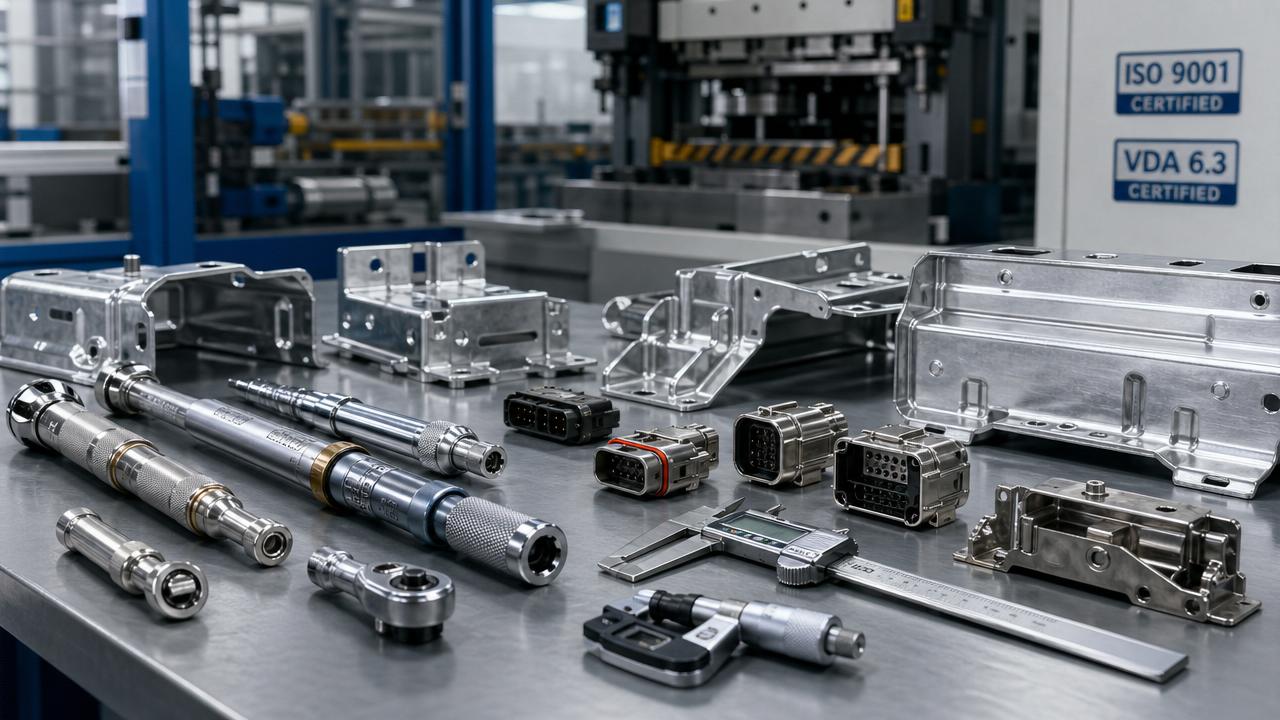
Phase II of the 139th Canton Fair (April 23–27, 2026) revealed intensified overseas demand for hand tools, stamping parts, and connectors—key segments of the precision manufacturing toolchain. Notably, inquiry volumes at related booths rose 37% year-on-year, with procurement interest surging from Germany, Mexico, and Indonesia. This signals growing integration of Chinese suppliers into global Tier-1 production systems—particularly where safety, dimensional accuracy, and automotive-grade compliance are non-negotiable.
Event Overview
The second phase of the 139th Canton Fair took place from April 23 to 27, 2026. Publicly reported data indicates that average booth inquiries for Hand Tools, Stamping, and Connectors increased by 37% year-on-year. German, Mexican, and Indonesian buyers showed pronounced interest in explosion-proof hand tools, high-precision stamped structural components, and automotive-grade connectors. Among concluded intent orders, 42% explicitly required RoHS/REACH test reports and VDA 6.3 process audit certification.
Industries Affected
Direct Exporters & Trading Enterprises
These enterprises face heightened documentation and compliance expectations—not just for product conformity, but for auditable manufacturing processes. The 42% requirement for VDA 6.3 proof reflects a shift from transactional verification to embedded quality assurance in buyer supply chain planning.
Contract Manufacturers & OEM/ODM Factories
Factories supplying stamping or connector components must now treat process capability as a commercial prerequisite. Demand for VDA 6.3 alignment suggests buyers are mapping Chinese facilities into their internal production control frameworks—not merely sourcing discrete parts.
Raw Material & Component Suppliers
Suppliers upstream of hand tool or connector assembly—including specialty alloy vendors, plating service providers, and contact terminal makers—are indirectly affected: traceability, material declarations (e.g., RoHS-compliant substrates), and batch-level documentation are becoming prerequisites for downstream qualification.
Supply Chain Compliance & Certification Service Providers
Third-party labs and audit firms offering RoHS/REACH testing and VDA 6.3 readiness assessments may see rising demand—but only if their scope explicitly covers manufacturing process evaluation (not just product testing) and aligns with automotive-tiered requirements.
What Relevant Enterprises Should Focus On Now
Monitor official updates on Canton Fair Phase III (July 2026) category allocations
The elevated demand in Phase II may prompt reclassification or expanded booth allocation for precision mechanical components in upcoming phases—especially categories overlapping with automotive or industrial equipment.
Prioritize documentation readiness for RoHS/REACH and VDA 6.3—not just certification acquisition
Buyers are not merely requesting certificates; they are verifying whether documented processes (e.g., change control, process validation, supplier management) meet VDA 6.3 criteria. Preparing internal audit trails—not just external audit outcomes—is now operationally critical.
Map demand geography to compliance pathway
Germany’s emphasis on VDA 6.3 implies automotive supply chain linkage; Mexico’s focus on explosion-proof tools correlates with energy-sector safety standards (e.g., NOM-001-SEDE); Indonesia’s connector demand likely ties to domestic electronics assembly growth. Regional regulatory alignment—not generic compliance—drives relevance.
Assess current capacity for batch-level material traceability
Rising RoHS/REACH requirements signal stricter scrutiny of material origin and substitution history. Firms lacking ERP-integrated material lot tracking may face qualification delays—even if final products pass testing.
Editorial Observation / Industry Insight
Observably, this Canton Fair outcome is less about short-term order volume and more about structural recalibration: overseas buyers are no longer treating Chinese suppliers as standalone vendors, but as accountable nodes in their vertically integrated production systems. Analysis shows the 42% VDA 6.3 requirement is not an outlier—it reflects a broader trend where Tier-1 manufacturers outsource process governance alongside component supply. This is not yet universal, but it is increasingly normative for high-precision, safety-critical, or regulated-use categories. The event functions as a leading indicator—not a one-off result—warranting sustained attention across Q3 2026 as buyers finalize 2027 sourcing plans.
Concluding, the Canton Fair Phase II 2026 data point underscores a measurable shift toward process-anchored sourcing in precision manufacturing toolchains. It does not indicate a new market opening, but rather a tightening of quality integration thresholds—particularly where functional safety, dimensional repeatability, and regulatory traceability converge. Currently, this is best understood as an operational signal: compliance is evolving from a product attribute into a documented, auditable, and geographically contextualized capability.
Source: Official statistics released by the China Foreign Trade Centre (CFTC) for the 139th Canton Fair Phase II (April 23–27, 2026). Note: VDA 6.3 adoption rates and regional demand breakdowns remain subject to ongoing verification through CFTC’s post-fair buyer survey reports, expected in May 2026.