
Manufacturing Tools Explained: Key Types, Functions, and When to Use Each

Why do manufacturing tools matter so much in day-to-day production?
Manufacturing tools shape how parts are cut, formed, joined, finished, and inspected. In simple terms, they turn production plans into repeatable physical results.
That is why the topic goes beyond equipment catalogs. The right manufacturing tools affect tolerance control, cycle time, operator safety, scrap rate, and maintenance frequency.
A small change in tool choice can alter an entire workflow. A faster cutting tool, for example, may reduce machining time but increase heat and shorten tool life.
In actual production settings, the question is rarely just, “Which tool works?” A better question is, “Which tool works reliably under this material, volume, and quality requirement?”
This is also why industry platforms such as GHTN organize industrial tools, molds, fasteners, electrical components, and pneumatic products into searchable categories. It helps users connect tool function with application reality.
When people search for manufacturing tools, they usually want more than definitions. They want to understand types, compare options, and know when one category makes more sense than another.
What counts as manufacturing tools, and how are the main types grouped?
The term covers a broad set of tools used across industrial processes. Not all of them cut material. Some hold, shape, fasten, move, or verify parts.
A practical way to understand manufacturing tools is to group them by function rather than by brand or machine size.
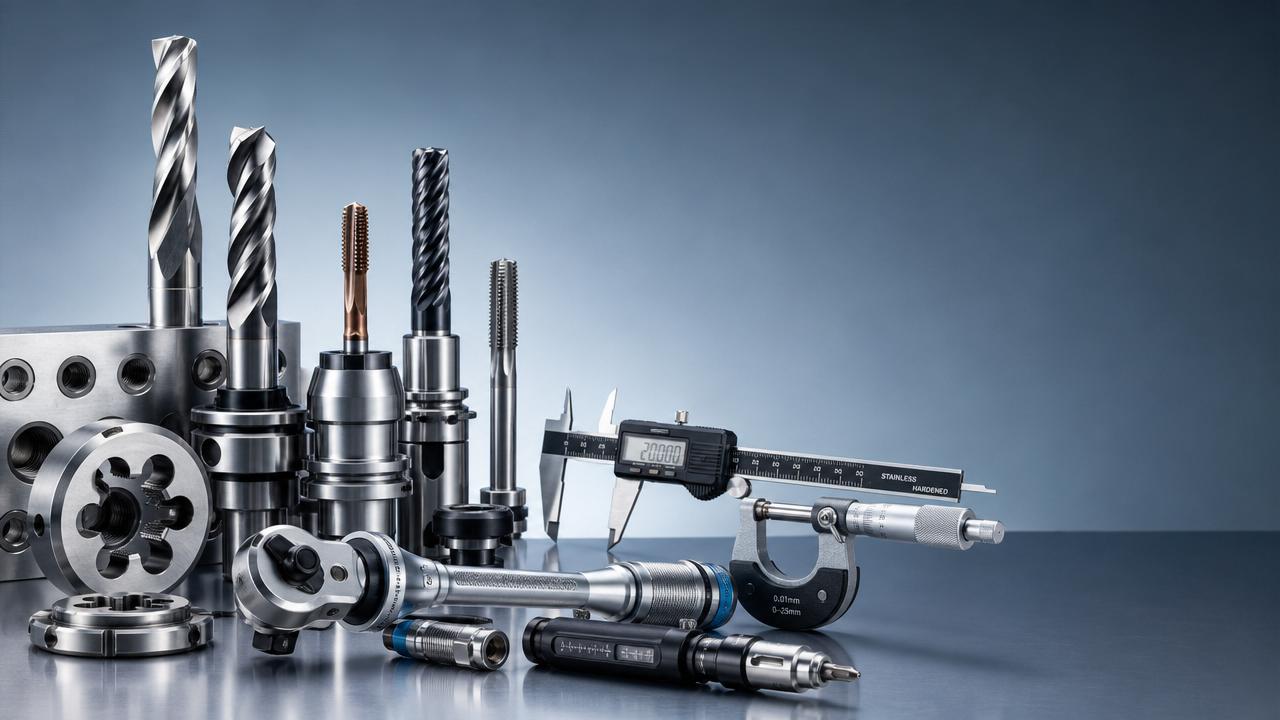
- Cutting tools: drills, end mills, taps, inserts, saw blades, reamers, and turning tools.
- Forming tools: dies, molds, punches, and stamping tools that reshape material.
- Hand and power tools: torque tools, grinders, impact drivers, crimpers, and assembly tools.
- Fastening tools: rivet tools, bolting tools, screwdriving systems, and anchor installation tools.
- Pneumatic tools: air cylinders, air drivers, valves, and compressed-air tools for repetitive tasks.
- Tooling support: jigs, fixtures, holders, collets, and clamping systems.
- Inspection tools: gauges, comparators, measuring instruments, and test devices.
This functional view is useful because many production lines combine several categories at once. A machined part may involve cutting tools, a fixture, a deburring tool, fasteners, and inspection gauges.
More complex workflows can also include injection molds, die casting molds, or stamping tools. In those cases, the tooling itself becomes a central production asset, not just an accessory.
Which manufacturing tools are best for cutting, shaping, fastening, and assembly?
Different tasks call for different manufacturing tools because each process places unique demands on force, precision, heat, and repeatability.
For cutting and material removal
Cutting tools are the first choice when the goal is to remove material accurately. Common examples include drills, milling cutters, inserts, broaches, and saws.
They are widely used for metalworking, plastics machining, and precision finishing. Tool material matters here, especially when working with stainless steel, aluminum, or hardened alloys.
For shaping and high-volume forming
Molds, dies, and stamping tools are better suited to repeatable mass production. They do not remove material in the same way cutting tools do.
Instead, they create shape through forming, injection, pressing, or casting. The upfront tooling cost is higher, but unit cost usually drops as volume rises.
For fastening and final assembly
Assembly often depends on torque tools, riveters, screwdriving systems, crimping tools, and bolt installation equipment. These manufacturing tools support consistency more than geometry creation.
That distinction matters. A part may be perfectly machined, yet still fail in service if fastening force or installation sequence is wrong.
For repetitive motion and automation support
Pneumatic products often work alongside manufacturing tools rather than replacing them. Air cylinders, valves, and compressors help drive repetitive motion, clamping, or part transfer.
This is common in semi-automated stations where speed matters, but full robotic integration is not necessary.
How do you decide which manufacturing tools fit a specific job?
The most reliable approach is to start from the process requirements, not the tool catalog. A tool that performs well in one plant may underperform in another.
A quick comparison table helps narrow the field before deeper technical review.
Beyond the table, several questions usually separate a workable option from a strong one.
- What material is being processed, and how abrasive is it?
- Is the target low-volume flexibility or high-volume repeatability?
- How tight are the dimensional and surface finish requirements?
- How often will the tool need replacement, sharpening, or calibration?
- Does the process depend on operator skill, or should it be standardized?
In practice, the best manufacturing tools are not always the most advanced. They are the ones that match the process window with the fewest hidden trade-offs.
Where do people make the wrong call when comparing tool options?
A common mistake is comparing manufacturing tools only by purchase price. Initial cost matters, but total use cost often tells a different story.
A lower-cost tool may wear faster, create more rejects, require extra setup, or need more frequent downtime. Those indirect losses are easy to miss early on.
Another error is treating all material conditions as equal. The same cutting tool geometry may perform well on mild steel and fail quickly on heat-treated stock.
There is also a tendency to separate tools from surrounding systems. Yet many results depend on holders, lubrication, air supply, electrical protection, or fixture stability.
This wider view matters across the hardware and tooling supply chain. GHTN’s category structure is useful here because it places tools beside related components, not in isolation.
For example, a pneumatic fastening setup may require not only the driver, but also valves, cylinders, connectors, and compressor capacity matched to cycle demand.
One more blind spot is lead time. Custom molds, dies, and special tooling can improve output dramatically, but only if the production schedule supports the development period.
What should you check before shortlisting manufacturing tools?
Shortlisting works better when it is structured. Instead of jumping straight to models, confirm the decision points that shape tool performance and long-term value.
- Process target: define whether the priority is speed, finish, repeatability, or flexibility.
- Workpiece profile: confirm material type, thickness, hardness, geometry, and batch variation.
- Tool interface: review machine compatibility, holder standard, pressure source, or control method.
- Quality threshold: set tolerance, joint reliability, inspection method, and acceptable defect rate.
- Lifecycle factors: estimate wear rate, spare availability, maintenance rhythm, and retooling time.
- Supply context: compare lead time, documentation quality, standard compliance, and sourcing continuity.
This kind of checklist is especially helpful when reviewing information across broad categories such as cutting tools, fasteners, molds, electrical components, and pneumatic products.
Good research is rarely about finding one perfect answer. It is usually about reducing mismatch before testing, quoting, or implementation begins.
So, what is the smartest next step after understanding the basics?
Start by mapping the task, not the tool name. List the operation, material, quality target, expected volume, and any space or timing limits around the process.
Then compare manufacturing tools by function, not marketing language. A clear function-based comparison usually reveals whether flexibility, output speed, or tooling life matters most.
If the application spans several product areas, review related categories together. Fastening may connect to fasteners and torque control. Tooling may depend on molds, holders, or pneumatic actuation.
That broader comparison is where an industry knowledge portal becomes useful. Structured information on product applications, standards, and market trends makes technical choices easier to validate.
In the end, manufacturing tools are not just items on a list. They are decision points that influence quality, cost, timing, and operational stability.
A practical next move is to build a short evaluation sheet for each process. Compare type, function, expected life, setup demand, and risk of mismatch before moving forward.
Related News