
EU Battery Carbon Labels Hit Battery-Integrated Exports

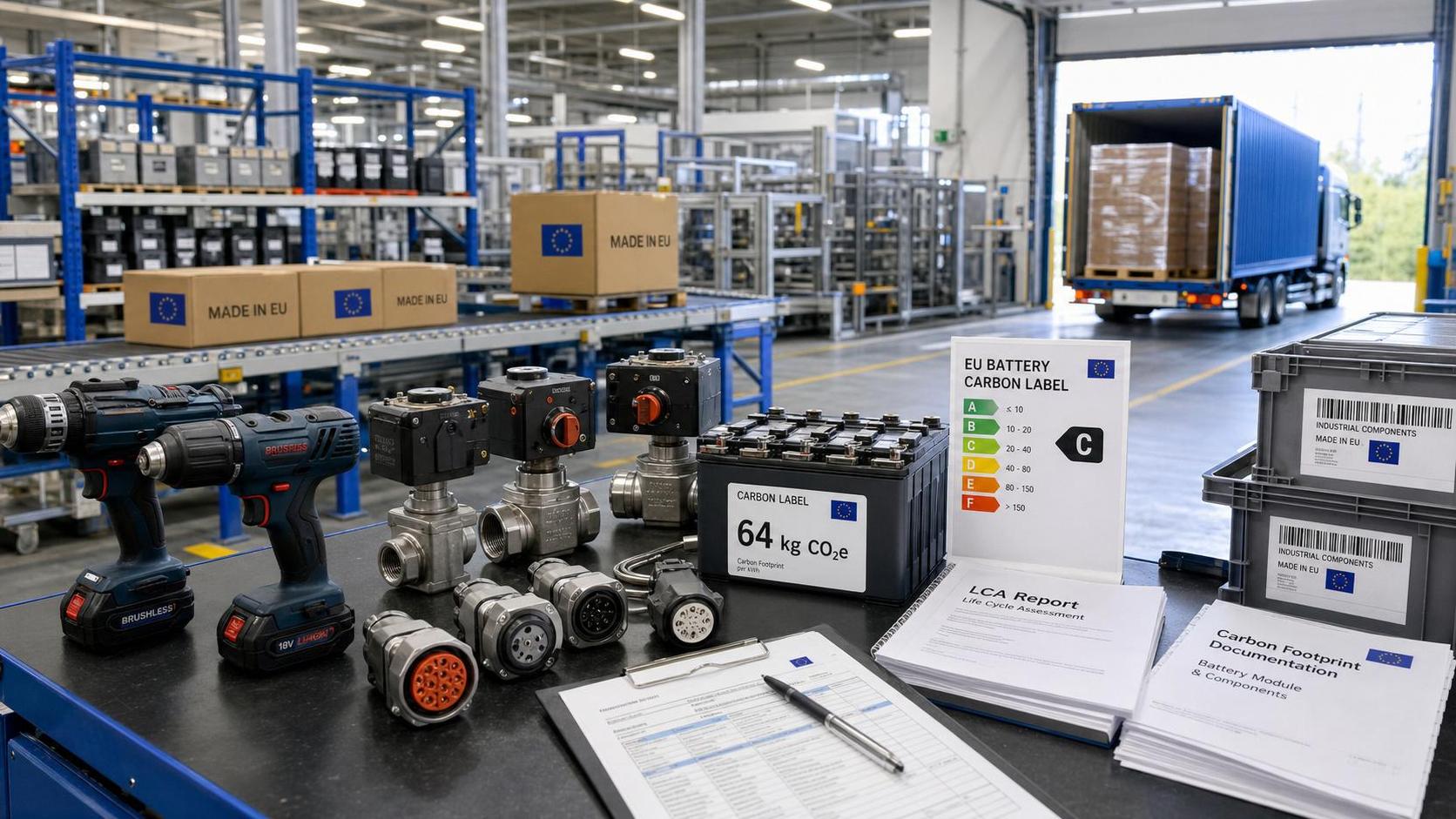
On August 18, 2026, a new EU compliance requirement moves from policy text into practical market access conditions: rechargeable industrial batteries with a capacity above 2 kWh must carry a carbon footprint performance class label under Regulation (EU) 2023/1542. For exporters of battery-integrated products such as smart fastening systems, Power Tools, Valves and Connectors, the issue is no longer limited to the battery itself; it now extends to documentation, product configuration, supply-chain carbon data and delivery readiness for EU-bound shipments.
What changes on August 18
According to the information provided, Regulation (EU) 2023/1542 requires rechargeable industrial batteries with capacity above 2 kWh to bear a carbon footprint performance class label from August 18, 2026.
The requirement is directly relevant to export compliance for integrated products that contain battery modules, including smart fasteners, Power Tools, Valves and Connectors.
The same information indicates that products failing to meet the requirement may face barriers to entering the EU market.
It also states that Chinese suppliers need to update LCA reports, prepare for the digital battery passport, and coordinate carbon data across the supply chain.
Where the compliance pressure is likely to appear first
Battery modules become a trade compliance checkpoint
For exporters shipping products with built-in battery modules, the likely impact is that the battery component can become a decisive compliance checkpoint in EU deliveries. This matters because the rule is tied to labeling and carbon footprint classification, which can affect whether supporting documents are considered complete before shipment or customs-facing review.
From a business-process perspective, these companies should pay close attention to whether product files, LCA-related materials and battery-related technical records are aligned across the final exported product and its battery module.
Assemblers of integrated industrial products face document coordination risk
Manufacturers assembling smart fastening systems, Power Tools, Valves or Connectors with battery modules may be affected not only at the design stage, but also in quotation, order confirmation and delivery preparation. The reason is that compliance responsibility may no longer be viewed only through mechanical or electrical performance; battery carbon information now becomes part of the export-readiness picture described in the provided event summary.
What deserves closer attention is whether technical files, product descriptions and customer-facing compliance statements remain consistent once battery modules above the stated threshold are included.
Procurement and supply-chain teams need usable carbon data
For procurement teams and supply-chain coordinators, the immediate concern is not simply buying a battery module that fits the product, but obtaining supporting carbon data that can be used in LCA reporting and later compliance preparation. Analysis shows that any disconnect between upstream battery data and downstream export documentation could create friction in order execution and delivery planning.
This means supplier qualification, document collection and internal data handover may receive more scrutiny in transactions involving battery-integrated industrial products destined for the EU.
Compliance and service providers may see a shift in client demand
Certification-related firms, testing service providers and trade compliance advisors may be drawn into earlier stages of export preparation. The provided information specifically highlights LCA updates, digital battery passport preparation and supply-chain carbon data coordination, all of which suggest that service demand may move upstream from final filing to pre-shipment document readiness.
Observably, the practical impact for these participants is less about a new standalone product category and more about helping exporters connect battery information with the compliance status of the finished industrial product.
What companies should review now
Check which exported configurations cross the battery threshold
Companies should first review whether their EU-bound products include rechargeable industrial batteries above 2 kWh. This is especially relevant where the exported item is marketed as an integrated system rather than a standalone battery product, because the compliance effect described in the event summary reaches battery-equipped industrial assemblies.
Reconcile LCA materials with product documentation
The provided information specifically mentions the need to update LCA reports. From an operational standpoint, companies should therefore focus on whether existing LCA materials, model-level technical files and export documents describe the same battery configuration and product scope. If those records are fragmented, later compliance review may become harder to manage.
Prepare for digital battery passport-related workflows
The event summary also points to preparation for the digital battery passport. Since no further execution details are provided in the input, it would be inappropriate to assume a settled documentation pathway. What companies should watch is how internal document ownership, supplier submissions and customer-requested compliance files are organized around this requirement.
Watch contract, tender and delivery language
Analysis shows that another practical issue may arise in commercial paperwork. Exporters, buyers and channel partners should monitor whether tender files, procurement specifications, acceptance conditions or shipment document requests begin to reflect battery carbon footprint labeling and related supporting materials. Even where the rule is known in principle, execution often becomes visible through contract and delivery language.
Why this matters beyond the battery label itself
From an industry perspective, this development is better understood as an execution signal rather than a purely theoretical regulatory update. The requirement has a clear effective date, a defined battery threshold and an explicit connection to market access risk for non-compliant products, which means affected companies cannot treat it as a distant policy discussion.
At the same time, observation remains necessary. The input does not provide detailed enforcement practice, review procedures or customer-side implementation patterns. For that reason, the market still needs to watch how compliance expectations are expressed in procurement documents, certification workflows, shipment checks and downstream customer requirements.
How to read the current signal
The most balanced reading of this development is that it marks a concrete compliance shift for battery-integrated industrial exports to the EU, especially where products combine mechanical, electrical and battery functions in one deliverable. It does not by itself confirm every operational consequence, but it clearly raises the importance of carbon-related battery documentation in export preparation.
For companies connected to smart fasteners, Power Tools, Valves, Connectors and similar integrated products, the immediate significance lies in aligning battery labeling, LCA materials, digital battery passport preparation and supply-chain carbon data before these issues emerge at the shipment or customer-acceptance stage.
Basis of this article and what still needs verification
This article is generated based on the user-provided news title, event date and event summary. For developments of this kind, commonly relevant source types may include official regulatory notices, releases from supervisory authorities, customs or trade administration information, industry association updates, standard-setting documents and reporting by established professional media.
No specific official source link was provided in the input, so the exact official publication path still requires further verification. What still needs continued observation includes detailed implementation language, certification and compliance interpretation, changes in tender or procurement documents, market feedback, and how affected companies carry out LCA updates, digital battery passport preparation and supply-chain carbon data coordination in practice.