
What Is Metal Stamping? Processes, Materials, and Common Part Applications

What Is Metal Stamping? Processes, Materials, and Common Part Applications
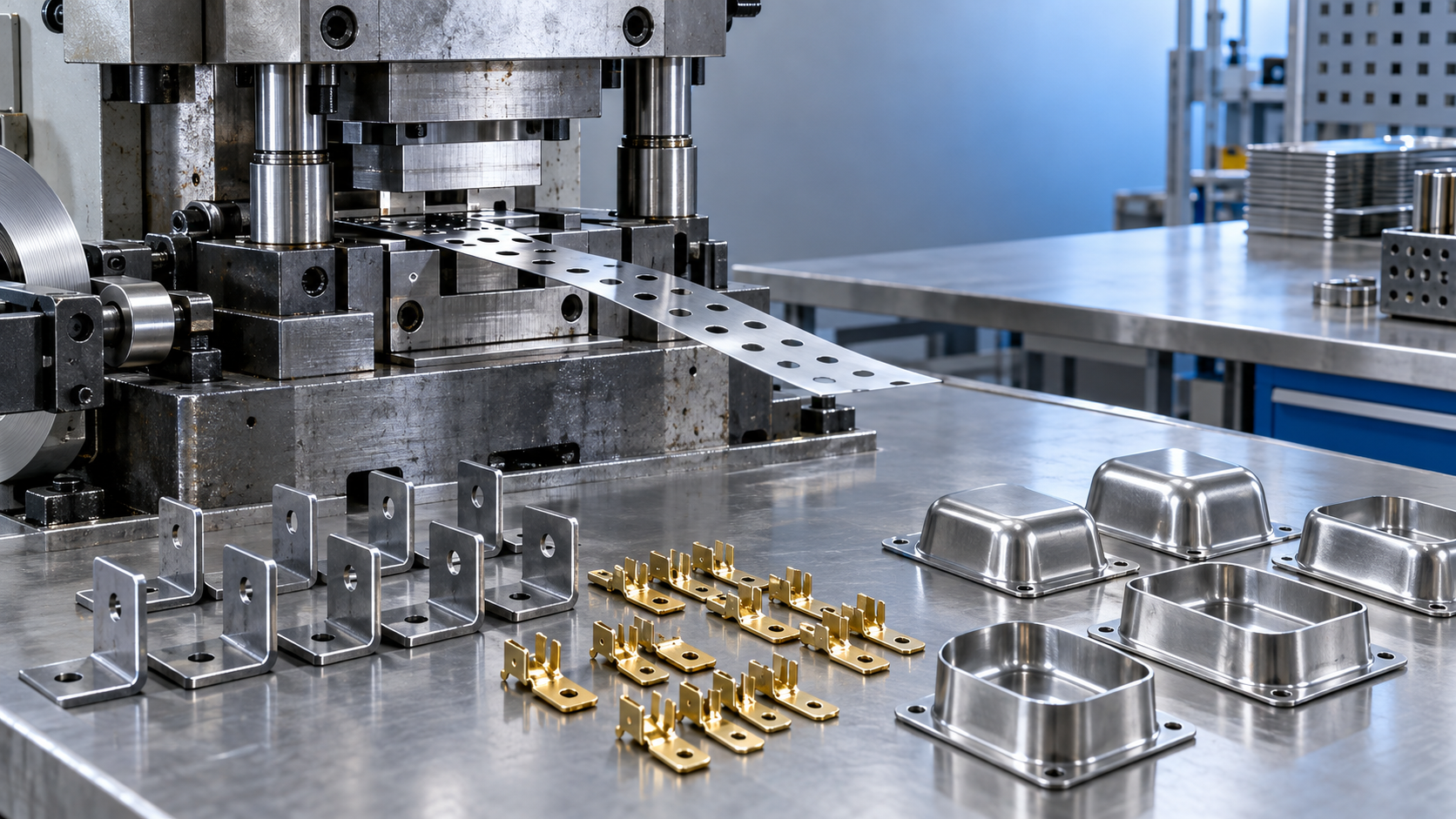
From electrical terminals and mounting brackets to automotive panels, many everyday components begin as flat metal sheet. Metal stamping uses presses and specialized dies to cut, bend, or form that sheet into repeatable shapes. It is widely used for industrial parts, but selecting a stamping process involves more than matching a drawing to a press.
A bracket needs reliable hole positions and enough stiffness to hold its load. An electrical contact may need conductivity, spring force, and a clean plated surface. Both can be stamped, yet their material choices, tooling, and inspection requirements differ considerably. Understanding those differences helps explain where stamping works well—and where another manufacturing method may be more practical.
What happens inside a stamping press?
Metal stamping turns sheet or strip into parts through controlled cutting and deformation. A press supplies force, while a die set determines the geometry. Depending on the operation, tooling may include punches, cutting edges, forming surfaces, pressure pads, and components that guide or strip material from the punch.
Material can enter as individual blanks or as coil-fed strip. In a coil-fed line, equipment typically uncoils, straightens, and advances the strip before each press stroke. The feed must stay synchronized with the tooling: incorrect positioning can damage a part, break a punch, or disrupt production.
Most conventional sheet-metal stamping takes place without deliberately heating the workpiece. Hot stamping is a separate route used for certain demanding applications, including some automotive structural components, where heating and controlled cooling are part of the process.
Unlike machining, stamping generally creates shape through shearing and plastic deformation rather than removing material as chips. Scrap still matters, however. The skeleton left between parts in a strip, pierced holes, and trimmed edges all affect material utilization and cost.
The core operations: cutting, bending, and drawing
Blanking and piercing
Blanking cuts the outside profile of a piece; the removed piece is the intended blank. Piercing creates holes or openings, with the removed slug normally treated as scrap. A washer, for example, needs both an outer profile and a central hole.
A stamped cut edge is not automatically smooth or square through its entire thickness. It normally contains rollover, a burnished region, a fracture region, and some burr. Punch-to-die clearance influences these features, as well as cutting force and tool wear. A burr that is harmless on a hidden bracket may be unacceptable near wire insulation or on a handling surface.
Bending, flanging, and embossing
Bending creates angles, channels, tabs, and other features. Flanging forms an edge, while embossing produces raised or recessed details that may add stiffness or locate another component.
The metal partly recovers elastically when the tooling releases it. This springback means the tool angle may need to differ from the required finished angle. Material strength, thickness, bend radius, and rolling direction all influence the result. Switching material grade without reviewing the tooling can turn a previously stable bend into an assembly problem.
Drawing and deep drawing
Drawing pulls a blank into a die cavity to create a hollow shape, such as a cup, cover, or housing. Deep drawing generally describes parts with substantial depth relative to their opening dimensions. Some shapes require multiple drawing stages rather than one severe operation.
The difficulty is controlling material flow. Excessive restraint can cause thinning or tearing; insufficient restraint can allow wrinkling. Blank-holder force, lubrication, die radii, and material formability must work together. A sheet that bends successfully is not necessarily suitable for a demanding drawn shell.
How the operations become a production process
Individual operations can be arranged in several ways. The choice depends on part geometry, handling needs, production volume, and tooling investment—not simply on which system runs fastest.
Progressive die stamping advances strip through successive stations. One station may pierce holes, another may form tabs, and a later station separates the finished part. The part usually remains attached to the strip until near the end. This arrangement suits many terminals, clips, and small brackets, although strip layout and carrier design can limit achievable shapes.
Transfer stamping moves individual blanks between stations using a transfer mechanism. Because the workpiece is not continuously attached to a carrier strip, it can offer greater freedom for certain forming operations. It is often considered for larger or more complex drawn parts.
A single-operation die or a sequence of separate presses may be more practical when quantities are lower or designs are still changing. Compound dies perform multiple cutting operations in one stroke and can suit flat parts where the relationship between internal and external profiles matters.
Dedicated tooling introduces an upfront cost. Repeated production can spread that cost across many parts, but there is no universal break-even quantity. A simple washer and a multi-stage drawn housing have very different tooling economics. Frequent engineering changes can also undermine the savings expected from a high-output die.
Choosing materials by function, not just price
The material specification needs more detail than “steel” or “copper.” Grade, temper, thickness, surface condition, and coating can change both stamping behavior and finished-part performance.
Low-carbon steel is common for brackets, covers, washers, and general structural parts because suitable grades offer useful formability at a relatively economical material cost. Corrosion protection may require plating, painting, or a coated sheet. Higher-strength steels can support stronger or lighter designs, but usually demand closer attention to press loads, springback, and tooling wear.
Stainless steel is selected where corrosion resistance, appearance, or service conditions justify it. Different grades behave differently. Some work-harden significantly during forming, and galling can become a concern. Tool surface condition and lubricant selection deserve attention rather than being treated as production details to solve later.
Aluminum is useful where low weight matters, including enclosures, shields, and selected vehicle components. Alloy and temper strongly affect formability. A stronger temper may restrict bend severity or drawing depth, while exposed surfaces can need protection from tooling marks.
Copper and copper alloys appear frequently in electrical hardware. Copper offers high conductivity, while brass and phosphor bronze can provide different balances of strength, formability, and spring behavior. A terminal that carries current and maintains contact pressure needs both electrical and mechanical properties; conductivity alone is not enough.
Coating sequence also matters. Preplated strip may simplify production, but cutting exposes edges and forming can affect coating integrity. Post-stamping plating covers accessible surfaces after forming, yet adds processing and may influence final dimensions. The appropriate route depends on corrosion exposure, contact requirements, and part geometry.
Common parts—and what actually matters in service
Across the industrial categories covered by the Global Hardware & Tooling Network (GHTN), stamped components often sit inside products rather than appearing as standalone equipment. Their service requirements explain why seemingly similar parts need different production controls.
In electrical connectors, switches, and circuit breakers, terminals and contact elements may need controlled contact force, precise mating geometry, and suitable surface finishes. Burr direction becomes important where edges face insulation or moving components. Passing a dimensional inspection does not by itself establish reliable electrical performance.
Fasteners and retaining hardware include stamped washers, clips, locking tabs, and spring elements. Flatness may dominate a washer specification, while a retaining clip needs an appropriate force-deflection response. Not all fasteners are stamped: many bolts and screws are produced through cold heading, thread rolling, or machining.
For tools, machinery, and pneumatic equipment, stamping can produce mounting brackets, guards, covers, and selected internal retainers. Hole location relative to a bend often matters more than the overall outline. A bracket can look correct on a bench but fail to align with mounting points after assembly.
Automotive applications range from small clips to body panels and structural components. Visible panels require surface quality and shape consistency; structural parts place greater emphasis on material properties, geometry, and joining requirements. Automotive stamping is therefore not one uniform process.
Tolerances, tooling, and the limits worth checking early
Stamping can deliver repeatable parts, but no single tolerance applies to every stamped feature. A hole made in a flat blank and its final position relative to a formed flange involve different sources of variation. Thickness variation, springback, tool alignment, and wear all contribute.
Inspection datums should reflect how the part functions. For a mounting bracket, the assembly may locate from a formed face rather than a convenient flat edge. Measuring from the wrong reference can make a part appear acceptable while hiding the variation that causes installation trouble.
Early drawing reviews should identify critical dimensions, allowable burrs, bend radii, finish requirements, and features that need secondary operations. Holes close to bends can distort during forming. Sharp corners can concentrate strain. Tight flatness requirements may need additional correction rather than being achievable directly from the die.
Laser cutting and press-brake bending often deserve consideration for prototypes, small batches, or changing designs. Machining may suit thick parts or features difficult to form. Stamping becomes particularly attractive when a stable design, suitable sheet material, and recurring demand justify dedicated tooling.
Before committing to production, define the material precisely and distinguish functional requirements from convenient drawing dimensions. Ask how burrs, springback, finish, and inspection will be controlled. Those details usually reveal more about whether a stamped part will work than press capacity or a low quoted unit price.
Related News
- What Is Metal Stamping? Processes, Materials, and Common Part ApplicationsTime : Oct 15, 2026
- How to Select Die Tooling for High-Volume Stamping Without Excessive WearTime : Oct 06, 2026
- How Progressive Stamping Dies Improve Part Consistency and Lower Unit CostTime : Jul 29, 2026