
Industrial trends pushing compressor efficiency standards higher

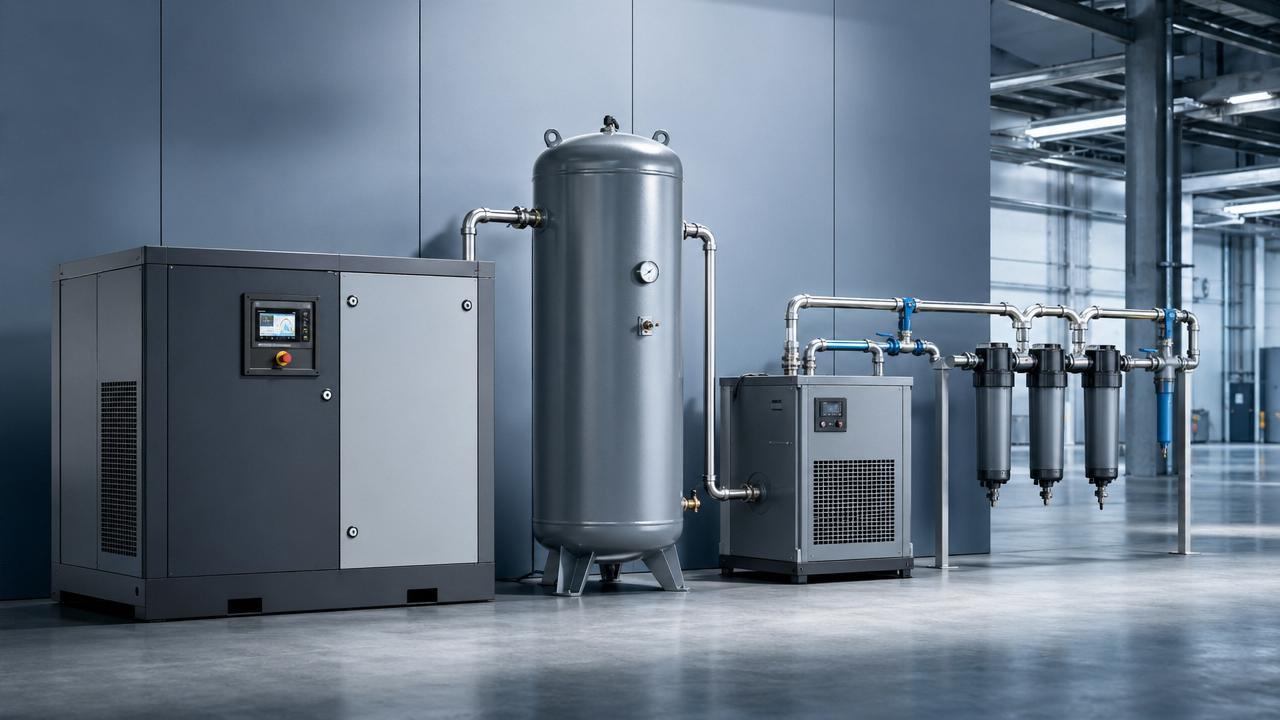
Industrial trends are redefining compressor efficiency standards as manufacturers face tighter energy targets, stricter compliance demands, and rising lifecycle cost pressures. For technical evaluators, understanding how system design, materials, controls, and application-specific performance interact is now essential. This article explores the forces pushing efficiency benchmarks higher and what they mean for sourcing, engineering decisions, and long-term industrial competitiveness.
Why compressor efficiency standards are moving faster than before
Across industrial production, one of the clearest industrial trends is the shift from nameplate performance to verified operating efficiency. Compressors are no longer assessed mainly by rated power or initial purchase price. In many facilities, they run for 4,000 to 8,000 hours per year, which means even a modest improvement in specific energy consumption can materially affect annual operating cost, maintenance intervals, and carbon reporting. For technical evaluators, this changes the baseline for comparison.
The pressure is coming from several directions at once. Energy prices remain volatile, plant managers are under stronger internal KPI control, and procurement teams are being asked to justify total cost of ownership over a 3-year to 10-year lifecycle. At the same time, compressed air systems are increasingly linked to automated lines, robotics, pneumatic logic, and precision tooling processes where pressure stability matters as much as motor efficiency.
Another important signal behind these industrial trends is that compressor efficiency is becoming a system issue rather than a single-machine issue. Leakage rates of 10% to 30%, pressure drops above 0.3 bar, oversized storage, poor dryer matching, and outdated controls can erase gains from a high-efficiency compressor. This is why buyers in the broader hardware, electrical, and mold-related manufacturing sectors are asking more detailed technical questions before approval.
What has changed in technical evaluation criteria
Five years ago, many evaluation teams focused on motor power, discharge pressure, and maintenance accessibility. Today, industrial trends are pushing evaluators to look deeper into variable-speed behavior, part-load efficiency, heat recovery potential, and digital monitoring compatibility. A compressor that looks competitive at full load may perform poorly in a duty cycle with 40% to 70% demand fluctuation.
This shift is especially relevant in mixed manufacturing environments served by GHTN audiences, where one facility may support machining, assembly, electrical cabinet production, and mold maintenance at the same time. In such settings, compressed air quality requirements often differ by process. A stable system must match pressure, dew point, filtration, and flow response to real load conditions rather than rely on generalized catalog assumptions.
The table below highlights how industrial trends are changing efficiency evaluation from a narrow equipment view to a broader operational view.
The practical takeaway is simple: technical evaluation now extends beyond compressor hardware. Industrial trends are making it necessary to verify how the machine behaves under real duty cycles, whether controls can reduce unloaded running, and how the broader air system affects true efficiency at the point of use.
The main drivers behind higher efficiency expectations
Several forces are converging to push standards upward. The first is energy intensity. In many industrial sites, compressed air is among the more expensive utilities because only a portion of electrical input becomes usable pneumatic work at the application point. When electricity prices rise or energy budgets tighten, management attention quickly turns to compressors, leaks, pressure settings, and idle-load waste.
The second driver is process quality. Industrial trends in precision manufacturing, automated assembly, and mold processing require tighter repeatability. If pressure fluctuates excessively or air treatment is inadequate, the result can be unstable torque, poor actuator timing, contamination, or reject rates that undermine the value of a supposedly efficient system. Efficiency therefore has to be considered together with reliability and air quality.
A third driver is compliance and reporting discipline. Even where there is no single mandatory global efficiency rule for all compressor types, buyers increasingly work within internal sustainability frameworks, regional energy-management expectations, and documentation requirements tied to capital expenditure reviews. This creates demand for better test transparency, clearer duty-cycle assumptions, and maintainable performance records.
Technology upgrades that are no longer optional
For many applications, variable speed drive control has moved from premium option to standard shortlist requirement. Where load profiles vary significantly during shifts, VSD-equipped compressors can reduce wasted unloaded running and lower pressure band variation. The benefit depends on system design, but in plants with multi-shift fluctuation, evaluators frequently consider VSD or hybrid staging when demand swings exceed 20% to 25%.
Motor efficiency, cooling design, and internal airend optimization are also becoming more visible in evaluation. Improved rotor geometry, lower internal leakage, and better bearing management can influence long-term power draw and service stability. In practice, these design refinements matter most when machines operate in demanding ambient conditions, such as high dust, elevated temperature, or continuous production windows of 16 to 24 hours.
Digital controls are another clear signal within industrial trends. Real-time monitoring of pressure, temperature, run hours, dew point, and service alarms allows earlier correction of drift. This does not automatically guarantee efficiency, but it does improve visibility. For technical evaluators, the difference between a measurable system and an opaque one is important when assessing long-term operating risk.
Core drivers technical teams should map
- Energy exposure: annual run hours, tariff structure, and peak load penalties can change payback calculations substantially.
- Load variability: steady 90% load and intermittent 40% load require different control strategies and sizing logic.
- Application sensitivity: pneumatic instruments, mold cleaning, and assembly tools often demand different air quality and response levels.
- Maintenance environment: filter replacement discipline, ambient contamination, and service access strongly affect realized efficiency.
When these variables are mapped early, industrial trends become easier to translate into practical engineering decisions. Instead of treating efficiency as a catalog claim, evaluators can frame it as a controllable outcome shaped by load pattern, environment, controls, and downstream consumption behavior.
How industrial trends are changing selection logic for different manufacturing scenarios
Not every plant should respond in the same way to rising efficiency standards. A facility producing precision mold components, for example, may prioritize clean, dry, stable air with low pressure variation, while a general fabrication line may place more emphasis on robust throughput and easier maintenance. One of the most useful responses to current industrial trends is to evaluate compressors by application cluster rather than generic plant average.
Technical evaluators should pay close attention to load profile segmentation. A single production site may include base-load operations, intermittent pneumatic tools, testing benches, and packaging zones. If one compressor is sized for the highest occasional peak but spends most of its time unloaded, the system may meet flow demand while failing efficiency expectations. In many cases, staged compressors, storage optimization, or decentralization improve the balance.
The next table outlines how typical manufacturing contexts influence compressor efficiency priorities and what industrial trends suggest technical teams should verify during selection.
This comparison shows why industrial trends cannot be reduced to a single efficiency number. A technically stronger decision comes from matching the duty profile to a configuration that can sustain expected air demand, treatment quality, and operating flexibility. That is especially important in international sourcing, where catalog specifications may not fully reflect the user’s ambient conditions or production rhythm.
Where hidden inefficiency usually appears
In many reviews, the biggest gap is not the compressor itself but the surrounding system. Common issues include oversized distribution lines in some zones and undersized lines in others, legacy filters causing excessive differential pressure, or drains and dryers that consume more energy than expected. Evaluators who inspect only compressor headline data may miss these losses entirely.
Another frequent issue is pressure setpoint inflation. Operators sometimes raise system pressure by 0.5 to 1.0 bar to compensate for local performance complaints, but this often increases power demand while masking root causes such as poor pipe layout, leakage, or badly timed peak consumption. Current industrial trends favor diagnosis and correction over brute-force pressure increase.
For technical teams in OEM, distribution, and plant engineering roles, this means the selection process should include point-of-use verification, not just central equipment review. A compressor may be efficient in isolation yet underperform in the real system due to avoidable downstream losses.
What technical evaluators should check before approving a compressor project
Industrial trends are making technical approval more evidence-based. A strong review process should begin with demand characterization over a realistic operating period, ideally at least 7 to 14 days for variable plants and longer where seasonal shifts matter. Snapshot readings are useful, but they rarely capture startup peaks, shift changes, tool changeovers, and weekend idle behavior that shape actual efficiency.
The second step is to separate mandatory performance from convenience assumptions. Required delivery pressure at the tool or actuator is not the same as discharge pressure at the compressor outlet. Likewise, required air quality for a sensitive process should be specified by application need, not by using the highest treatment level across the entire site. This distinction can reduce overdesign and improve efficiency outcomes.
The third step is to compare proposals using a standard framework. Without a structured checklist, one supplier may quote a bare compressor while another includes controls, treatment, storage, and monitoring. The result looks like a price gap when it is actually a scope gap. Under current industrial trends, transparent scope comparison is essential for fair evaluation.
A practical review checklist
- Confirm average flow, peak flow, and minimum flow over representative production periods.
- Identify target pressure at the point of use and measure total pressure drop through the network.
- Check whether the application needs oil-free air, low dew point, or enhanced particle filtration.
- Review part-load efficiency, unload behavior, and sequencing logic rather than full-load figures alone.
- Estimate service intervals in operating hours and compare planned maintenance access and spare availability.
- Verify compatibility with existing plant electrical conditions, controls, and monitoring systems.
This checklist helps technical evaluators convert broad industrial trends into a disciplined selection workflow. It also reduces the risk of approving a compressor that appears efficient on paper but performs weakly once integrated into a demanding production environment.
Parameters worth documenting in every comparison
At minimum, teams should record flow range, operating pressure band, annual operating hours, ambient temperature range, filtration requirement, dew point target, and expected service interval. A project that documents these six to eight inputs usually produces more reliable selection decisions than one based only on motor size and quoted free air delivery.
It is also useful to define acceptance criteria in advance. For example, some sites may require pressure stability within a narrow band, a targeted leak reduction program within 3 to 6 months, or data connectivity for energy review. These conditions help translate industrial trends into measurable post-installation outcomes rather than abstract expectations.
Where systems support precision manufacturing or value-sensitive tooling processes, evaluators should further ask whether the compressor strategy allows later expansion. A plant may need 15% to 25% additional capacity within two years, and the wrong architecture can make future optimization more expensive than expected.
Signals to watch over the next procurement cycle
Looking ahead, industrial trends suggest that compressor efficiency will increasingly be judged through measurable operating behavior, not only declared machine capability. Buyers are likely to place more emphasis on trending data, remote diagnostics, and system-level tuning. This matters for distributors, OEM sourcing teams, and plant engineers who need equipment choices that remain credible over a multi-year operating horizon.
Another signal is the tightening connection between equipment efficiency and broader industrial sustainability programs. Even when carbon accounting is not the main purchase driver, pressure to reduce waste and improve utility performance is becoming part of general operational governance. In practical terms, that means leak audits, heat recovery review, and compressor room optimization may move from optional improvement projects to routine management tasks.
A third signal is specification maturity. More buyers now request clearer documentation around test conditions, maintenance assumptions, and recommended system layouts. This trend favors suppliers and technical partners who can discuss compressors in the context of materials, controls, air treatment, and application performance rather than offering isolated equipment quotations.
How to respond strategically
For technical evaluators, the best response to industrial trends is to create a repeatable decision model. That model should compare proposals on lifecycle cost, control philosophy, serviceability, and fit for process requirements. It should also distinguish between short-term savings and long-term operating resilience, especially in facilities with mixed manufacturing loads or future capacity plans.
For sourcing teams working across borders, it is wise to request structured clarification on spare parts supply, lead time, and documentation support. Typical lead times can vary from a few weeks for standard units to several months for specialized configurations or integrated treatment packages. If project timing is tight, delivery rhythm becomes part of efficiency planning because delayed commissioning can disrupt broader capacity targets.
For manufacturers and component suppliers in GHTN’s ecosystem, the message is equally clear: industrial trends are rewarding those who connect compressor efficiency with precision production needs, electrical integration, and maintainable system design. Better decisions now come from cross-functional evaluation rather than isolated procurement.
Why work with a specialized industrial intelligence partner
When compressor efficiency standards move higher, the challenge is not only to identify better equipment but to interpret industrial trends correctly for your own operating context. That is where a specialized platform like GHTN adds value. Our focus on hardware, electrical systems, mold manufacturing, and industrial components helps technical evaluators connect utility decisions with the realities of precision manufacturing, automation, and supply chain execution.
We support decision-making by helping teams frame the right questions: which parameters need confirmation, how application demands affect system architecture, what delivery and documentation issues may influence the project, and where hidden inefficiencies are likely to appear. This is especially useful for OEMs, distributors, and plant engineering teams that need practical insight rather than generic market commentary.
If you are reviewing compressor options, planning a system upgrade, or assessing how industrial trends may affect sourcing and specification decisions, contact us to discuss parameter confirmation, product selection, lead time expectations, custom configuration paths, certification-related questions, sample support, or quotation planning. GHTN is committed to linking precision and helping industrial teams make sound, future-ready decisions.
Related News
- How to Use an Air Compressor Selection Chart to Size CFM, PSI, and Tank CapacityTime : Aug 06, 2026
- How to Choose Compressed Air Equipment for Automation Based on Load, Speed, and Duty CycleTime : Jul 23, 2026
- How to Improve Compressed Air System Efficiency: 7 Loss Points to Check FirstTime : Jul 13, 2026