
Evaluating Edge Bander Pre-Milling Through Sample Panel Trials

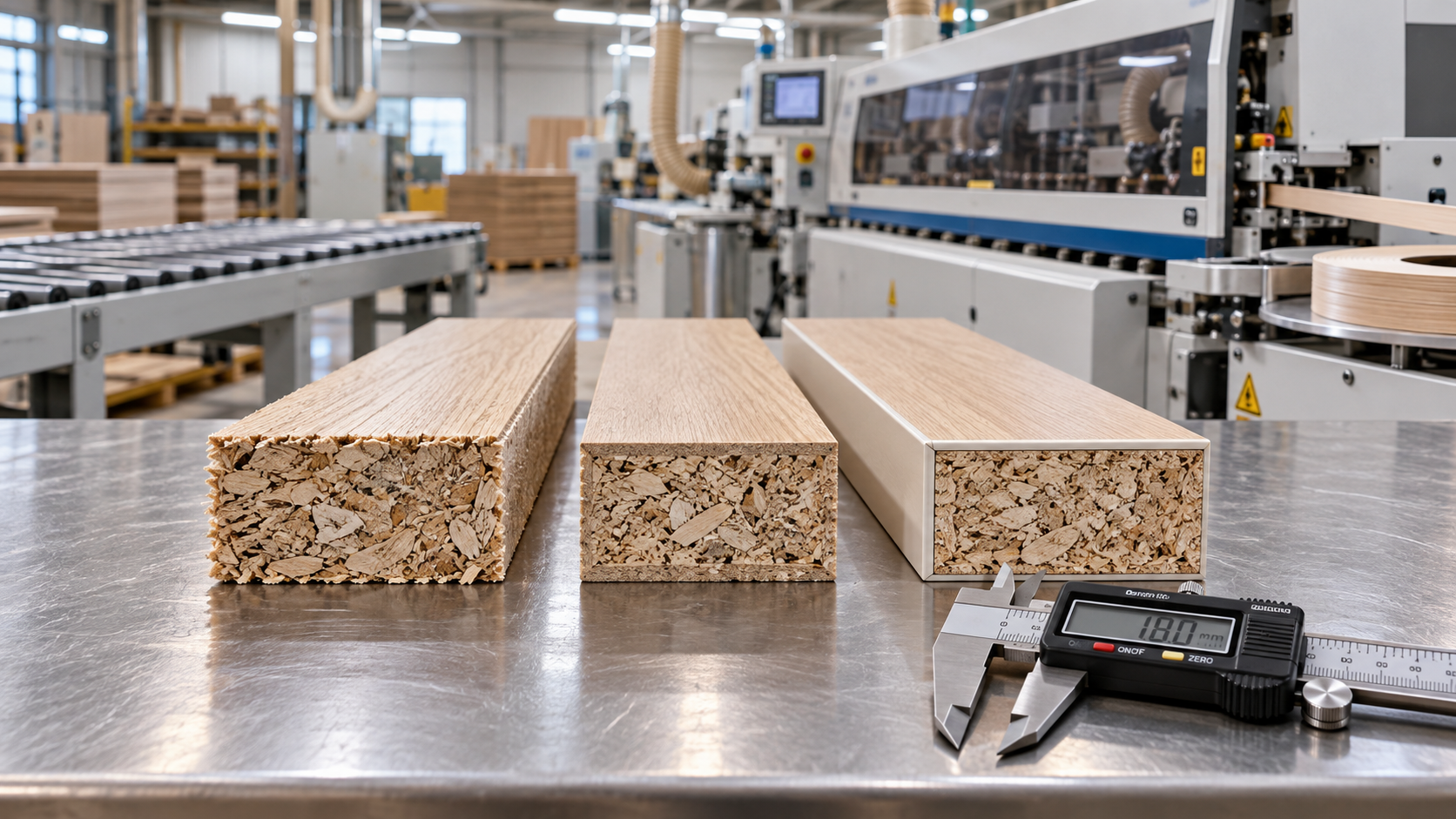
A clean-looking edge-banded sample does not establish whether a machine’s pre-milling unit is suitable for production. The purchasing question starts earlier: how much material was removed, how consistently was it removed, and did the panel remain within its dimensional allowance? A convincing trial should connect those measurements to the finished edge, rather than judge appearance alone.
For buyers, this distinction affects more than surface quality. Excessive removal can create undersized components or require changes to upstream cutting dimensions. Insufficient removal may leave damage that the edge band conceals without correcting. The most useful sample-panel trial therefore starts with stock removal, then checks bonding, repeatability, operating conditions, and cost.
Establish the stock-removal allowance before running samples
Pre-milling prepares the panel edge before adhesive application and edge-band attachment. Its intended role is to remove a controlled amount of material and produce a suitable edge for the following operations. It should not be treated as an unlimited correction stage for inaccurate cutting, damaged faces, or unstable workpieces.
The buyer and supplier should agree on three dimensions: the incoming panel size, the substrate size required after milling, and the finished size after edging. These are different reference points. Confusing substrate dimensions with finished dimensions can make an otherwise successful demonstration irrelevant to the actual component drawing.
For a simple dimensional check, the reduction across a panel equals the material removed from the relevant opposing edges. Where both edges are processed, both allowances must be included. Edge-band thickness then contributes to the finished outside dimension; any subsequent finishing allowance must also be understood. This is a dimensional relationship, not a proposed machine setting.
Record the intended removal per edge in the trial specification. Ask the supplier to explain how that setting is established, adjusted, and verified. Do not accept a control-screen value as proof of actual removal: the sample dimensions need to support it.
When reviewing pre-milling edge bander process details for a candidate machine, use the information to frame configuration questions rather than assume that a listed pre-milling function establishes capability. The quotation and trial record should identify the actual unit, tooling, adjustment method, and operating conditions being evaluated.
Choose panels that expose the purchasing risk
A supplier-selected panel can show what the equipment can achieve under favorable conditions. It cannot, by itself, establish suitability for the buyer’s material mix. Supply representative blanks from normal production wherever practical, with their origin and condition recorded.
The sample set should reflect the materials that matter commercially: frequent jobs, demanding visible finishes, and components with tight dimensional requirements. Particleboard, MDF, and plywood should not automatically be treated as interchangeable trial materials. Their construction differs, so evidence from one should not be extended to another without verification. The USDA Forest Products Laboratory’s Wood Handbook—Wood as an Engineering Material, FPL–GTR–282 (2021), provides background on wood-based composite materials and their differing characteristics; it does not establish machine-specific milling allowances.
Include ordinary incoming-edge variation, but distinguish acceptable production variation from rejected material. Otherwise, a trial can become an attempt to rescue panels that the factory should have rejected upstream.
Use uniquely identified samples and retain unprocessed controls. Without that traceability, it becomes difficult to determine whether an apparent improvement came from pre-milling, a better incoming blank, or a changed downstream setting.
Separate the milling assessment from the finished-edge assessment
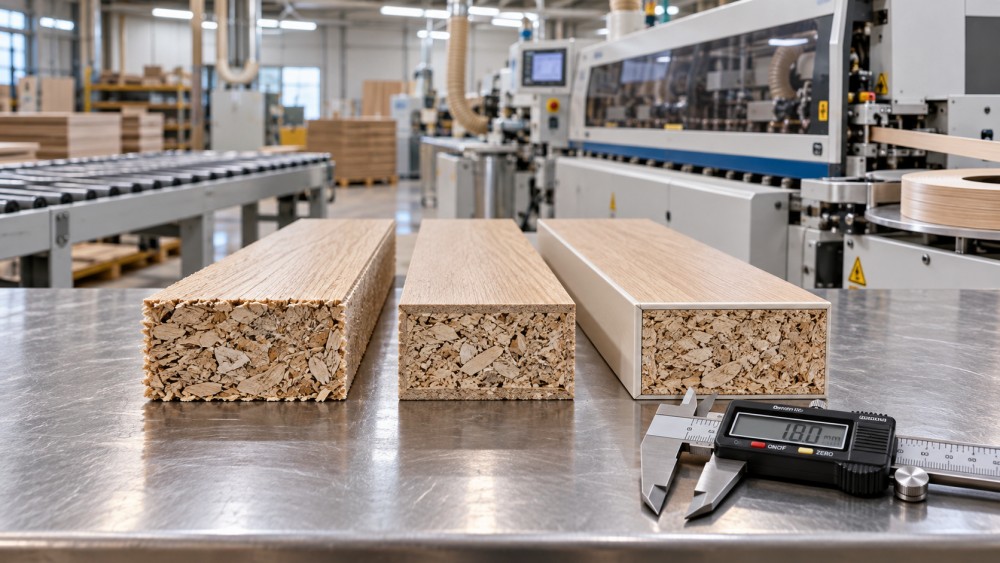
A finished sample combines the effects of milling, adhesive application, pressure, edge-band characteristics, and trimming. Evaluating everything together makes fault attribution difficult. Plan separate inspection stages, using only the machine manufacturer’s approved operating and sample-access procedures.
Measure actual removal and check consistency
Measure each selected blank before processing at identified positions. After milling, repeat the measurements from the same reference edges. Use a measurement method suitable for the component tolerance, and record the instrument and method so that the buyer can reproduce the check.
A single reading across the center is not enough to investigate variation along an edge. Compare positions near the leading end, middle, and trailing end, while avoiding a measurement method that is distorted by local damage. If the readings differ, investigate workpiece guidance, incoming geometry, setup, and measurement repeatability before assigning the cause.
Where feasible, assess one processed edge at a time. A total width reduction after machining two opposing edges does not establish how much each edge contributed. This matters when one face or edge serves as the dimensional reference for later drilling, assembly, or fitting.
Inspect what the cutter leaves behind
On samples obtained through an approved inspection procedure, examine the exposed milled edge before adhesive obscures it. Record remaining saw damage, torn areas, local voids, visible machining marks, and damage at the face-to-edge boundary. Describe defects rather than recording only “pass” or “fail.”
Ask whether the selected removal reaches beyond the incoming damage while preserving the required component size. If those requirements conflict, more cutter adjustment may not be the answer. The buyer may need a different cutting allowance, improved upstream edge quality, or a revised process route.
Keep observations of incoming and newly created defects separate. A void already present inside a board is not the same purchasing issue as damage introduced during the trial, even if both appear on the milled surface.
Finish the same samples under documented conditions
Once the stock-removal result is understood, assess the complete edge-banding process. Keep the material, tooling, feed setting, adhesive system, edge-band specification, and relevant adjustments documented. If the supplier changes several settings between samples, require the changes to be recorded; otherwise, the successful result may be difficult to reproduce.
Inspect finished dimensions as well as appearance. Compare the substrate and edge-band relationship at both faces, the continuity of the visible joint, and the leading and trailing ends. A visually neat joint is useful evidence, but it is not a substitute for an agreed bond-performance test.
If destructive bond checks are required, define the method, conditioning period, sample preparation, and acceptance criteria before testing. These should come from the applicable customer specification, an agreed test method, or the adhesive supplier’s technical instructions. An improvised peel check should not be presented as proof of durability, moisture resistance, or compliance.
Retain labeled finished samples and photographs alongside the setup record. The purpose is to connect an acceptable result with an identifiable process—not to collect an attractive demonstration piece with no reproducible settings.
Test repeatability and the changeovers buyers will actually face
One satisfactory panel establishes a possibility. Procurement needs evidence that the result can be repeated under the agreed production conditions.
Run a documented sequence of comparable samples without corrective adjustment between every piece. Agree the sequence length according to the purchase risk rather than applying an arbitrary universal number. Include production-relevant feed settings and workpiece formats within the supplier’s stated operating limits.
Record every intervention. A setting that needs frequent manual correction may still be usable, but it carries a different staffing and process-control requirement from a setup that remains stable through the agreed sequence.
Changeovers deserve their own assessment. Ask the supplier to demonstrate how the operator moves between the materials, thicknesses, or removal allowances expected in production. Record which settings are recalled, which require physical adjustment, and how the first acceptable component is verified.
Tool condition is another boundary on the evidence. A demonstration with freshly prepared tooling does not establish performance throughout its usable life. Request the tooling specification, maintenance instructions, sharpening or replacement arrangements, and the method for restoring the setup afterward. If no extended trial is conducted, record tool-life performance as unverified rather than infer it from a short demonstration.
Convert trial findings into cost and acceptance terms
The purchase comparison should distinguish machine capability from the process changes needed to use it. A successful trial may depend on larger incoming blanks, a particular cutter configuration, more careful upstream cutting, or additional setup time. Those dependencies belong in the evaluation.
Calculate operating costs from the buyer’s own production assumptions and the supplier’s documented consumable requirements. Relevant items include tooling service, replacement cutters, setup material, changeover labor, rejected components, and any change to cutting allowances or nesting layouts. Do not convert a short trial into a claimed annual saving without a defensible production model.
A modest removal allowance is not automatically cheaper if it leaves unacceptable damage. A larger allowance is not automatically better if it compromises dimensions or material yield. The useful comparison is the cost of producing an acceptable component under repeatable conditions.
Translate the trial into a written acceptance schedule covering:
- The approved materials, thicknesses, workpiece formats, and incoming-edge condition.
- The required removal allowance and the method used to verify it.
- Substrate and finished-component dimensional tolerances.
- Agreed visual criteria, supported by labeled reference samples.
- Any bond test, with its source method and acceptance criteria.
- The demonstrated operating settings, permitted adjustments, and repeatability requirements.
- The supplied tooling and the responsibilities for setup, training, and acceptance testing.
Separate demonstrated results from supplier statements and unresolved questions. A function shown in a brochure, an option included in a quotation, and a result achieved on the buyer’s panels are three different forms of evidence.
The purchasing decision should return to a simple test: can the proposed machine remove the necessary stock without consuming the component’s dimensional allowance, and can it repeat that result within the required edge-banding process? When the sample record answers both questions clearly, appearance becomes supporting evidence rather than the basis of the purchase.
Related News