
Niche industrial fields gaining demand in 2026

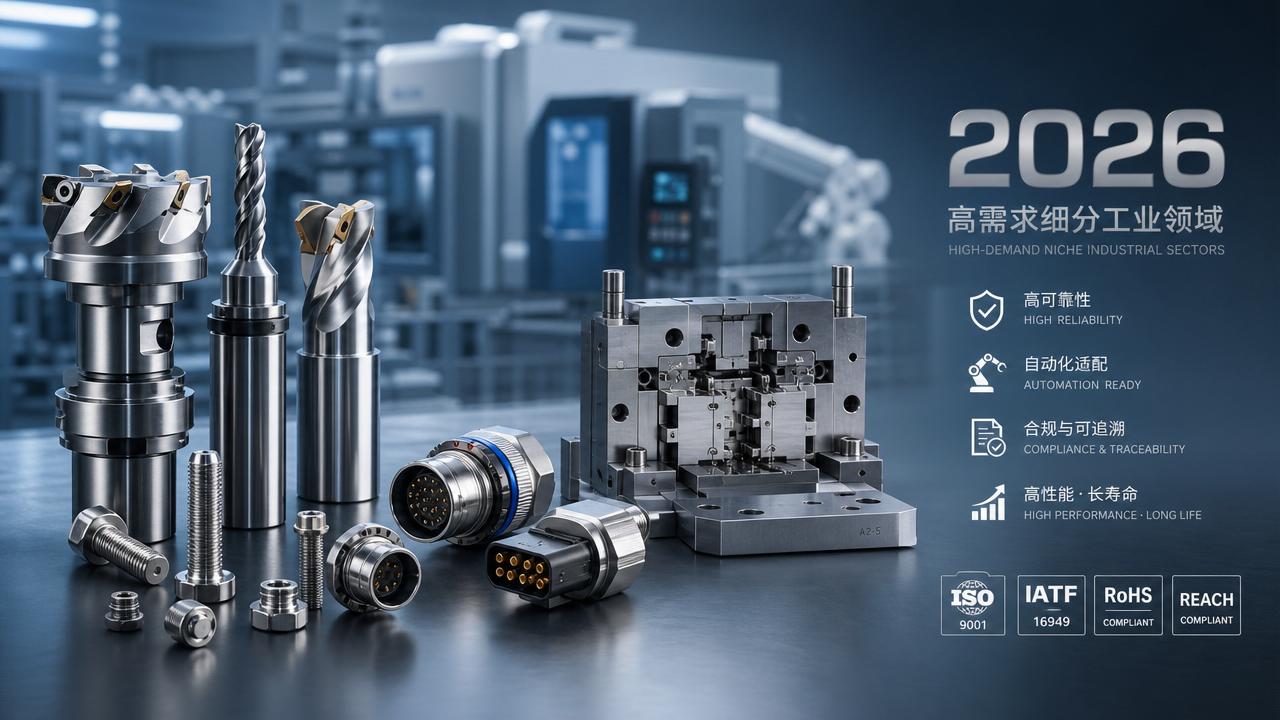
As global supply chains rebalance and advanced manufacturing accelerates, niche industrial fields are emerging as high-value opportunities for strategic buyers and evaluators in 2026. From precision tooling and fasteners to electrical components and mold systems, these specialized segments are gaining traction through compliance upgrades, automation demand, and performance-driven sourcing. This article explores where demand is rising and what business assessment teams should watch next.
For business evaluators, the core question is not simply which niche industrial fields are growing, but which ones are becoming strategically important, margin-resilient, and difficult to replace in industrial supply chains. In 2026, demand is expected to shift toward specialized component categories that solve concrete manufacturing problems: tighter tolerance control, higher energy efficiency, better regulatory compliance, longer service life, and greater automation compatibility.
The most attractive segments are usually not the largest by volume. They are the ones with technical barriers, recurring replacement demand, qualification complexity, and direct influence on production uptime. That is why assessment teams should look beyond generic industrial expansion and focus on smaller but high-dependency categories where procurement standards are rising and supplier capabilities matter more than unit price alone.
What business assessment teams are really trying to determine in 2026
When decision-makers search for insight on niche industrial fields, they are usually evaluating commercial viability. They want to know where demand is increasing, what is driving it, how durable that demand may be, and whether a niche is attractive enough for sourcing expansion, distribution entry, supplier qualification, or portfolio investment.
For this audience, the most relevant questions are practical. Is the segment tied to long-term industrial transitions such as electrification, factory automation, energy efficiency, medical manufacturing, or aerospace compliance? Does it require specialized manufacturing know-how that limits new entrants? Are buyers willing to pay a premium for performance, certification, or reliability? And how exposed is the category to commoditization?
In other words, evaluating niche industrial fields in 2026 requires a framework that combines market demand with engineering dependency. A field can look small on paper yet become highly attractive if it sits deep inside critical systems, creates switching friction, and supports compliance or productivity gains for OEMs.
Why niche industrial demand is rising now
Several structural forces are lifting demand across specialized industrial categories. First, supply chains are being redesigned for resilience. Buyers increasingly prefer dual sourcing, regional manufacturing support, and suppliers with stronger quality traceability. This benefits niche component makers that can deliver certified performance and stable output in technically sensitive applications.
Second, automation is moving deeper into mid-sized manufacturing operations. This increases demand for pneumatic controls, motion-support hardware, precision tooling, electrical connectors, cable management systems, sensor-compatible housings, and mold components that can sustain repeatability over long production cycles.
Third, compliance is no longer a back-office issue. Environmental rules, electrical safety regulations, workplace standards, and export requirements are reshaping purchasing criteria. Specialized fasteners with corrosion resistance, flame-retardant electrical components, low-waste tooling systems, and traceable mold materials all gain relevance when compliance failure carries operational or legal risk.
Fourth, many industries are demanding more from basic components. EV platforms, renewable energy installations, medical devices, semiconductor equipment, and aerospace subassemblies all require tighter tolerances and more reliable materials. That pushes value toward niche industrial fields where engineering performance, rather than simple availability, determines buying decisions.
High-demand niche industrial fields gaining traction in 2026
Among the most promising niche industrial fields are precision cutting and finishing tools. These products benefit from the need for better machining efficiency, harder materials processing, and reduced downtime. Demand is especially strong where manufacturers want longer tool life, better thermal stability, and data-backed consistency in CNC and automated production environments. For evaluators, this segment is attractive because product performance can justify premium pricing and repeat purchasing.
Advanced industrial fasteners are another growth area. While fasteners are often seen as mature products, specialized variants for extreme temperature, vibration-heavy environments, lightweight assemblies, and corrosion-sensitive sectors are gaining attention. Aerospace, energy, rail, marine, electronics, and EV-related uses increasingly depend on fasteners that meet precise mechanical and regulatory requirements. This is a niche where certification and application knowledge can create strong differentiation.
Precision mold components and mold-base systems are also positioned for rising demand. As manufacturers seek faster cycle times, tighter part consistency, and more complex geometries, the quality of mold inserts, cooling components, ejector systems, hot runner elements, and wear-resistant mold materials becomes more important. Niche demand is strongest where molds support medical devices, consumer electronics, automotive plastic components, and technical packaging.
Electrical interconnection components represent another important category. This includes terminal blocks, industrial connectors, protection housings, cable glands, and compact power distribution parts designed for automation systems and electrified equipment. Growth is being driven by stricter safety expectations, digital factory upgrades, and the need for durable, modular system design. Buyers in this space prioritize compliance, heat resistance, ingress protection, and installation reliability.
Pneumatic and fluid-control subcomponents continue to gain value as automated production systems expand. The demand is not only for major cylinders or valves, but also for specialized fittings, seals, manifolds, regulators, and compact motion-control accessories that improve line efficiency. These categories are often overlooked, yet they are deeply tied to uptime and maintenance performance, making them commercially meaningful for targeted sourcing strategies.
Another notable area is wear-resistant and application-specific industrial materials used in tooling, dies, and high-stress assemblies. Products such as engineered coatings, specialty steels, carbide-based components, and thermal-treatment optimized parts are seeing stronger pull from customers that want longer service intervals and lower total cost of ownership. This kind of niche tends to perform well when manufacturers focus on lifecycle economics instead of lowest upfront price.
How to identify whether a niche is commercially attractive or just temporarily popular
Not every growing segment will become a strong long-term opportunity. Business assessment teams should distinguish between demand spikes and structurally durable growth. A useful starting point is to examine what role the component plays in the customer’s system. If failure creates downtime, safety risk, quality loss, or recertification costs, the niche has stronger commercial defensibility.
Next, look at the qualification burden. In many niche industrial fields, customers take time to approve materials, dimensions, tolerances, and test performance. That may slow initial sales but often improves supplier stickiness after approval. High switching cost is usually a positive sign, especially for distributors and sourcing teams seeking long-term account stability.
Another test is pricing logic. If suppliers compete mainly on commodity price, the niche may be less attractive than it first appears. By contrast, if customers are willing to pay for durability, repeatability, compliance documentation, traceability, custom engineering, or delivery reliability, margins are more likely to hold. The best niches combine technical value with recurring replacement or expansion demand.
Finally, assess whether the niche is tied to a broad industrial trend. Segments linked to electrification, automation, miniaturization, lightweight design, or stricter regulation are more likely to maintain momentum beyond 2026. If demand depends only on a temporary project cycle, the opportunity may be real but less scalable.
Key signals evaluators should monitor before entering or expanding in these segments
One important signal is specification tightening. When OEMs begin requiring higher corrosion resistance, narrower tolerance bands, more detailed material declarations, or stronger audit documentation, it usually indicates that a niche is moving up the value ladder. This can create room for specialized suppliers while filtering out low-capability competitors.
Another signal is increasing aftermarket relevance. Many niche industrial fields become especially attractive when components need regular replacement, recalibration, refurbishment, or customization. This creates recurring revenue and can support stronger distributor relationships. Tooling, pneumatic accessories, electrical protection components, and mold wear parts often perform well under this model.
Regionalization trends also matter. If customers are shifting away from single-country sourcing or requesting near-market support, localized specialists may gain advantage. This is particularly important in technical components where lead time, communication accuracy, and engineering service affect project success.
Assessment teams should also watch for standard changes and certification updates. New energy-efficiency rules, electrical safety codes, or environmental material restrictions can rapidly reshape demand in niche industrial fields. Suppliers that are prepared early often gain share because buyers need compliant alternatives without disrupting production schedules.
Risks and blind spots in evaluating niche industrial fields
A common mistake is overestimating a segment based on technical sophistication alone. Some products are highly specialized but commercially narrow, with limited repeat demand or long sales cycles. A niche may be impressive from an engineering perspective yet still offer poor market scalability if only a small number of end users require it.
Another risk is underestimating customer education costs. In many specialized categories, the supplier or distributor must explain performance differences, application fit, and compliance implications. If the market is still immature, sales conversion may take longer than expected even when the product is objectively better.
There is also the challenge of dependency on a few key industries. A niche strongly tied to automotive, electronics, or construction may look attractive until that end market slows. Diversification across multiple industrial applications usually strengthens resilience, especially for firms evaluating supplier partnerships or market entry paths.
Lastly, technical claims must be verified carefully. In precision manufacturing fields, differences in metallurgy, heat treatment, tolerance control, coating quality, or lifecycle testing can materially affect end performance. Business evaluators should not rely only on catalogs. Process capability, QC discipline, application history, and field failure data matter just as much as price and capacity.
A practical evaluation framework for 2026 sourcing and portfolio decisions
For teams assessing niche industrial fields, a five-part framework can improve decision quality. First, define critical use cases. Understand exactly where the product fits in the customer’s manufacturing or assembly process and what operational problem it solves.
Second, map demand drivers. Separate short-term order recovery from structural growth linked to automation, regulation, efficiency, or redesign of industrial systems. This helps avoid confusing cyclical improvement with genuine market repositioning.
Third, evaluate supplier defensibility. Review technical barriers, certifications, process consistency, engineering support, and switching friction. In many industrial niches, defensibility is a stronger predictor of long-term value than market size alone.
Fourth, model commercial quality. Look at average order patterns, replacement frequency, customization needs, service intensity, and gross margin potential. A smaller niche with stable repeat sales may be more valuable than a larger category with severe price pressure.
Fifth, assess scalability and risk. Determine whether the niche can expand across regions or adjacent applications, and identify exposure to regulation shifts, raw material volatility, or customer concentration. The best opportunities in 2026 are those that combine technical stickiness with commercially manageable expansion paths.
What this means for buyers, distributors, and industrial intelligence teams
In 2026, the most promising niche industrial fields are likely to be those embedded in high-precision, compliance-sensitive, and automation-linked production environments. These are not always headline sectors, but they are often the categories where quality failure is expensive and supplier reliability carries strategic value.
For buyers, this means procurement should increasingly evaluate lifecycle performance, qualification readiness, and engineering support rather than focusing only on unit cost. For distributors, it means stronger opportunity in categories where technical interpretation and product matching create real customer value. For industrial intelligence teams, it means tracking specification changes and application trends at the component level, not just at the finished-product level.
Platforms and research networks that understand the granular core of manufacturing are especially useful in this environment. The real opportunities often sit beneath the finished machine or final assembly, in the specialized tools, connectors, fasteners, mold parts, and control components that determine whether production can run efficiently, safely, and at scale.
Conclusion: where demand is truly building in niche industrial fields
The strongest demand in niche industrial fields for 2026 is building in specialized component segments that improve precision, reliability, compliance, and automation readiness. Precision tooling, advanced fasteners, mold systems, electrical interconnection parts, pneumatic subcomponents, and wear-resistant materials stand out because they solve operational problems that manufacturers cannot afford to ignore.
For business assessment professionals, the right question is not whether these fields are niche, but whether they are indispensable. When a product category supports uptime, certification, product quality, and total cost efficiency, it can become strategically valuable far beyond its apparent size. That is where the most durable industrial opportunities are likely to emerge.
In short, niche industrial fields gaining demand in 2026 are those closest to the hidden mechanics of industrial performance. Teams that evaluate them through application criticality, technical barriers, compliance relevance, and recurring demand will be better positioned to identify high-quality opportunities before they become obvious to the broader market.
Related News
- Quality Standards for Electronics Explained: IPC, ISO, CE, RoHS, and When They ApplyTime : Jul 10, 2026
- Micron-Level Precision Standards Explained: Tolerances, Inspection Methods, and Common PitfallsTime : Jul 07, 2026
- Hardware Sector Europe: Key Supply Chain Shifts Affecting Sourcing DecisionsTime : Jul 03, 2026