
UL 61058-1 Ed. 5 Deadline Reshapes Switch Certification

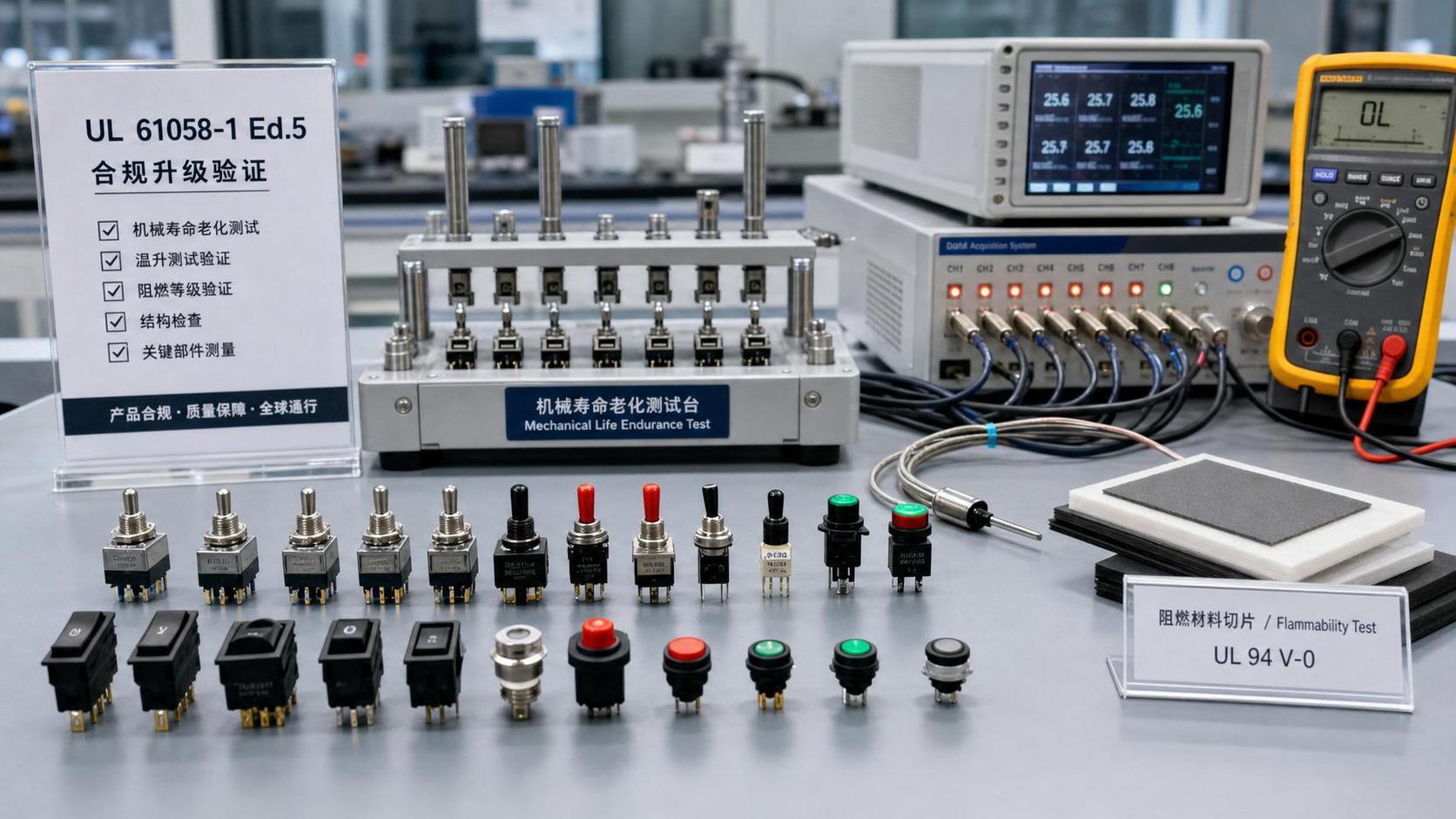
UL 61058-1 Edition 5 is set to become mandatory on 2026-10-01 for industrial and household switches exported to the U.S. market, turning what had been a certification update into an immediate compliance and delivery issue for manufacturers, exporters, sourcing teams, testing partners, and buyers. The point worth watching is not only that the standard is changing, but that products still relying on older certificates will no longer be able to complete UL listing renewals, which can directly affect product continuity, procurement qualification, and shipment planning.
What the mandatory shift formally changes
According to the provided event summary, UL has announced that UL 61058-1 Edition 5 will be fully mandatory from 2026-10-01. The requirement applies to various industrial and household switches exported to the U.S. market. The new edition adds an accelerated aging test for mechanical life, raises the flame-retardant requirement to V-0, and lowers the terminal temperature-rise limit by 15%. Products holding certificates under the previous edition will not be able to complete UL listing renewal.
Where the pressure is likely to appear first
Export programs tied to active UL listings
From an industry perspective, exporters of switch products to the U.S. are likely to face the most direct pressure because the change affects whether existing listed products can remain current in certification status. The practical impact may appear in model continuation decisions, shipment scheduling, customer qualification checks, and contract execution where valid UL listing status is a prerequisite. What deserves closer attention is the alignment between certificate validity, technical files, and delivery commitments already made to customers.
Manufacturing and design validation cycles
Analysis shows that manufacturers may be affected not just at the paperwork stage but in the product verification cycle itself. The added accelerated aging test for mechanical life, the move to a V-0 flame-retardant requirement, and the tighter terminal temperature-rise threshold point to possible review needs in materials, component selection, structural design, and test readiness. The rule change therefore reaches beyond certification teams and can extend into engineering change control, sample preparation, and production release timing.
Procurement and supplier qualification reviews
For procurement teams and buyers, the issue is likely to surface in approved vendor lists, technical specifications, and incoming qualification documents. If a purchasing decision depends on continued UL listing renewal, older certificates may no longer be enough for future orders tied to the U.S. market. Observably, this makes supplier document status, test evidence, and version control more important in purchasing and bid evaluation workflows.
Testing, certification, and delivery coordination
Certification-related service providers and supply chain coordinators may also see higher operational pressure. Where projects depend on renewed listings, document completeness, test scheduling, and review timing could become part of delivery risk management. This is especially relevant for transactions where compliance evidence must be matched with shipment windows, customer onboarding, or after-sales traceability records.
What companies should review now
Check which products still depend on the previous edition
Analysis shows that the first practical task is to identify which switch models for the U.S. market still rely on older certificates and whether those products are expected to require UL listing renewal after 2026-10-01. This is less a broad strategy issue than a portfolio-screening exercise tied to actual sales, export, and renewal timelines.
Reconcile technical documents with the new test focus
Companies should review whether current technical files, internal specifications, test reports, and customer-facing compliance documents are consistent with the Edition 5 changes described in the provided summary. What deserves closer attention is whether existing documentation clearly supports the added mechanical life aging test, the V-0 flame-retardant requirement, and the lower terminal temperature-rise limit, rather than assuming older evidence will remain sufficient.
Review sourcing and delivery commitments with compliance timing in mind
From an industry perspective, teams handling orders, sourcing, and production planning should pay attention to whether delivery schedules overlap with the mandatory date. If compliance conversion is still pending, there may be implications for procurement release, model substitution discussions, and customer documentation packages. Since the provided information does not include operational transition details, this should be treated as a point for active monitoring rather than as a confirmed disruption outcome.
Watch for execution language and market-side document updates
It is more appropriate to understand this as a compliance deadline that may influence downstream documentation practices. Companies should therefore watch for how the new standard is referenced in certification communications, product files, tender specifications, buyer qualification requests, and after-sales quality records. The current input does not provide detailed implementation wording beyond the mandatory date and renewal consequence, so later execution language still requires verification.
Why this reads as an execution signal
Observably, this update is more than a general standards revision notice because it includes a clear mandatory date and a concrete consequence for products holding older certificates: they will not be able to complete UL listing renewal. That makes the development easier to interpret as an execution signal rather than a distant policy trend. At the same time, analysis shows there is still room for continued observation around how market participants, certification workflows, and customer document requirements respond in practice.
How the industry should frame this change
The most balanced reading is that UL 61058-1 Edition 5 is becoming a near-term compliance threshold for switch products entering the U.S. market, with likely effects on certification continuity, procurement review, and delivery planning. It should not be overstated as a universal market outcome, but it should also not be treated as a routine technical update. At this stage, it is more appropriate to understand the event as a rule change that has already moved into implementation territory and that now requires product-level and document-level follow-through.
Basis of this article and what still needs verification
This article is generated based on the user-provided news title, event date, and event summary. For developments of this kind, commonly relevant source types may include official announcements, regulator publications, trade or customs authority information, industry association releases, standards organization documents, and reporting by authoritative media. A specific official source link was not provided in the input, so that part still requires follow-up verification. Continued monitoring is also needed for detailed execution language, certification interpretation, tender document updates, market feedback, and how individual companies implement the transition.