
Which Rivet Materials Help Prevent Galvanic Corrosion?

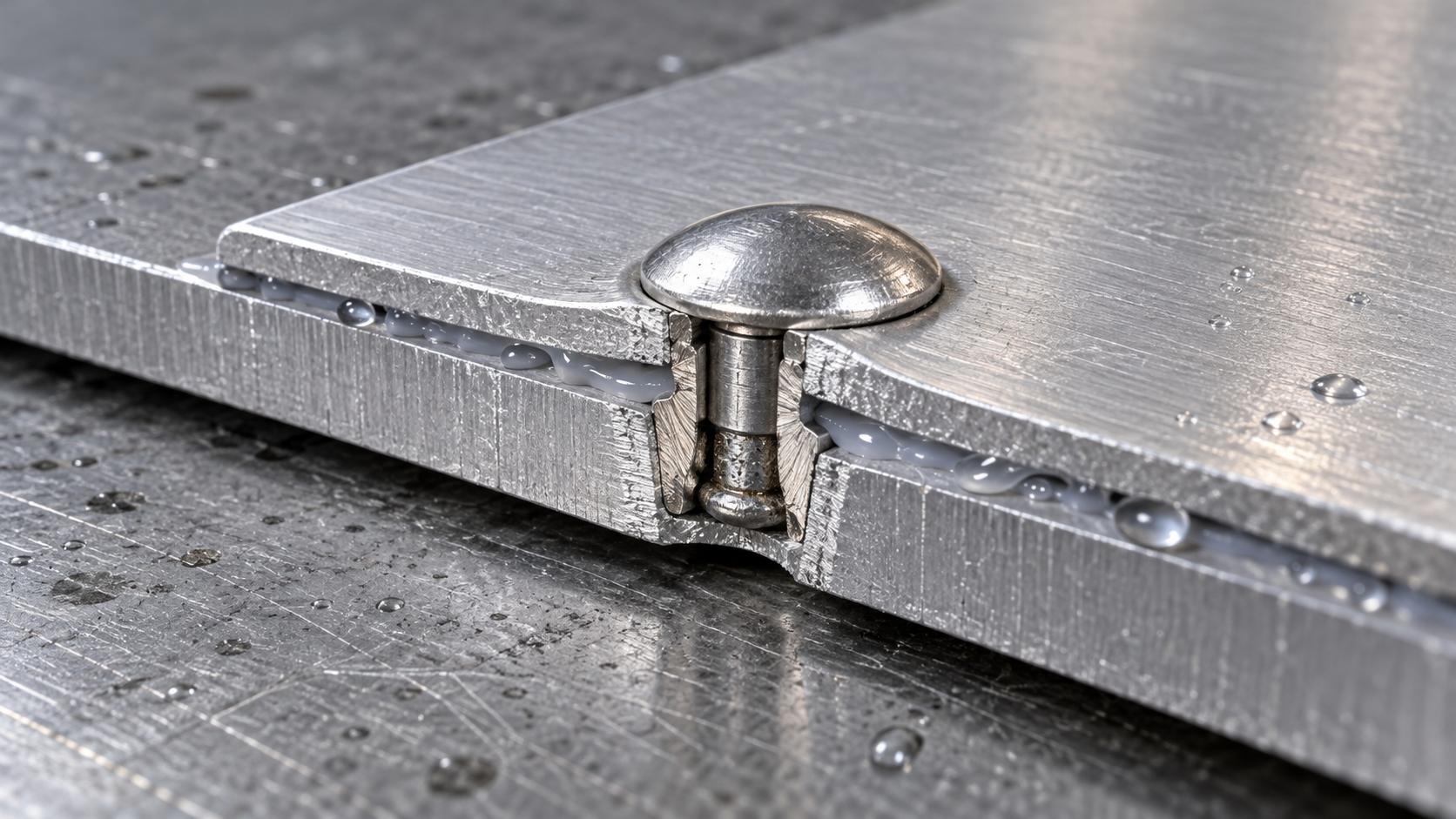
Which rivet material prevents galvanic corrosion? The best starting point is a rivet that is electrochemically compatible with the metals being joined. Aluminum rivets often suit aluminum panels, copper rivets generally suit copper sheet, and stainless steel rivets commonly suit compatible stainless steel assemblies. However, no rivet material prevents galvanic corrosion in every joint.
The answer also depends on moisture, exposed surface areas, protective finishes, and the complete fastener assembly. A corrosion-resistant rivet can still accelerate damage to the surrounding sheet. Even a suitable rivet body may introduce an unfavorable pairing through its retained mandrel. For engineers and buyers, the useful question is not simply “Will this rivet rust?” but “How will every material in this joint behave together?”
Why does galvanic corrosion occur around rivets?
Galvanic corrosion requires three conditions: materials with different electrochemical behavior, an electrically conductive connection between them, and an electrolyte connecting their exposed surfaces. Rainwater, condensation, road salt solution, and seawater can provide that electrolyte.
When these conditions exist, the more active metal becomes the anode and corrodes faster, while the more noble material acts as the cathode. The effect can concentrate around rivet holes, underneath heads, or along overlapping sheets—places where moisture collects and inspection is difficult.
Riveted joints present a particular challenge because drilling and setting can damage coatings. A painted panel may appear protected, yet its hole edge can expose bare metal directly beside a dissimilar fastener. Tight overlaps can also retain moisture long after the visible surface looks dry.
Not every stain or pit is galvanic corrosion. Crevice corrosion, ordinary steel rusting, and chloride-induced pitting can occur independently or alongside it. Correctly identifying the mechanism matters before changing rivet materials.
Which rivet materials are suitable for common base metals?
Match electrochemical behavior, not just material names. Similar materials are usually the safest starting point, but alloy composition, surface condition, and service exposure still matter. A galvanic series for the relevant environment is more useful than a universal ranking of metals.
Are aluminum rivets best for aluminum panels?
Often, yes. A compatible aluminum rivet generally creates less galvanic mismatch with aluminum sheet than a stainless steel or copper rivet would. This makes aluminum a practical starting point for enclosures, ductwork, light fabrication, and panel assemblies.
However, “aluminum” covers many alloys. The rivet must also meet shear, tensile, fatigue, and installation requirements. Selecting a softer rivet solely for corrosion compatibility can create a mechanically inadequate joint.
For blind rivets, check whether the product is aluminum-body/aluminum-mandrel, aluminum-body/steel-mandrel, or another combination. These are not equivalent corrosion specifications.
Do stainless steel rivets prevent galvanic corrosion?
Stainless steel rivets can be appropriate for stainless steel assemblies, but they are not universally safe for aluminum or galvanized steel. Passive stainless steel is relatively noble in many wet environments, so the less noble surrounding metal may corrode preferentially.
A small stainless rivet in a large aluminum panel may have a more favorable overall area relationship than a small aluminum rivet fastening a large stainless sheet. Nevertheless, local conditions at an unprotected hole can still produce serious attack.
Where stainless steel is needed for strength, use a validated protection system rather than relying on the rivet’s corrosion resistance alone. Depending on the joint, that may involve compatible sealants, insulating components, protected hole edges, and drainage.
When are copper, brass, or titanium rivets appropriate?
Copper and brass rivets are useful in compatible copper-alloy assemblies, but neither is a general-purpose corrosion solution for aluminum. Copper-containing runoff can also contribute to aluminum corrosion, so nearby components and drainage paths deserve attention.
Titanium offers high corrosion resistance and is used in specialized assemblies. However, it is relatively noble in many environments and can increase galvanic attack on less noble metals. Its cost and installation requirements also limit its usefulness as a routine substitute.
The broader lesson is simple: a rivet that resists corrosion itself may still be the wrong neighbor for the surrounding structure.
Why does the blind-rivet mandrel matter?
A blind rivet is an assembly, not a single piece of metal. Its body, mandrel, retained stem, and any separate washer can have different compositions. Catalog descriptions sometimes emphasize the body material while leaving the stem specification less visible.
An aluminum-body rivet with a retained steel mandrel can introduce dissimilar-metal contact inside an otherwise aluminum joint. Depending on the exposure and protective finishes, the stem may rust, produce staining, or participate in galvanic attack. A stainless steel mandrel avoids ordinary carbon-steel rusting but does not automatically eliminate galvanic incompatibility with aluminum.
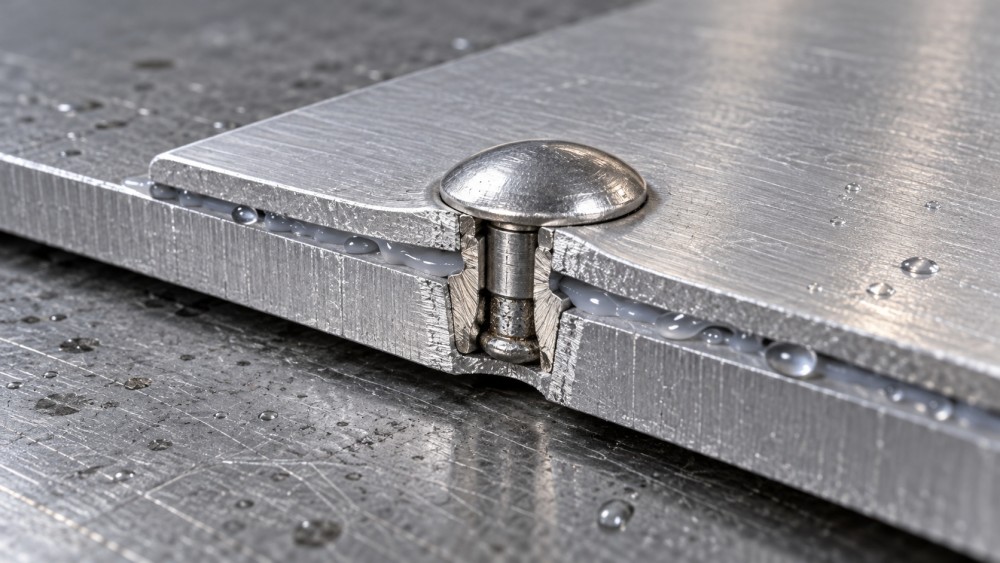
For wet-service applications, request the complete body-and-mandrel specification, including finishes and retained-stem details. Closed-end blind rivets can help restrict water passage through the rivet body, but the head-to-sheet interface still needs attention. A closed end alone does not make the entire joint watertight or galvanically isolated.
Does the size of the rivet relative to the sheet change the risk?
Yes. The exposed cathode-to-anode area ratio strongly influences galvanic corrosion severity. A small anodic area coupled to a large cathodic area is particularly unfavorable because corrosion current concentrates on the smaller active surface.
Consider an aluminum rivet fastening a large stainless steel sheet in a continuously wet location. The aluminum rivet may become the small anode connected to a much larger cathode, making loss of fastener material a serious concern.
The reverse arrangement—a stainless rivet in a large aluminum sheet—can have a less severe overall area ratio, but that does not guarantee durability. Coatings may leave only a tiny ring of aluminum exposed around the hole, creating an unfavorable local geometry. The relevant areas are the electrically connected surfaces wetted by the electrolyte, not simply the total dimensions shown on a drawing.
Can coatings, sealants, and washers make dissimilar-metal riveting safe?
They can reduce risk substantially when designed as a system. Their effectiveness depends on continuity, installation quality, and survival under service conditions.
- Protective coatings reduce contact between metal and electrolyte. They must remain effective after drilling, riveting, vibration, and weathering.
- Compatible joint sealants can exclude moisture from overlaps, hole edges, and areas beneath rivet heads.
- Insulating sleeves, bushings, and washers can interrupt electrical contact if they isolate every relevant contact path.
- Drainage and ventilation reduce the time that conductive moisture remains in the joint.
A plastic washer beneath the head is not complete electrical isolation if the rivet shank still touches the hole wall. Similarly, a gasket between sheets does not isolate them if a conductive fastener bridges both materials.
Coating selection also requires care. A coating that protects only the anodic metal can leave small defects vulnerable to concentrated attack when coupled to an exposed cathode. Where practical, protecting both materials and sealing the joint is more robust than depending on a thin barrier over the vulnerable member alone.
Zinc coatings provide sacrificial protection for steel, but that protection is finite. Rivet setting may damage the coating, and aggressive exposure can consume it. Specify the finish and suitable repair procedures rather than accepting “plated” as a complete description.
Which environments need extra caution?
Dry indoor equipment generally presents less galvanic risk than outdoor assemblies exposed to recurring condensation. The difference becomes more pronounced in coastal infrastructure, vehicle bodies exposed to deicing salts, washdown machinery, and marine equipment.
Salt increases electrolyte conductivity, while sheltered overlaps can trap concentrated contaminants. An apparently minor material mismatch may therefore become important when the same assembly moves from a warehouse to an exposed coastal installation.
Carbon-fiber-reinforced polymer deserves separate attention. Although it is not a metal, electrically conductive carbon fibers can act as a cathodic material when coupled to metals such as aluminum. Riveting aluminum directly to carbon composite requires an engineered isolation and sealing approach, not merely a different rivet label.
Chemical exposure and temperature can also change coating durability, sealant performance, and material behavior. For critical joints, compatibility should be assessed under representative service conditions.
What should buyers specify before ordering rivets?
A request for “corrosion-resistant rivets” leaves too much open to interpretation. A useful purchasing specification should identify:
- The alloys and finishes of both joined components.
- The rivet body, mandrel, retained stem, and washer materials.
- Required mechanical performance, grip range, and hole dimensions.
- Exposure to rain, condensation, chlorides, cleaning chemicals, or immersion.
- Required coatings, sealing products, and isolation components.
- Installation controls and the method used to verify corrosion performance.
Supplier test information is helpful only when its scope is understood. A salt-spray result for an individual rivet does not, by itself, establish the service life of a riveted mixed-metal assembly. The substrate pairing, coating damage, joint geometry, and wetting conditions may differ substantially from the test arrangement.
For demanding applications, test representative installed joints—not just loose fasteners. Include the actual sheets, finishes, hole preparation, sealant, and installation process.
What is the most reliable selection rule?
Choose a mechanically suitable rivet that is electrochemically compatible with the complete assembly, then control moisture and unintended metal contact. Aluminum rivets are often the starting point for aluminum, stainless steel for compatible stainless assemblies, and copper for copper. Mixed-metal joints require closer evaluation.
Before approving a substitution, check the retained mandrel, exposed area ratio, coating integrity, and service environment. Those details often determine whether a joint remains dependable or begins corroding around an otherwise intact fastener. No material label replaces that whole-joint assessment.