
China Tightens Drone Export Declarations From June 30

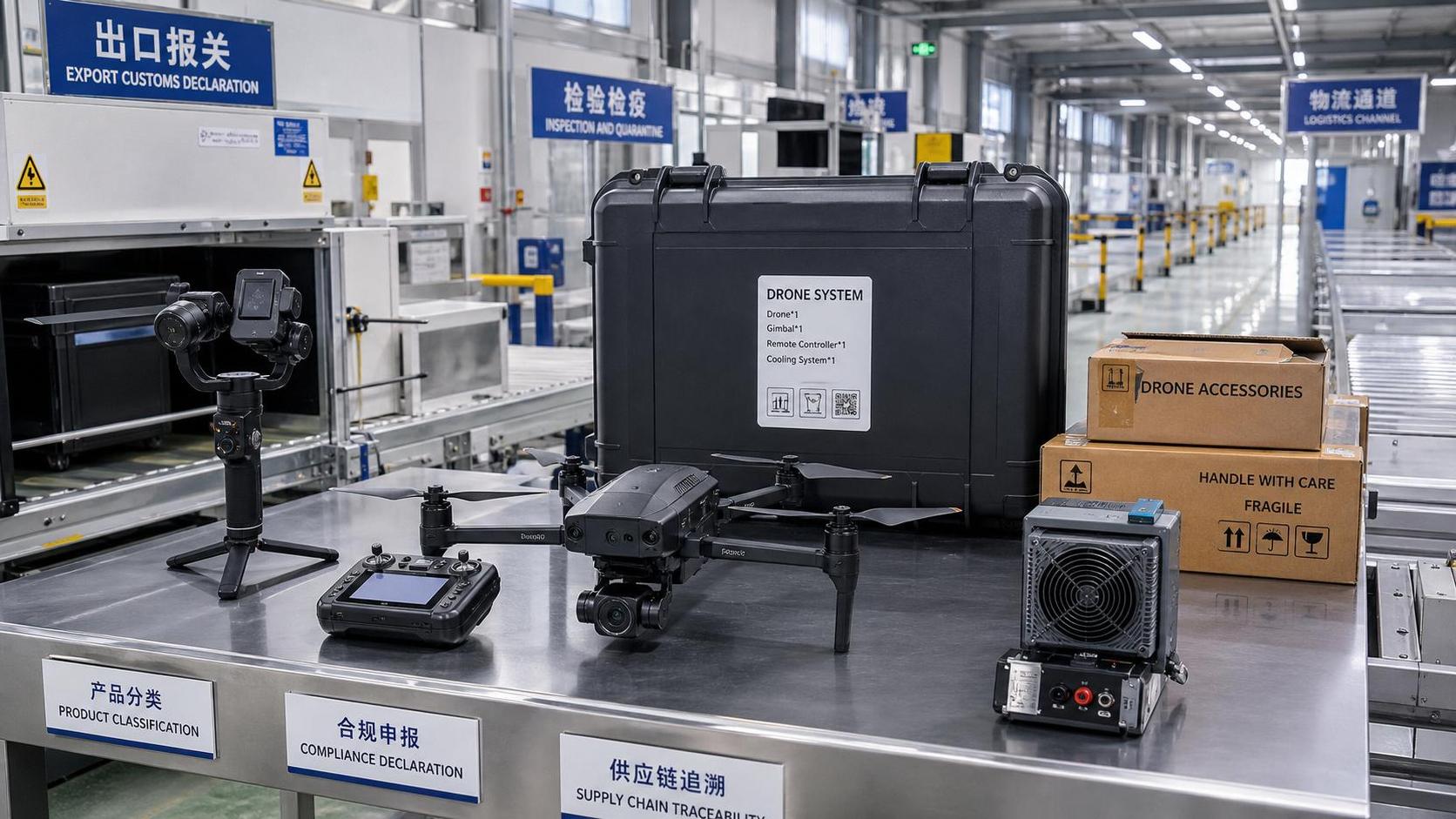
On June 30, 2026, China’s General Administration of Customs introduced a clearer export declaration requirement for drones and related supporting products, requiring the use of precise 10-digit HS codes and full identification of the domestic manufacturer. For exporters, manufacturers, compliance teams, and supply chain service providers dealing with drone systems, pneumatic gimbal stabilizers, industrial remote-control handles, embedded compressed-air cooling modules, and adjacent smart control products, the change is worth close attention because it raises the standard for product classification and traceability at the point of export.
What the new declaration requirement clearly covers
According to the information provided, from June 30, 2026, all drones and related supporting products must be declared for export with an exact 10-digit HS code. Export filings must also include the domestic manufacturer’s full name and unified social credit code.
The scope described in the summary includes drone-related supporting products such as pneumatic gimbal stabilizers, industrial-grade remote-control handles, and embedded compressed-air cooling modules. The same summary states that the rule strengthens traceability management for exports involving advanced smart control systems used in manual or electric tools, as well as industrial pneumatic components.
The information provided also indicates that compliance declarations for newer categories may be affected, including cutting tools with flight-control functions and smart wrenches.
Why the impact extends beyond drone assemblers
Exporters face tighter classification responsibility
From an industry perspective, direct trading companies are likely to feel the impact first because the requirement is tied to export declaration itself. The practical pressure point is not only whether a product can be shipped, but whether the declared 10-digit HS code and manufacturer information are complete and consistent across customs documentation.
Manufacturers need stronger identity linkage in filings
For processing and manufacturing companies, the new requirement means the domestic producer’s name and unified social credit code become a more explicit part of the export record. Analysis shows this may require closer coordination between factories and export-facing entities, especially where production and sales are handled by different parties.
Component suppliers in mixed-use product lines may need closer review
Observably, the products named in the summary are not limited to complete drones. Supporting modules, industrial control accessories, and smart-control-related parts are also relevant. That means suppliers serving both drone and industrial tool applications may need to pay closer attention to how product functions are described and how goods are classified in actual export workflows.
Logistics and customs service providers may see more document checks
For customs brokers and supply chain service providers, the key issue is execution. What deserves closer attention is whether clients can provide complete manufacturer data and accurate product coding before customs filing, particularly for products that sit near the boundary between drone equipment, smart tools, and industrial pneumatic assemblies.
What companies should focus on now
Recheck product mapping against 10-digit HS declarations
Companies involved in export should review whether existing internal product descriptions are detailed enough to support exact 10-digit HS code declaration, particularly for products with integrated control, remote-operation, or flight-control-related functions.
Confirm manufacturer information can be supplied consistently
Because the rule requires the domestic manufacturer’s full name and unified social credit code, businesses should pay attention to whether this information is complete, current, and aligned across contracts, shipping documents, and customs declaration materials.
Watch products at the edge of traditional category lines
The summary specifically points to categories such as cutting tools with flight-control functions and smart wrenches. Analysis shows these are the kinds of products for which compliance risk may come less from ordinary product naming and more from how technical function affects classification and declaration treatment.
Separate confirmed rules from later implementation details
The confirmed fact is the new declaration requirement itself. It is more appropriate to understand questions about filing practice, review intensity, and treatment of borderline categories as areas that still need ongoing observation rather than settled conclusions.
How to read the policy signal at this stage
Analysis shows this development is not just about adding one more data field in export paperwork. It points to stronger traceability expectations around drone-related products and adjacent intelligent control components. At the same time, based on the information provided, it should not yet be overstated as a full redefinition of the entire export environment for all smart tools or industrial control products.
Observably, the most important near-term implication is operational: classification accuracy, manufacturer disclosure, and product-to-factory linkage are becoming more central in export compliance for the covered goods. Whether this later leads to broader practical adjustments across neighboring categories remains something the industry should continue to watch.
A near-term compliance change with longer-term implications
At present, this is best understood as a concrete compliance change that takes effect on June 30, 2026, while also sending a longer-term signal about tighter export traceability for drone-related and smart-control-related products. For the industry, the immediate task is not speculation but document readiness, product classification review, and closer coordination between exporters and domestic manufacturers. The broader significance will become clearer as implementation practice around newer and cross-category products continues to develop.
Basis of this article and what still needs verification
This article is based on the user-provided news title, event date, and event summary. Relevant source types for developments of this kind typically include official notices, company disclosures, industry association updates, authoritative media reporting, and standard-setting documents.
No specific official source link was provided in the input, so the exact wording and any later interpretive guidance still require continued verification. Follow-up attention should focus on whether further official clarification appears on covered product scope, declaration practice for emerging categories, and treatment of products that combine drone, smart control, and industrial tool functions.
Related News