Which technological trends are changing power tools fastest

From AI-driven diagnostics to smarter batteries and connected jobsite ecosystems, technological trends are reshaping power tools at remarkable speed. For researchers tracking industrial innovation, understanding which advances deliver real gains in efficiency, safety, precision, and lifecycle value is essential. This overview highlights the forces accelerating change and what they mean for manufacturers, distributors, and professional users worldwide.
Among all current technological trends, the fastest-changing areas in power tools are battery systems, embedded electronics, connectivity, automation support, and software-led performance optimization. These are not marginal upgrades.
They are changing how tools are designed, sold, maintained, and integrated into industrial workflows. For information researchers, the key question is not which idea sounds modern, but which trend is creating measurable market impact first.
What researchers really need to know about fast-moving technological trends
If you are studying the power tool market, the most important conclusion is clear: electrification and digitalization are now advancing together. Batteries improve runtime and output, while sensors and software improve control, uptime, and asset visibility.
That combination is accelerating product turnover. Manufacturers can now differentiate not only through torque, speed, or ergonomics, but also through charging intelligence, predictive service, user analytics, and platform compatibility across tool families.
In practice, the fastest-changing technological trends are those that affect daily use, fleet economics, and procurement decisions. A breakthrough matters most when it reduces downtime, lowers maintenance burden, improves safety, or supports standardization across teams.
By contrast, some highly visible innovations remain slower to scale. Fully autonomous jobsite robotics, for example, draws attention, but its near-term effect on mainstream portable power tools is still narrower than battery platforms and connected tool ecosystems.
Why battery technology is still the biggest driver of change
Battery innovation remains the single most influential force in modern power tools. Improvements in cell chemistry, energy density, thermal control, and charge management are changing expectations for cordless tools across construction, manufacturing, and maintenance settings.
Five years ago, many heavy-duty applications still favored corded or pneumatic tools. Today, more users expect cordless systems to deliver comparable performance, especially when supported by high-output battery packs and better power electronics.
This shift matters because batteries influence nearly every purchasing variable: runtime, weight, charging speed, portability, safety, and total cost of ownership. When battery performance rises, entire tool categories become candidates for cordless replacement.
Another major trend is platform consolidation. Buyers increasingly prefer battery ecosystems that support dozens of compatible tools. This makes battery strategy a commercial issue, not just an engineering one, because lock-in and cross-selling become more powerful.
Researchers should also watch charging infrastructure. Fast charging, intelligent charging profiles, and battery health monitoring are becoming more important in fleet environments where uptime has direct financial value and uncontrolled charging habits shorten pack life.
Battery sustainability is another emerging layer. Pressure is growing for longer service life, easier recycling, traceable materials, and safer transport compliance. These concerns may not drive first adoption alone, but they increasingly influence institutional buyers and global brands.
How brushless motors and power electronics are raising performance quickly
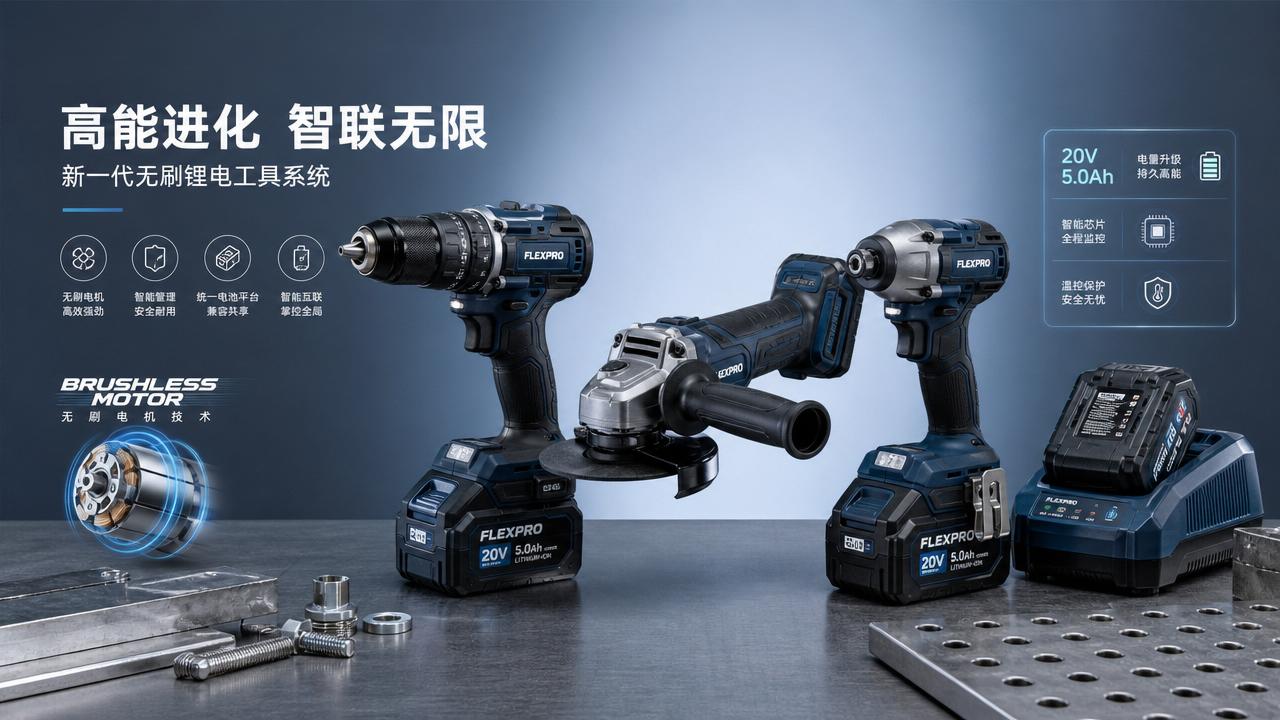
Brushless motor technology is no longer a premium novelty. It has become a core enabler of faster performance gains in power tools because it supports better efficiency, longer life, lower maintenance, and finer electronic control.
When combined with advanced controllers, brushless systems can dynamically adjust power delivery based on load conditions. That helps tools maintain output more efficiently while reducing heat generation and unnecessary battery drain during demanding tasks.
For professional users, the value is practical rather than theoretical. Better motor control can mean cleaner cuts, more stable drilling, reduced kickback risk, and less variation in performance across changing materials and operator habits.
For manufacturers, these advances also create a software layer inside the tool. Once tool behavior depends more on firmware and electronic control, companies gain new ways to differentiate models without redesigning the entire mechanical platform.
This is one reason technological trends in power tools are moving faster than before. Improvements can now come from both hardware and software cycles, which shortens innovation intervals and encourages more frequent product refreshes.
Why connectivity and smart fleet management are gaining strategic importance
Connected power tools are one of the most commercially important technological trends, especially for contractors, industrial maintenance teams, and enterprise buyers managing large distributed tool inventories. Connectivity turns a standalone tool into a trackable digital asset.
Common functions include location tracking, usage monitoring, maintenance alerts, asset assignment, anti-theft controls, and service documentation. These features may seem secondary to raw tool performance, but they often influence procurement at scale.
For a fleet manager, knowing where tools are, how often they are used, and when they need service can produce savings larger than small improvements in torque or speed. Visibility reduces loss, misuse, and avoidable downtime.
For distributors and OEMs, connectivity also creates recurring service opportunities. Tool management platforms, software subscriptions, and data-enabled maintenance programs can extend customer relationships beyond one-time hardware sales.
However, adoption depends on simplicity. Researchers should evaluate whether connected systems are easy to deploy, interoperable across brands or sites, and secure enough for enterprise environments. Connectivity adds value only when the administrative burden stays low.
How AI and onboard intelligence are changing diagnostics and user support
Artificial intelligence in power tools is still developing, but AI-adjacent capabilities are already making an impact. The fastest near-term changes are appearing in diagnostics, performance optimization, and context-aware safety or maintenance support.
For example, tools and batteries can already collect data on load, temperature, cycle count, and abnormal operating patterns. Software can then interpret this data to flag likely failures, identify misuse, or recommend preventive maintenance before breakdown occurs.
In service networks, AI can accelerate troubleshooting by correlating fault patterns across tool populations. That helps manufacturers improve designs, and it helps distributors or repair centers shorten inspection time and parts planning cycles.
Some systems are also moving toward adaptive control. A tool may adjust output to reduce overdriving, overheating, or material damage. While this is not always marketed as AI, it reflects the same broader shift toward embedded intelligence.
For researchers, the key distinction is between marketing language and usable functionality. The most meaningful AI-related technological trends are not flashy autonomous features, but data-driven improvements that reduce service costs and improve operating consistency.
Are safety innovations becoming a faster differentiator?
Yes, especially in professional and industrial applications. Safety features are evolving from passive mechanical protections to active electronic systems that detect hazardous conditions and intervene more quickly than older tool architectures allowed.
Examples include anti-kickback systems, electronic braking, overload protection, restart prevention, vibration reduction, and better dust control integration. These features are increasingly expected in premium segments and are spreading wider over time.
Safety innovation matters because it intersects with regulation, insurance, training, and labor productivity. A safer tool does more than reduce injury risk. It can also lower operator fatigue, reduce error rates, and support compliance in tightly controlled work environments.
In markets facing skilled labor shortages, easier-to-control and more forgiving tools can also shorten learning curves. That gives safety-led design a broader business value than many product comparisons initially reveal.
Researchers should pay attention to which safety features are becoming standard and which remain brand-specific advantages. That distinction often shows where the market is moving from differentiation toward baseline expectation.
How ergonomics and human-centered design are evolving beyond comfort
Ergonomics is sometimes treated as a softer topic, but it is changing quickly and carrying real operational importance. Weight distribution, grip design, vibration control, noise reduction, and balance directly affect productivity during extended use.
As battery systems become more powerful, design teams face a new challenge: increasing output without creating tools that are too heavy or tiring. This has pushed faster innovation in compact packaging, materials engineering, and thermal layout.
Human-centered design also overlaps with digital features. Better interfaces, clearer charge indicators, simpler mode selection, and intuitive alerts reduce cognitive load and support more consistent use across mixed-skill teams.
For enterprise buyers, ergonomic improvements can support labor retention and lower fatigue-related inefficiencies. For individual users, they shape brand loyalty because comfort and control are felt immediately, not only measured in technical specifications.
What role do materials and manufacturing advances play in faster tool evolution?
Not all change in power tools is visible at the user interface. Materials science and precision manufacturing are also accelerating product evolution by improving durability, heat resistance, weight, and component consistency.
Advanced polymers, magnesium alloys, improved gear materials, and more precise machining can extend service life while reducing tool mass. Better sealing and housing design also help tools survive dust, moisture, and vibration-heavy environments.
From a manufacturing perspective, modular design and smarter assembly processes shorten development cycles. This allows companies to update product families faster and customize features for different markets without rebuilding every component from scratch.
For an organization like GHTN, this layer matters deeply because underlying industrial components often determine whether a promising design can scale reliably. Tool performance is shaped not only by headline technology, but by fasteners, housings, bearings, switches, and tolerances.
Researchers assessing technological trends should therefore connect finished products back to supply-chain capabilities. A tool brand can only move quickly when its component ecosystem supports consistency, traceability, and repeatable quality at volume.
Which technological trends matter most for manufacturers, distributors, and professional buyers?
The answer depends on where each stakeholder captures value. Manufacturers should focus on battery ecosystems, software-enabled differentiation, and supply-chain readiness, because these determine both product competitiveness and margin structure.
Distributors should prioritize trends that affect aftersales service, fleet management, compliance questions, and platform expansion opportunities. Connected systems and battery compatibility often shape long-term account growth more than isolated single-tool specifications.
Professional buyers should evaluate trends through lifecycle economics. The best innovation is not always the newest one, but the one that improves uptime, reduces training friction, simplifies inventory, and performs reliably in actual site conditions.
For all three groups, interoperability is becoming a central filter. Tools, batteries, chargers, accessories, software, and service systems increasingly need to function as a coherent ecosystem. Fragmented innovation creates friction; integrated innovation creates adoption.
How to judge whether a trend is truly changing the market fast
Not every innovation deserves equal attention. A useful evaluation framework begins with five questions: Does it improve measurable productivity? Does it reduce downtime? Does it spread across multiple tool categories? Is it economically scalable? Does it influence procurement behavior?
If the answer is yes across most of those criteria, the trend is likely moving the market quickly. Battery innovation and connected fleet management currently score highly because they affect performance, standardization, and ownership economics at the same time.
Researchers should also compare adoption signals across regions and segments. Some technologies scale first in premium contractor markets, while others emerge in industrial maintenance, regulated facilities, or OEM assembly environments with different decision drivers.
Finally, watch ecosystem behavior rather than isolated product launches. The fastest-moving technological trends usually trigger changes in training, accessories, service models, dealer strategy, and even component sourcing. That broader ripple effect is often the clearest sign of real transformation.
Conclusion: the fastest-changing trends are the ones linking power, data, and lifecycle value
The power tool sector is evolving fastest where electrification, electronics, and digital intelligence intersect. Smarter batteries, brushless systems, connected asset management, embedded diagnostics, and active safety features are reshaping both product design and buyer expectations.
For information researchers, the most useful perspective is practical: focus on the technological trends that create visible gains in uptime, safety, control, and total lifecycle value. Those are the trends moving from innovation to market standard most rapidly.
In that sense, the future of power tools is not defined by one breakthrough alone. It is being built through tighter integration between precision components, advanced power systems, intelligent controls, and service-aware ecosystems.
That is where the fastest change is happening today, and where manufacturers, distributors, and professional users will continue to find the strongest competitive signals tomorrow.
Related News