
CITIC Heavy Industries Tests 60-Ton Feed Chute Trailer

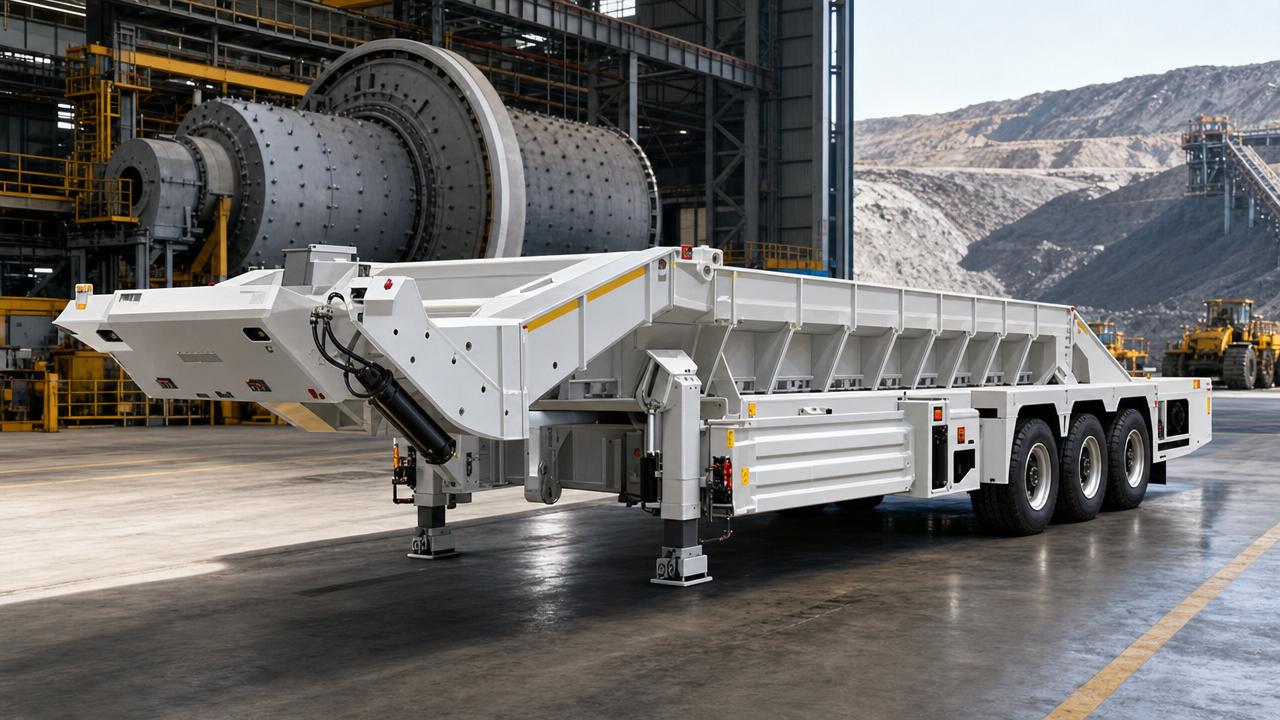
On June 10, 2026, attention in mining equipment, industrial procurement, and cross-border project delivery turned to CITIC Heavy Industries after the company completed full-machine testing in early June in Luoyang for a self-developed 60-ton feed chute trailer. The development matters not simply as a product update, but because it combines 100% localization of core components with export delivery for an Australian gold mine, highlighting how Chinese heavy equipment suppliers are moving into highly specialized mining maintenance applications that must meet overseas technical and safety requirements.
What has been confirmed so far
CITIC Heavy Industries completed full-machine testing in Luoyang in early June 2026 for its self-developed 60-ton feed chute trailer. According to the provided information, the equipment achieves 100% localization of core components and breaks a long-standing dominance of comparable products from Germany and the United States.
The trailer is set to be exported to an Australian gold mine, where it will be used for liner replacement work on semi-autogenous grinding mills and ball mills. The equipment is described as meeting ISO 14122-3 platform safety requirements and AS 2550.1 crane load standards.
The provided summary also states that, for global mining equipment importers, this result indicates that Chinese heavy equipment manufacturers can now deliver specialized equipment for complex working conditions in line with Australian, U.S., and European standards. Compared with comparable overseas products, delivery time is said to be 35% shorter, and the equipment supports remote diagnostics and modular maintenance.
Why this development matters across the supply chain
For mining equipment importers, supplier evaluation may widen
From an industry perspective, importers and project procurement teams may view this development as a sign that supplier selection for specialized mining service equipment is becoming less concentrated. The immediate business impact is likely to be seen in tender screening, technical qualification review, and lead-time comparison, especially where overseas projects require compliance with specific safety and load standards.
What deserves closer attention is whether importers begin placing greater weight on delivery flexibility, maintainability, and remote support capability alongside conventional performance checks.
For mine operators, maintenance support becomes part of the decision
For end users such as mine operators, the reported application is not general bulk handling but liner replacement work for SAG and ball mills, a task linked directly to shutdown planning and maintenance execution. Analysis shows that procurement decisions in this category may increasingly consider how equipment serviceability, modular maintenance, and remote diagnostics can reduce coordination pressure during maintenance windows.
The practical impact is likely to fall on maintenance planning, spare-parts strategy, and service response expectations rather than on headline equipment specifications alone.
For manufacturers and integrators, standards compliance becomes more visible
For equipment manufacturers, engineering contractors, and system integrators, the notable point is not only localization of components but the stated ability to deliver against ISO 14122-3 and AS 2550.1 in an export scenario. Observably, this raises the importance of technical documentation, design verification, and communication around standards-based delivery in overseas business development.
The relevant business links include bid preparation, compliance review, customer acceptance preparation, and after-sales support design.
For supply chain service providers, delivery promises need stronger backing
For logistics, service, and aftermarket partners, a shorter quoted delivery cycle and support for remote diagnostics imply that delivery assurance is no longer limited to shipment timing. Analysis shows that supporting roles may need to pay closer attention to documentation completeness, modular spare-part coordination, and post-delivery service interfaces when working on specialized export equipment.
What companies should watch next
Track how standards-based delivery is communicated
Companies following this segment should pay close attention to how future official disclosures describe compliance with Australian, U.S., and European standards in actual export projects. The key issue is not to assume broad equivalence from a single case, but to watch how standards alignment is presented in technical, commercial, and acceptance contexts.
Focus on the export use case, not only the localization claim
The 100% localization of core components is important, but in practical business terms the export use case is equally important. Procurement teams, distributors, and project suppliers should look at how specialized equipment for complex mine-site maintenance work is positioned, because that affects qualification thresholds, service expectations, and communication with overseas clients.
Compare lead time with service readiness
The provided information states that delivery time is 35% shorter than comparable overseas products. What deserves closer attention is whether shorter lead time is matched by clear arrangements for remote diagnostics, modular maintenance, and documentation support, since these factors directly affect buyer confidence in cross-border delivery.
Prepare for more detailed customer due diligence
Suppliers and service partners in related categories should be ready for deeper customer checks on component sourcing, compliance files, maintenance planning, and fulfillment capability. In this type of equipment trade, commercial opportunity and documentation burden often rise together.
How this should be interpreted at this stage
Analysis shows that this development is better understood as a strong industry signal rather than a final market conclusion. The confirmed facts point to progress in localized manufacturing, standards-oriented export delivery, and specialized mining maintenance equipment capability. However, one successful full-machine test and one export application do not by themselves establish a broad market shift.
Observably, the reason the industry should keep watching is that the case sits at the intersection of three issues that matter to global buyers: technical substitution in specialized equipment, compliance with overseas standards, and delivery plus service responsiveness. Whether this becomes a repeatable pattern will depend on how similar products perform in subsequent international projects.
What this news indicates for the market
At present, it is more appropriate to understand this news as evidence that Chinese heavy equipment suppliers are moving further into exportable, standards-conscious, special-purpose mining machinery rather than as proof of a fully reshaped competitive landscape. The immediate significance lies in buyer confidence, supplier evaluation, and the visibility of alternative sourcing options for complex maintenance equipment.
For industry participants, the main takeaway is not to overstate the result, but to recognize that delivery capability, standards compliance, and service design are becoming as important as manufacturing substitution in this category.
About the basis of this article
This article is based on the user-provided news title, event date, and event summary. For reporting of this type, commonly relevant source categories may include official company announcements, corporate disclosures, industry association information, authoritative media reports, and documentation from standards organizations. A specific official source link was not provided in the input, so further verification remains necessary. Areas worth continued monitoring include any subsequent official project updates, export delivery milestones, and additional disclosures related to standards compliance, remote diagnostics, and modular maintenance implementation.