
Injection Molding Technical Analysis Behind Sink Mark Defects

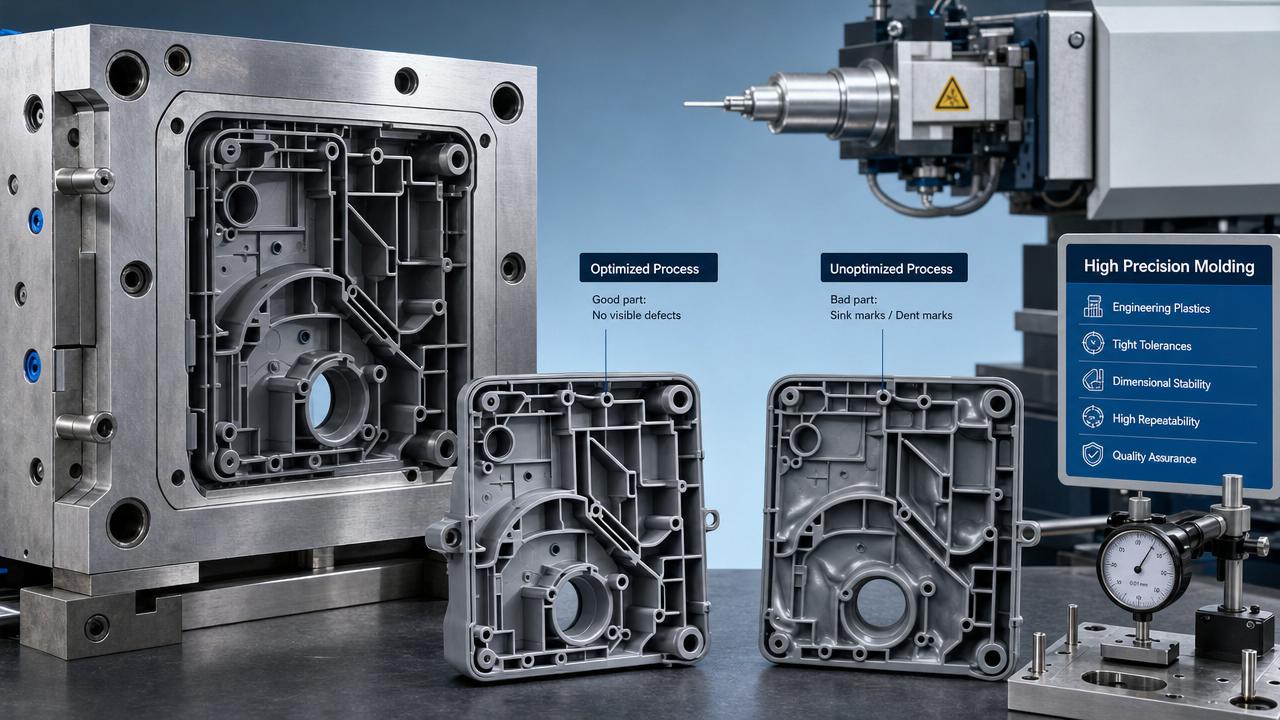
Sink marks are more than cosmetic flaws—they often reveal weak links in part geometry, resin behavior, cooling balance, and machine setup.
This injection molding technical analysis explains why sink marks matter more today, especially in industrial components requiring dimensional stability, strength, and traceable quality.
Across hardware, electrical, and mold-related sectors, defect tolerance is narrowing. Surface quality now connects directly with assembly fit, sealing performance, and long-term reliability.
A precise injection molding technical analysis helps expose hidden process drift early, reducing rework, warranty exposure, and safety risks in demanding manufacturing environments.
Why sink mark defects are becoming a stronger process signal
Sink marks typically appear as shallow depressions above thick sections, ribs, bosses, or internal mass concentrations.
In older quality systems, they were often treated as appearance defects. That view is now too narrow.
Today, sink marks often indicate inconsistent volumetric shrinkage, insufficient packing pressure, poor thermal control, or design imbalance.
For industrial products, these conditions can also signal variation in wall density, internal stress, and local stiffness.
This is why injection molding technical analysis increasingly treats sink marks as a leading indicator, not an isolated visual issue.
Current manufacturing shifts are exposing sink mark risks earlier
Several industry changes are making sink marks easier to detect and harder to ignore.
- Lighter part designs use thin walls with localized reinforcement, increasing shrinkage contrast.
- Higher recycled content can widen viscosity and shrinkage variation between production lots.
- Tighter cosmetic standards expose minor depressions once hidden by texture or geometry.
- Automated inspection systems identify subtle contour defects more consistently than manual checks.
- Complex molds with hot runners and multiple cavities increase balancing challenges.
As a result, injection molding technical analysis now supports not only troubleshooting, but also early-stage risk prediction.
The root causes behind sink marks rarely come from one variable
A useful injection molding technical analysis separates causes into design, material, tooling, and process domains.
Key drivers and how they create visible sink
Most sink defects emerge from interaction between these variables, rather than from one incorrect setting alone.
Design decisions are still the strongest hidden trigger
Part geometry governs how heat leaves the polymer and how shrinkage accumulates inside the cavity.
When bosses or ribs exceed recommended ratios, the outer skin freezes first while the core remains molten longer.
As the inner mass contracts, the surface gets drawn inward, creating the classic depression.
A reliable injection molding technical analysis therefore reviews wall transitions, corner radii, support structures, and nominal thickness consistency.
- Rib thickness should remain controlled relative to adjoining wall sections.
- Bosses should avoid isolated mass buildup without coring or relief features.
- Abrupt thickness changes should be replaced by gradual transitions.
- Decorative texture should never be used to hide structural instability.
Process windows are tightening as materials and applications evolve
Process settings still matter greatly, but the acceptable window is narrower than before.
A small drop in hold pressure, a slight gate freeze shift, or unstable melt temperature can produce visible sink marks quickly.
This is especially true for engineering plastics, mineral-filled grades, and high-precision industrial housings.
Common process-side causes observed in injection molding technical analysis
- Hold pressure too low to compensate post-fill shrinkage.
- Hold time ending before the gate fully seals the section.
- Melt temperature too high, increasing volumetric contraction.
- Mold temperature too high in local zones, delaying skin formation.
- Injection speed causing imbalance between cavity fill and packing response.
- Cushion inconsistency or check ring wear affecting repeatable pressure transfer.
These issues show why machine capability, maintenance condition, and process discipline all influence final defect outcomes.
The impact extends beyond appearance into function and business continuity
Sink marks can reduce confidence in dimensional accuracy, even when parts still pass basic visual standards.
In sealing interfaces, electrical covers, tool housings, and molded structural supports, local shrinkage may change contact behavior.
Repeated sink-related adjustments can also destabilize cycle time, scrap rates, and cavity balance across long production runs.
From a broader industrial perspective, injection molding technical analysis helps connect defect patterns with uptime, compliance, and total manufacturing cost.
Where sink marks create broader operational risk
- Assembly lines requiring repeatable fit and snap performance
- Electrical parts where enclosure flatness affects protection performance
- Tooling components needing stable geometry under repeated load
- Visible hardware parts where branding depends on premium finish
What deserves closer monitoring in the next production cycle
An effective response starts with focused monitoring, not random parameter changes.
- Track part weight variation across cavities and time intervals.
- Compare actual hold pressure profile with machine setting values.
- Measure gate freeze timing instead of assuming nominal behavior.
- Map mold surface temperature near ribs, bosses, and thick sections.
- Review resin drying records and lot-to-lot consistency data.
- Inspect screw, barrel, nozzle, and non-return valve wear.
- Recheck wall ratios during design revisions or tooling modifications.
This structured injection molding technical analysis reduces guesswork and accelerates root-cause confirmation.
A practical way to judge correction priorities
The stronger outlook is preventive, data-based, and cross-functional
The future direction is clear: sink mark control is moving from reactive adjustment to predictive process governance.
That means linking mold design review, CAE validation, machine data, inspection feedback, and maintenance records into one decision loop.
For industrial sectors served by GHTN, this approach supports better tooling decisions, stronger component consistency, and faster technical alignment across global supply chains.
If sink marks appear repeatedly, begin with a disciplined injection molding technical analysis instead of isolated trial-and-error changes.
Review geometry, validate gate freeze behavior, confirm packing transfer, and measure cooling balance. Those steps turn a visible defect into a useful process signal.
For deeper industrial insights on molds, hardware components, and precision manufacturing trends, GHTN continues to connect technical detail with practical manufacturing judgment.
Related News