
Medical Mold Release Agents: Documentation and Residue Validation Requirements

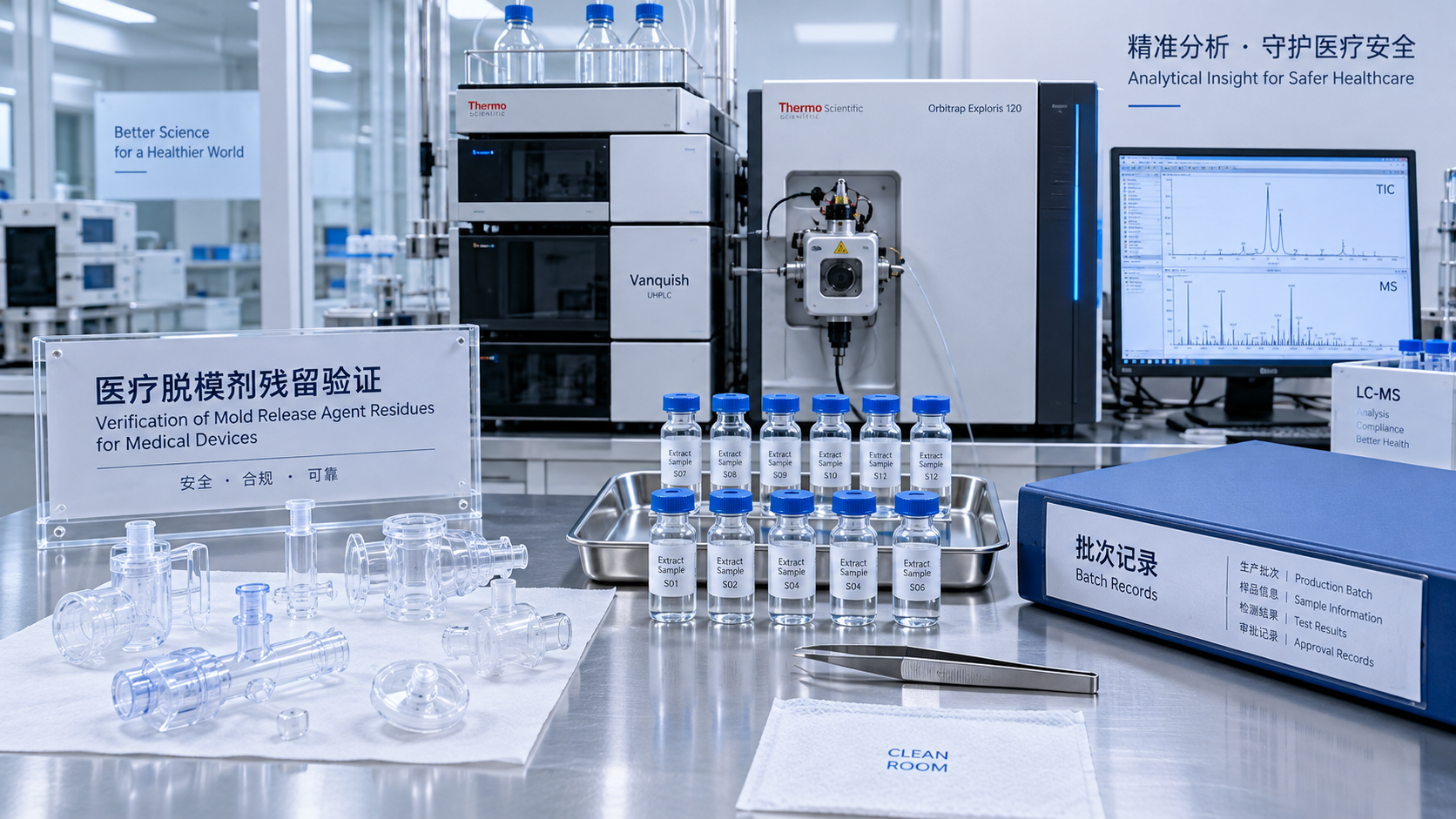
A mold release agent is not suitable for medical manufacturing simply because its supplier labels it “medical grade.” Suitability depends on what transfers to the component, what remains after downstream processing, and whether that residue is acceptable for the finished device’s patient-contact conditions. A supplier’s certificate can support an evaluation, but it cannot replace evidence from the actual materials and manufacturing process.
The practical requirement is a traceable chain from formulation information to residue characterization, toxicological assessment, and production controls. Selecting a medical compliant mold release therefore means defining an approved use—not granting the chemical unrestricted acceptance across every medical component, molding condition, or cleaning process.
What standards establish—and what they do not certify
There is no universal “medical mold release” certification that establishes suitability for all medical devices. The relevant requirements arise from the device’s regulatory framework, biological safety evaluation, risk management, and manufacturing quality system. Their application depends on the target market and the device’s intended use.
ISO 13485 provides a quality-management framework for medical devices, including purchasing controls, production controls, and process validation where applicable. Certification to this standard does not prove that a particular release-agent formulation is biologically acceptable. The certificate’s scope also matters: certification covering one manufacturing site or activity should not be assumed to cover every product supplied by the organization.
ISO 14971 provides the framework for managing medical-device risks. Release-agent residues can enter that assessment as chemical hazards, contributors to particulate contamination, or causes of functional failure. ISO 10993-1 provides the framework for biological evaluation within a risk-management process; ISO 10993-18 addresses chemical characterization, while ISO 10993-17 addresses toxicological risk assessment of medical-device constituents. These standards support a reasoned evaluation, not a universal residue limit.
A report citing USP Class VI or selected ISO 10993 tests must be read in context. It establishes results for a specified test article, preparation, extraction condition, and set of endpoints. It does not automatically establish the safety of residues deposited on a different polymer, exposed to molding temperatures, cleaned differently, and incorporated into a finished device.
Similarly, food-contact statements, REACH declarations, or RoHS declarations answer particular regulatory questions. None is a substitute for evaluating patient exposure to manufacturing residues. Applicable editions and regulatory recognition of standards should be established for the intended market rather than inferred from a supplier’s brochure.
The supplier documentation must support chemical traceability
A safety data sheet is necessary for handling and occupational safety, but it is not a complete formulation disclosure. Ingredients may be omitted because they are not subject to disclosure requirements, appear below relevant thresholds, or are protected as confidential information. An SDS alone may therefore leave important gaps in a biological safety assessment.
The documentation package should identify both the supplied product and the chemistry reasonably expected to remain on the molded component. Carrier evaporation does not establish removal of lubricants, film-forming ingredients, surfactants, or other additives.
Composition information should be detailed enough to select analytical targets and assess detected substances. Depending on the formulation and processing conditions, this may include impurities, residual solvents, or potential degradation products. Where disclosure remains incomplete, the gap must be addressed through additional characterization, a justified assessment strategy, or selection of a better-documented material.
Documentation also needs version control. Each production lot should be linked to the approved product grade and the applicable specification, rather than only to a supplier name. Distributor repackaging, dilution, or substitution can undermine this link unless those activities are controlled.
Define the exposure pathway before setting a residue limit
The first technical question is not “How many parts per million are allowed?” It is “How could this residue reach the patient or affect the device?” A release agent used on an external housing has a different risk profile from one used on a fluid-path component, mucosal-contact part, or implantable component.
The assessment should distinguish direct contact from indirect transfer. Residue on a component without direct patient contact can still matter if it migrates into a delivered fluid, transfers during assembly, or contaminates an adjacent patient-contacting surface. An enclosed location is not, by itself, evidence that exposure is impossible.
Contact duration, exposure route, number of components used, and repeated use affect the assessment. Relevant patient populations also matter where their characteristics alter the safety evaluation. These factors determine which chemical and biological evidence is needed; they should not be replaced by a generic classification of the release agent as “non-toxic.”
Acceptance criteria should connect measured residue to justified exposure. A limit expressed in micrograms per component may be more useful than a bulk concentration when exposure depends on the number of components used. A surface-area limit can be appropriate when transfer depends on the contacting area. Whichever unit is selected, the calculation must account for the relevant device configuration and use conditions.
There is no single acceptable residue concentration for every release-agent chemistry. A toxicological assessment may derive an allowable exposure for identified constituents, accounting for route, duration, uncertainty, and other relevant exposures. Separate controls may be necessary for particles, local tissue effects, or device performance. Pharmaceutical cleaning rules such as a blanket “10 ppm” limit should not be imported without a device-specific justification.
Measure residue on representative processed components
Testing the release agent as supplied cannot establish the residue profile on a molded part. Molding can change what transfers and what remains: volatile ingredients may evaporate, other constituents may concentrate at the surface, and thermal exposure may generate different chemical species. Polymer absorption can also make removal and recovery more difficult.
A sampling strategy should represent the conditions capable of producing the greatest relevant residue or exposure. These may include the maximum permitted application amount, the shortest permitted drying interval, repeated application and mold-film buildup, difficult-to-clean geometry, and the least effective permitted cleaning conditions. The choices should be supported by process knowledge or preliminary measurements, not selected solely because a sample is convenient to collect.
Samples should reflect the finished-device condition relevant to exposure. If subsequent assembly, sterilization, or aging can change the residue profile or its release, that effect needs consideration. Intermediate samples remain useful for locating contamination sources, but they do not necessarily represent what reaches the patient.
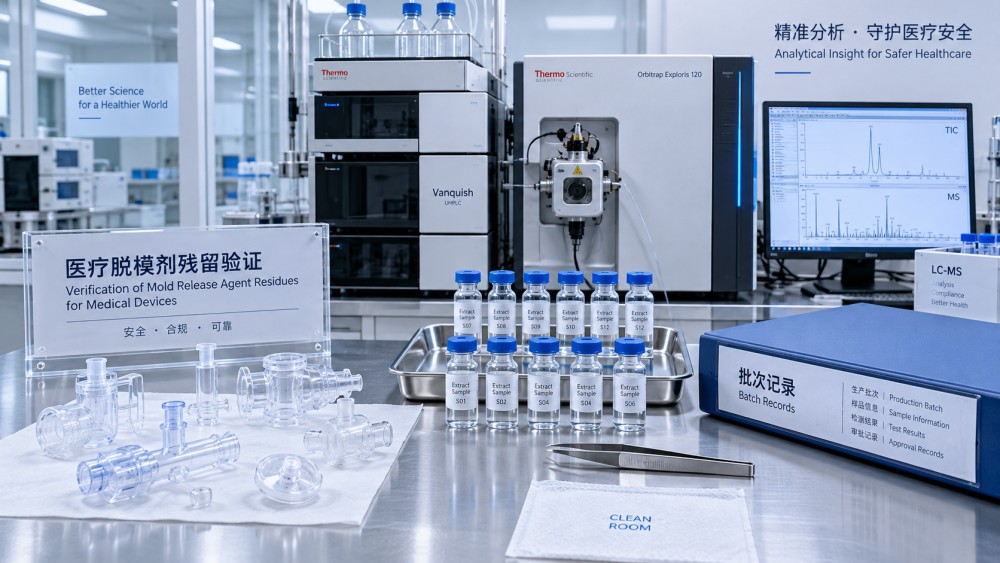
Analytical methods must match the expected chemistry and the decision being made. Gas chromatography–mass spectrometry can address suitable volatile and semivolatile compounds; liquid chromatography–mass spectrometry can address suitable less-volatile organic constituents. Elemental analysis, infrared spectroscopy, surface analysis, or particle measurements may answer other formulation-specific questions.
A broad cleanliness measure is not automatically a residue-specific method. Total organic carbon can indicate organic contamination under suitable conditions, but cannot identify individual compounds. Gravimetric nonvolatile residue measurements can quantify collected material but may lack sufficient sensitivity or chemical discrimination. Water contact angle can reveal a surface change without establishing its chemical identity or toxicological significance.
Method suitability should address specificity, detection and quantification limits, accuracy, precision, recovery, and the sample matrix. Recovery is particularly important for swabbing, rinsing, or extraction: a low result may reflect poor collection rather than a clean component. Laboratory blanks, solvent blanks, and untreated-component controls help separate release-agent residues from polymer additives and background contamination.
“Not detected” is meaningful only with a stated detection limit and a suitable method. If that limit exceeds the acceptance criterion, the result cannot demonstrate compliance. Likewise, an analytical evaluation threshold used to guide identification under a chemical-characterization strategy is not itself a toxicological pass/fail limit.
Cleaning validation must demonstrate removal—not just a clean appearance
If cleaning is necessary to achieve acceptable residues, the cleaning process becomes part of the safety justification. Its validation should show that the defined process consistently meets approved criteria under justified challenging conditions. Visual inspection can identify gross contamination, but cannot establish removal of an invisible silicone film or low-level organic residue.
The protocol should define the relevant operating ranges: detergent concentration, temperature, contact time, mechanical action, loading, rinse conditions, and drying. The interval between molding and cleaning can also matter when residues cure, spread, or become harder to remove. If parts are cleaned in batches, load configuration and access to recessed surfaces need consideration.
Validation should include the contamination introduced by cleaning itself. Removing mold release while leaving detergent or rinse contaminants does not establish an acceptable finished component. A process may also alter the polymer surface, dimensions, bonding performance, or other functional characteristics, even when residue removal is effective.
Sterilization must not be assumed to perform this cleaning function. A sterilization process establishes microbial inactivation under its validated conditions; it does not automatically remove chemical residues. Where it changes residue chemistry, the resulting substances and their exposure implications require assessment.
Residue control must also protect device performance
Biological acceptability is only one acceptance condition. A release film can interfere with adhesive bonding, coating adhesion, printing, welding, optical performance, or sealing. A residue amount that satisfies a toxicological criterion may still cause functional failure.
Consequently, the approved limit may be governed by the more restrictive of a biological criterion and a performance criterion. For a bonded assembly, analytical evidence should be connected to bond performance under relevant conditions. For a fluid-path component, transfer into the contacting fluid may be more informative than measuring only the total material remaining on the surface.
This distinction also prevents inappropriate reliance on “silicone-free” or “water-based” descriptions. Neither establishes low transfer, easy removal, or biological safety. A water-based formulation can leave nonvolatile additives; a silicone-free formulation can still compromise downstream operations.
Approval remains valid only within the controlled process
The approval record should connect the exact product grade, component material, application method, process limits, cleaning conditions, analytical methods, acceptance criteria, and supporting assessment. Operators need enforceable instructions for application quantity or frequency, drying, and reapplication. An undefined instruction such as “apply as needed” makes the validated residue condition difficult to maintain.
Routine monitoring should follow the demonstrated risks and process capability. It may combine application controls, cleaning-parameter records, periodic residue testing, and relevant functional checks. Validation does not necessarily require chemical analysis of every lot, but reduced testing needs a documented basis and controls capable of detecting drift.
A formulation change, new resin, altered mold temperature, revised cleaning chemistry, or different patient-contact application can invalidate parts of the original justification. Change assessment should identify the affected evidence and determine whether targeted testing or broader revalidation is necessary.
The defensible endpoint is not a supplier’s “medical compliant” statement. It is an approved, traceable use in which the remaining residue has been characterized adequately, assessed against relevant exposure and performance requirements, and controlled through production conditions that preserve that conclusion.
Related News
- Micron-level precision in molds: when tighter tolerances backfireTime : Apr 29, 2026
- North American Moldmaker Rankings: Top Five Sales Fall 9.3%, Smaller Firms Hold SteadyTime : Oct 27, 2026
- Which Mould Steel Is Best for High-Volume Injection Moulding?Time : Oct 29, 2026