
Mold design choices that quietly increase rework rates

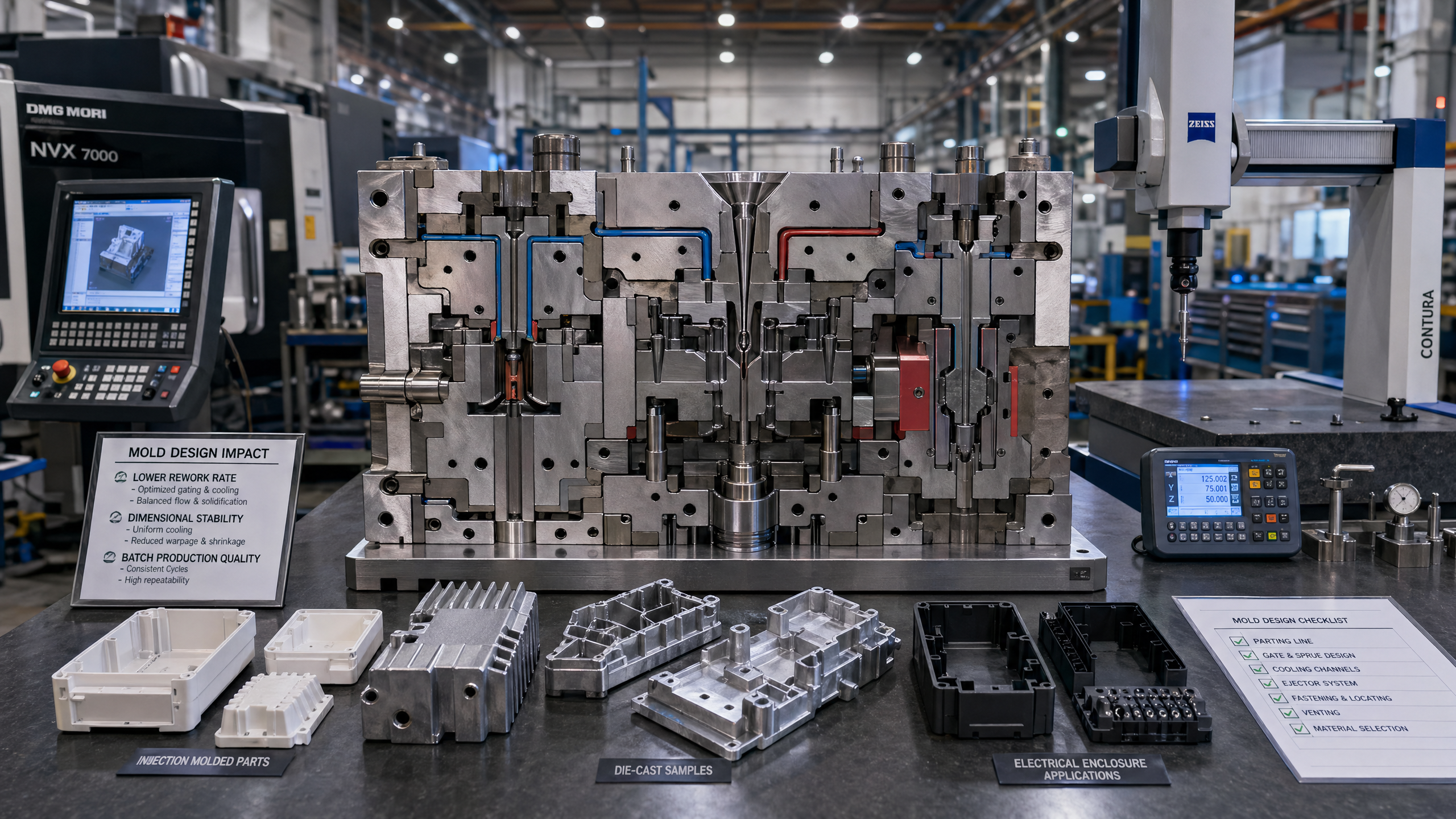
Small mold design decisions often look harmless at review stage, yet they can quietly drive rework, scrap, and delivery risk across injection molding and die casting programs. This technical analysis explores how mold design choices affect precision engineering, industrial automation, fasteners integration, mechanical tools performance, and even adjacent electrical components, helping buyers, engineers, and decision-makers identify hidden cost triggers before they scale.
Why do minor mold design choices create major rework rates later?
Many rework problems do not start on the shop floor. They start in the mold design phase, often with decisions that look efficient during a 30-minute design review but become expensive across a 12-week tooling schedule. A draft angle reduced by 0.5°, a gate moved for cosmetic reasons, or a cooling channel simplified to save machining time can all increase part distortion, flash, sink, mismatch, or unstable cycle performance.
The reason these issues remain hidden is simple: mold design is a system decision, not an isolated drawing task. One feature affects melt flow, venting, ejection force, insert wear, machining access, and maintenance frequency at the same time. In injection molding and die casting, rework often appears only after T1 or T2 trials, when steel changes become slower, tooling access is restricted, and dimensional correction windows narrow from millimeters to tenths or even hundredths.
For OEM buyers, project managers, and technical evaluators, this means rework rates should not be treated only as a production issue. They are a design governance issue. In many industrial sectors, a mold that misses its first-pass capability target by just 10% to 15% can create cascading effects across assembly tools, fastener fit, robotic pick-up points, inspection gauges, and downstream electrical enclosure integration.
Which design decisions are most often underestimated?
The most underestimated choices are usually the least visible in early discussion. Teams focus on cavity count, steel type, or quoted lead time, but rework is more often driven by local geometry transitions, cooling balance, vent depth, ejection layout, parting line placement, and insert interface strategy. These are not small details in operational terms. They define process stability over thousands or hundreds of thousands of cycles.
- Insufficient draft on textured or deep-wall features, which increases drag marks and ejection stress.
- Uneven wall thickness transitions above typical 15% to 25% variation, which raise sink and warpage risk.
- Gate locations chosen for convenience rather than flow balance, causing weld lines in load-bearing zones.
- Cooling circuits designed around drilling simplicity rather than thermal uniformity, extending cycle time by 10% to 20%.
- Venting kept too conservative, resulting in gas trapping, burn marks, and unstable fill pressure.
In sectors ranging from consumer hardware to industrial control housings, these decisions affect not only molded parts but also how mechanical tools engage, how threaded inserts seat, and how electrical components align with mounting features. That is why mold design review should include manufacturing, quality, and assembly stakeholders rather than design engineering alone.
A quick screening question for cross-functional teams
A useful screening method is to ask whether a design choice improves only one objective or supports at least three objectives at once. For example, a better parting line decision may improve appearance, reduce flash trimming, and simplify inspection datum control. If a proposed shortcut helps tooling cost today but increases trial iterations from 2 rounds to 4 rounds, it is rarely a true saving.
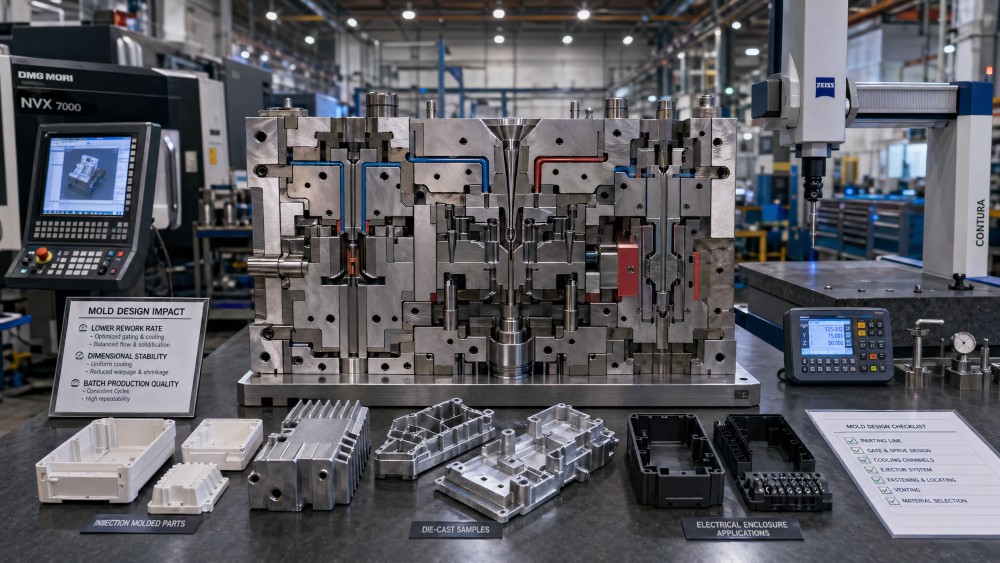
What mold design mistakes most often increase rework in injection molding and die casting?
Injection molding and die casting share a common pattern: rework rises when the mold does not control heat, flow, release, and dimensional repeatability in a balanced way. The visible defect may differ by process, but the design logic behind the failure is often similar. Rework appears as steel modification, hand polishing, vent addition, gate resizing, insert relocation, or repeated process compensation.
The table below summarizes common mold design choices that quietly increase rework rates across broad industrial applications, including housings, brackets, tool handles, electrical covers, connector supports, and precision component carriers.
A practical reading of this table is that rework does not always come from “wrong” design, but from unbalanced design. A mold may run, yet still consume excessive trial hours, fixture correction, secondary trimming, or sorting effort. In high-mix industrial supply chains, that kind of hidden inefficiency damages margins more than one visible defect event.
Are the risks different for precision hardware, electrical parts, and tool-related components?
Yes, but the underlying pattern is linked. Precision hardware parts often fail on fit, concentricity, and insert location. Electrical components and housings are more sensitive to warpage, sealing surfaces, snap fits, and mounting boss position. Tooling-related parts, such as grips, handles, and holders, are more exposed to cosmetic defects, ergonomic mismatch, and structural stress around fastener zones.
In die casting, poor overflow and vent strategy may increase porosity, which later affects machining, thread integrity, coating quality, or pressure tightness. In injection molding, weak cooling control may shift part dimensions outside a typical tolerance band such as ±0.05 mm to ±0.20 mm depending on resin, geometry, and application. Rework then expands beyond molding into drilling, tapping, trimming, or assembly adaptation.
For distributors and procurement teams, this matters because the part may pass a basic visual inspection while still generating line-side adjustment during customer use. That is why mold design should be assessed against application conditions, not only sample appearance.
How can engineers and buyers judge whether a mold design is likely to cause rework?
A useful approach is to evaluate rework risk before tool release using a short, cross-functional checklist. This is especially important for procurement personnel, project leaders, and quality managers who may not design molds directly but must absorb the cost if the tool underperforms. Good evaluation looks at function, process window, maintainability, and downstream assembly compatibility.
Instead of asking only whether the mold can be built, ask whether it can run repeatedly with stable output over the expected production band. For many industrial programs, the meaningful target is not one approved sample, but stable production over 3 shifts, multiple material lots, and preventive maintenance intervals such as every 20,000 to 100,000 cycles depending on tooling class and application intensity.
The following table can be used as a practical question-based review tool during RFQ, DFM review, or tooling kickoff.
This review method is useful across industries because it translates mold design into commercial risk language. It helps technical teams explain to sourcing and management why a lower quote may still produce higher total cost through added tryout rounds, delayed PPAP-style documentation, secondary operations, and field complaint exposure.
What signals during DFM review should raise concern?
Several warning signs appear early if teams know where to look. If draft relief is repeatedly reduced to preserve appearance, if cooling is described only in general terms, if venting is deferred to trial stage, or if core and cavity steel conditions leave minimal room for adjustment, rework probability increases. Another warning sign is when tolerance allocation ignores gate direction, shrink behavior, or insert stack-up.
- No clear plan for datum control between molded geometry and post-machined features.
- Parting line selected mainly for tool simplicity, not flash management or inspection stability.
- Ejection layout concentrated in non-rigid zones that may distort under force.
- Insufficient discussion of material lot variation, filler content, or thermal sensitivity.
When these issues appear together, the result is often not one dramatic failure but repeated low-level corrections. That is exactly how mold design choices quietly increase rework rates without being noticed in the quotation stage.
Which common misconceptions cause teams to approve risky mold designs?
One common misconception is that a mold is acceptable if simulation looks reasonable. Mold flow and thermal analysis are valuable, but they depend on assumptions. If the actual gate freeze behavior, vent maintenance condition, or insert thermal conductivity differs from the model, the real process window may be much narrower than expected. Simulation supports judgment; it does not replace design discipline.
Another misconception is that tighter tolerances automatically improve product quality. In practice, unrealistic tolerances often force repeated tool spotting, selective fitting, or unstable process settings. A better strategy is to tighten only dimensions that directly affect sealing, mating, torque transfer, electrical mounting, or safety-related function. The rest should follow achievable process capability for the chosen material and geometry.
A third misconception is that mold rework is normal and therefore harmless. Some adjustment is expected between T1 and final approval, but there is a major difference between planned tuning and structural redesign. If the tool requires repeated gate relocation, large weld repair, or cooling redesign after initial trials, both cost and schedule risk rise sharply. A 2-week correction can become 6 to 8 weeks once spare parts, validation reruns, and customer resubmission are included.
What is the hidden cost beyond scrap and repair?
The hidden cost often appears outside the molding cell. Assembly teams may add hand fitting. Quality teams may increase inspection frequency from first article checks to hourly containment. Purchasing may need emergency secondary suppliers. Tool maintenance may shorten service intervals. Logistics teams may absorb split shipments because the mold reaches stable output later than planned.
For products integrated with fasteners, pneumatic elements, electrical hubs, or automation fixtures, dimensional instability can force redesign of jigs, torque tools, or robotic grippers. What begins as a mold design compromise can therefore spread into several departments, especially in OEM programs where one delayed component blocks a broader equipment build.
For business evaluators and decision-makers, the lesson is clear: the lowest initial tool cost should be compared against probable rework hours, change-order cycles, launch delay exposure, and maintenance burden over the expected production life.
How should different stakeholders evaluate mold design risk before approving a program?
Different stakeholders do not need the same level of mold theory, but they do need a shared decision framework. Engineers should focus on geometry, flow path, thermal balance, and tolerance stack-up. Operators and users should focus on stability, release behavior, and handling issues. Procurement should examine total cost, not only tool price. Quality and safety personnel should check whether the design supports repeatable inspection and traceable correction.
The most effective project teams align around three stages: pre-tool review, trial validation, and production transfer. At pre-tool stage, key questions include gate concept, cooling logic, vent strategy, steel-safe plan, and service access. During trial validation, teams should review not only appearance but also cycle repeatability, cavity balance, insert seating, and dimensional drift across a minimum sample range such as 30 to 50 consecutive parts where relevant.
At production transfer, stakeholders should confirm whether the mold remains stable under planned machine conditions, material supply variability, and actual maintenance routines. This is especially important when the molded or cast part interfaces with precision tools, threaded hardware, electronic assemblies, or automated handling systems that have limited tolerance for variation.
What should a practical approval checklist include?
- Confirm critical functional dimensions and define which ones require capability focus during sampling.
- Verify draft, parting line, ejection, and venting against both geometry and surface finish needs.
- Review cooling or thermal control around thick sections, bosses, inserts, and sealing faces.
- Check whether fasteners, inserts, clips, or electrical mounting points depend on tight positional repeatability.
- Ask how steel-safe adjustments will be handled if T1 results show warpage, mismatch, or gas-related defects.
- Estimate realistic trial rounds, normally 2 to 4 for standard programs, and define escalation points if this is exceeded.
A checklist like this helps all parties convert technical uncertainty into visible decision points. That improves communication between design, quality, sourcing, and commercial teams and reduces surprise rework after tool completion.
If a company wants fewer mold rework issues, what should it do next?
The first step is to shift the discussion from “Can this mold be made?” to “Can this mold run reliably in the intended application?” That sounds simple, but it changes review behavior. It encourages teams to validate function, process window, maintenance practicality, and downstream integration before steel is cut. Across industrial components, this approach usually saves more than any small reduction in up-front tooling scope.
The second step is to involve technical reviewers who understand not only mold construction but also mechanical tools, fastener interfaces, electrical mounting logic, and automated line requirements. At GHTN, we see repeatedly that hidden mold design risks emerge where component disciplines overlap. A bracket is not only a molded part; it may also be a torque-bearing interface, a sensor mount, a thermal barrier, or a sealing reference.
The third step is to document decisions in a way that supports procurement and project control. If gate location, vent strategy, insert type, cooling method, or tolerance ownership remain vague, later disputes become expensive. Clear review records improve supplier communication and reduce argument over whether rework comes from design intent, manufacturing execution, or changing customer expectations.
Why choose us for mold design insight and industrial component evaluation?
GHTN connects mold design analysis with the broader industrial system around it. Our coverage spans mold manufacturing, mechanical tools, electrical components, fasteners, and precision production logic, which makes our perspective useful for engineers, sourcing teams, distributors, and business decision-makers who need more than a narrow tooling view.
If you need support, you can contact us to discuss parameter confirmation, mold design review priorities, component compatibility, tooling lead time expectations, supplier evaluation points, sample planning, certification-related considerations, or quotation communication. We can also help frame the right pre-launch questions when your project involves precision parts, assembly interfaces, or cross-border sourcing decisions.
For companies trying to reduce rework risk before it spreads into cost, delay, and quality exposure, the right conversation should start early. Contact us to review your application scenario, tolerance concerns, material behavior, tooling assumptions, and commercial targets before minor design choices become major correction programs.
Related News