
Industrial Air Cylinder Uses in Clamping, Material Handling, and Packaging
Industrial air cylinders are well suited to repetitive pushing, clamping, and transferring tasks when machines need straightforward motion between fixed positions at moderate cost.
From holding a workpiece steady during machining to pushing cartons along a packaging line, industrial air cylinder uses span many everyday production and automation tasks.
These pneumatic actuators convert compressed air into linear motion. Their suitability depends on required force, stroke, speed, guidance, and what happens if air pressure disappears.
This guide explains the most useful applications in clamping, material handling, and packaging, with practical selection criteria for engineers, industrial buyers, and information researchers.
Which Tasks Are Best Suited to an Industrial Air Cylinder?
An air cylinder is usually a strong candidate when a mechanism repeats a defined stroke, the load is predictable, and compressed air is available.
Typical movements include extending a locating pin, pressing a component against a fixture, diverting a carton, or raising a small platform between two levels.
Standard cylinders work particularly well when mechanical stops define the final positions. Magnetic switches can confirm piston position, helping a controller sequence the next operation.
However, a piston position signal does not prove that a part is present or securely clamped. Critical processes may require separate workpiece or force verification.
Applications requiring continuously variable positioning, tightly controlled motion profiles, or highly repeatable intermediate stops often justify evaluating electric actuators or specialized pneumatic positioning systems.
For very high forces within a compact actuator envelope, hydraulics may be preferable. The decision should reflect the complete machine requirement, including maintenance and energy.
Clamping: How Air Cylinders Hold Parts During Production
Clamping is among the most common industrial air cylinder uses because many fixtures need repeated engagement and release without complex changes in motion profiles.
In assembly fixtures, cylinders press components against locating surfaces before fastening, inspection, or joining. The fixture establishes alignment while the clamp maintains contact during processing.
For machining applications, cutting forces require particular attention. A cylinder may operate a toggle or wedge mechanism, while fixture supports carry the primary machining loads.
Direct cylinder thrust should not automatically be treated as available holding force. Linkage geometry, contact position, friction, and load direction all influence the result.
Thin sheet, plastic housings, and finished surfaces can deform under excessive pressure. Larger contact pads and suitable pressure regulation help distribute force and limit damage.
For more demanding verification, a force sensor can measure contact force directly. Pressure monitoring alone cannot reliably distinguish correct clamping from every possible obstruction.
Air loss is another design concern. If releasing the workpiece could create a hazard, assess mechanical locking, retained clamping, and other validated protective measures.
Material Handling: Pushing, Lifting, and Transferring Products
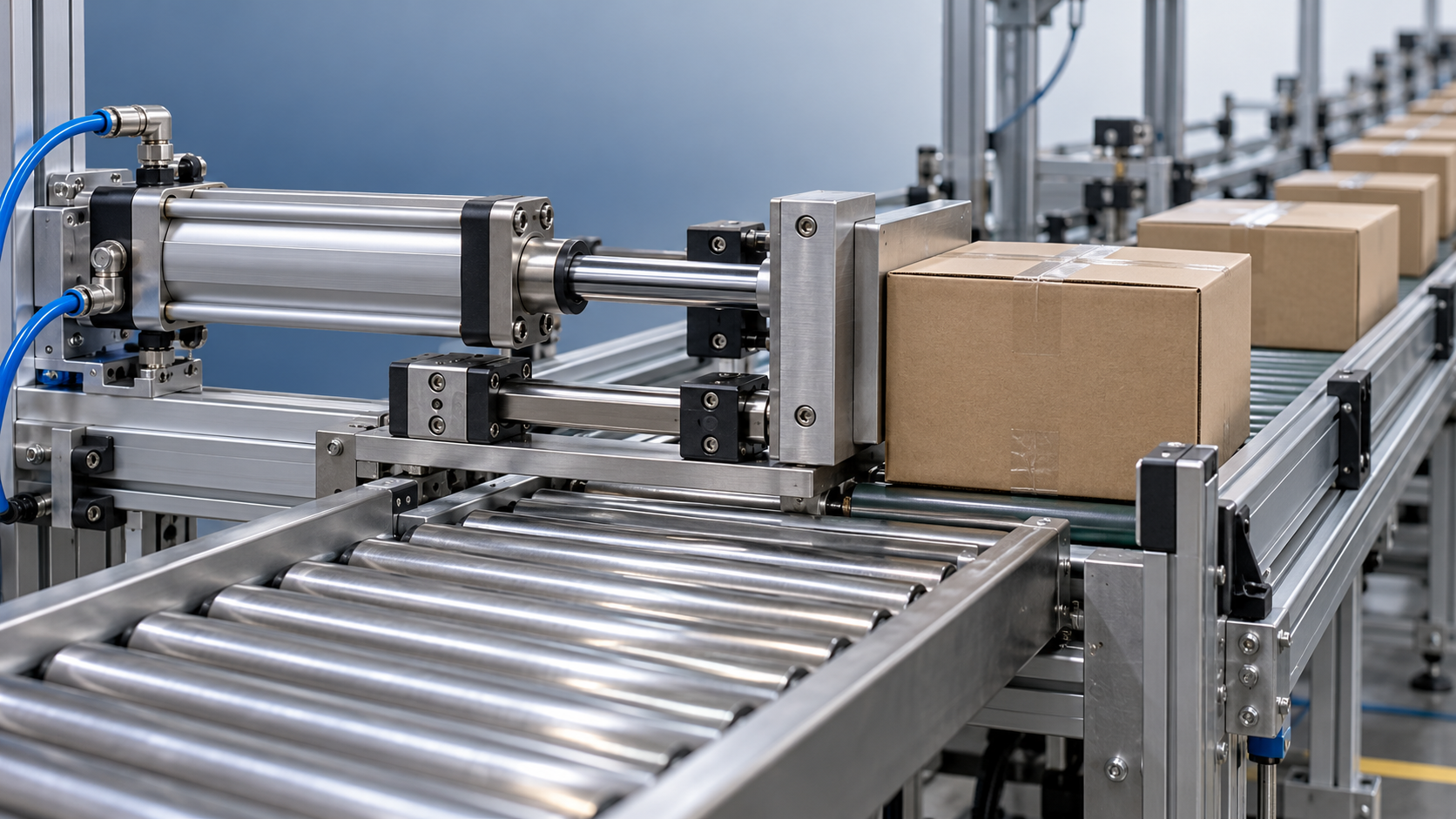
Material handling applications use cylinders to move parts between operations, separate incoming products, operate gates, and transfer items across short distances within automated equipment.
A conveyor pusher, for example, moves a package sideways onto another lane. Its required force depends on package mass, surface friction, acceleration, and possible obstructions.
A cylinder used as a conveyor stop faces a different challenge: resisting incoming impact. Product speed and stopping distance matter alongside the load's weight.
Repeated impact should be handled through an appropriately rated stop mechanism, cushioning, or shock absorber. A standard piston rod should not become an improvised barrier.
Vertical lifting adds gravity to the force calculation. Designers must evaluate upward acceleration, controlled descent, and the consequences of losing pressure while supporting a load.
A rod lock or external holding device may be needed, but suitability depends on its rating, engagement behavior, and the machine's overall safety design.
For transfers carrying offset loads, guided cylinders or external linear rails help resist bending moments. Standard piston rods should primarily transmit axial pushing or pulling force.
Packaging: Where Pneumatic Motion Adds Practical Value
Packaging machinery frequently combines many short, repetitive movements. Air cylinders can operate carton gates, position containers, actuate gripping mechanisms, and move products into nests.
On a carton line, one cylinder may square a box while another folds a flap. Mechanical tooling determines how cylinder motion reaches the packaging material.
In filling equipment, cylinders may raise containers toward nozzles or operate a shutoff mechanism. The complete assembly must suit the product and cleaning conditions.
For sealing jaws, the cylinder can supply closing force while the process separately controls temperature and dwell time. Sealing quality depends on all three factors.
Fragile products require controlled contact speed and force. Fast approach may shorten the cycle, but the final movement must avoid crushing or marking packages.
Packaging changeovers also influence selection. Adjustable stops, accessible sensors, and repeatable tooling settings can make one actuator arrangement practical across several product sizes and formats.
In food or pharmaceutical environments, evaluate cleanability, corrosion resistance, lubricant requirements, and contamination exposure. Stainless construction alone does not establish suitability for every hygienic application.
How Much Cylinder Force Does the Application Need?
Start with the force needed at the workpiece, then account for friction, acceleration, linkage losses, and the minimum pressure actually available at the cylinder.
The theoretical extension force equals gauge pressure multiplied by piston area. Retraction force is lower because the piston rod reduces the effective area on that side.
For example, a 50 mm bore cylinder operating at 6 bar gauge pressure produces approximately 1,178 N of theoretical extension force before practical losses.
That figure comes from 0.6 N/mm² multiplied by approximately 1,963 mm² of piston area. It is a sizing reference, not a guaranteed working output.
Seal friction, exhaust backpressure, and pressure drops reduce usable thrust. Pressure measured at the compressor may exceed the pressure available during a fast cylinder stroke.
Apply an appropriate design allowance using manufacturer guidance and the application's uncertainty. Excessive oversizing increases air consumption and can make gentle product contact harder.
Long compression strokes also require a buckling check. Rod diameter, mounting arrangement, unsupported length, and load alignment determine whether theoretical thrust can be used safely.
Stroke, Speed, and Guidance Often Decide Whether It Works
Choose stroke length from the actual travel requirement, including tooling clearance and installation tolerances. Unnecessary travel increases cycle time, space requirements, and compressed air consumption.
For high cycle rates, evaluate the complete pneumatic circuit. Valve flow capacity, tubing diameter, fittings, exhaust restrictions, and supply stability all affect achievable motion.
Meter-out flow controls commonly regulate speed by restricting exhaust air. Their adjustment should be checked under representative loads, operating pressures, and expected production conditions.
Compressed air is elastic, so motion can change as the load changes. Extremely slow, smooth movement may require additional measures or a different actuator technology.
End cushioning helps absorb energy near the stroke limit, but its capacity is finite. Heavy or fast loads may require externally mounted shock absorbers.
Check the manufacturer's allowable kinetic energy and side-load limits. Cylinder bore alone does not indicate whether an actuator can survive the proposed movement repeatedly.
Guidance deserves equal attention: a wide package, offset gripper, or overhung platform creates moments that should be carried by appropriately rated bearings or rails.
Which Cylinder Configuration Fits Each Application?
Double-acting cylinders use compressed air for extension and retraction, making them suitable for most transfer, clamping, and packaging movements that need powered motion both ways.
Single-acting cylinders use air in one direction and a spring or external load for return. Spring force reduces available output and influences stroke selection.
Compact cylinders suit fixtures with limited installation space. However, a short body does not remove the need to check mounting access, guidance, and load capacity.
Guided cylinders combine linear actuation with a guiding structure. They are useful for lifting plates, pressing tooling, or handling loads that create turning moments.
Rodless cylinders provide travel without an extending piston rod, which can simplify long transfers. Assess carriage moments, sealing design, contamination exposure, and installation space carefully.
Standards such as ISO 15552 and ISO 21287 can support dimensional comparison for relevant cylinder families. Confirm the specific dimensions and specifications before assuming interchangeability.
What Should Buyers Check Beyond Bore and Stroke?
A useful application brief records load, orientation, required force, travel, cycle rate, available pressure, mounting arrangement, environment, and the required behavior during a fault.
Also specify sensor requirements, connector preferences, service access, and expected operating hours. These details help suppliers identify differences that a basic catalog comparison can miss.
Compressed air quality affects reliability. Water, particles, or unsuitable lubrication can damage seals and valves, so filtration and drying should match the component manufacturer's requirements.
For abrasive dust, washdown, high temperatures, or chemical exposure, verify seals, rod materials, protective features, and operating limits against the actual environment before purchasing equipment.
Energy cost depends on bore, stroke, pressure, cycle frequency, and leakage. Compare total air demand across the machine rather than judging efficiency from purchase price.
A well-sized cylinder with maintained seals and appropriate pressure regulation can avoid unnecessary consumption. Reliable spare parts and accessible maintenance also influence lifetime operating cost.
Making a Sound Application Decision
The strongest industrial air cylinder uses combine repetitive motion, predictable loads, and clearly defined end positions. Clamping, short transfers, and packaging mechanisms often meet those conditions.
Successful selection requires more than matching bore and stroke. Confirm working force, guidance, impact capacity, air supply, environmental suitability, and safe behavior when pressure disappears.
When those requirements are clear, researchers and buyers can compare cylinder options meaningfully, recognize when another actuator fits better, and ask suppliers more useful technical questions.