
TÜV Rheinland 2026 Pneumatic Components Efficiency White Paper

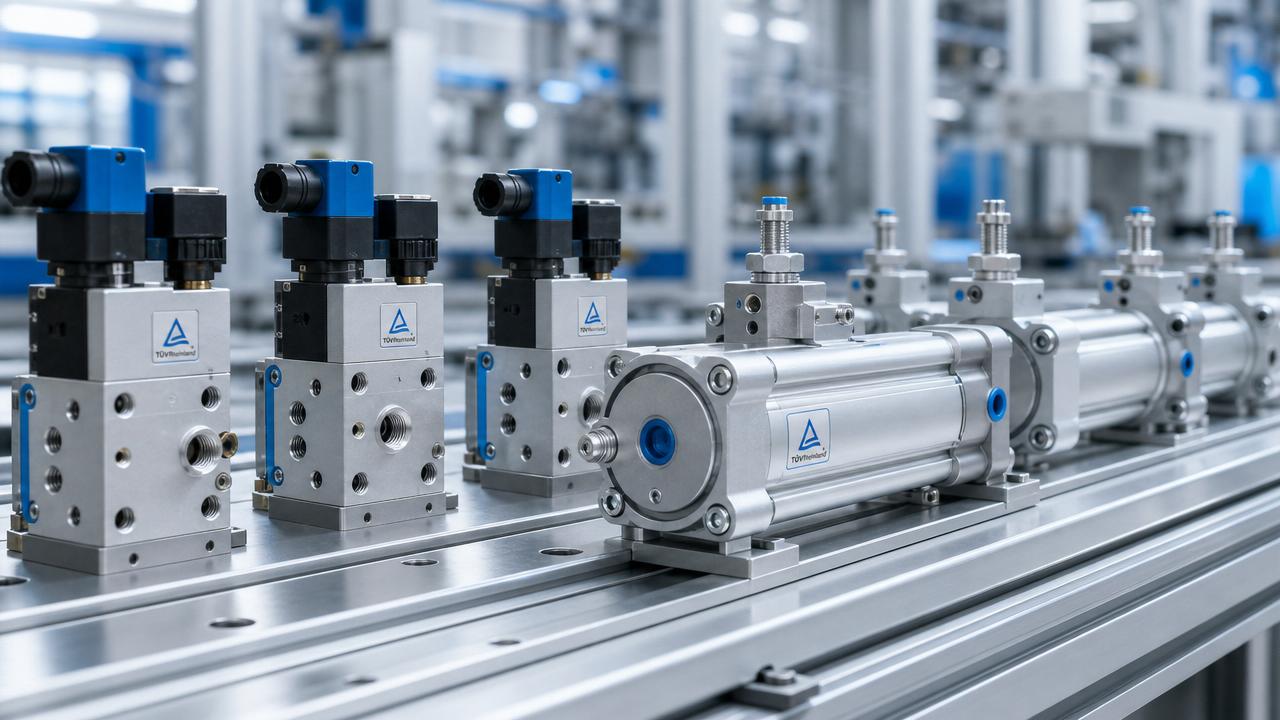
On May 6, 2026, German certification body TÜV Rheinland released its Industrial Pneumatics Energy Efficiency Roadmap 2026, introducing voluntary A–G energy efficiency labeling for pneumatic valves and air cylinders — a development with immediate implications for manufacturers supplying the EU industrial automation, machinery, and factory equipment markets.
Event Overview
On May 6, 2026, TÜV Rheinland published the Industrial Pneumatics Energy Efficiency Roadmap 2026. The document establishes a voluntary energy performance classification (A–G scale) for pneumatic control valves and air cylinders for the first time. It recommends that EU public and private procurement entities assign weight to energy efficiency class in technical evaluation criteria. While not legally binding, leading OEMs including Siemens and Bosch Rexroth have already referenced the white paper’s provisions in recent tender documents. Chinese pneumatic component suppliers lacking TÜV-certified energy test reports may be excluded from high-end project bidding processes.
Which Sub-Sectors Are Affected
Export-Oriented Pneumatic Component Manufacturers
These companies face direct impact because EU procurement decisions increasingly consider energy efficiency as a de facto technical gate. Without TÜV-verified test reports aligned with the new classification, product submissions may fail preliminary technical screening — even if price or functional specs are competitive.
OEM Suppliers & Tier-1 System Integrators
For firms integrating pneumatic components into larger machines or production lines, the white paper affects bill-of-materials (BOM) validation. If sub-suppliers cannot demonstrate compliance with the recommended labeling framework, integrators risk non-conformance in their own tenders — especially where Siemens or Bosch Rexroth require documented energy performance data in qualification packages.
Procurement & Sourcing Teams in EU-Based Industrial Buyers
Buyers at EU-based machinery, packaging, and automotive equipment manufacturers now need to assess whether internal procurement guidelines should formally incorporate the A–G classification. Though voluntary, early adoption by major OEMs signals an emerging expectation — making pre-emptive alignment with the framework operationally prudent.
What Relevant Enterprises or Practitioners Should Focus On — And How to Respond
Monitor official uptake by EU standardization bodies and public procurement authorities
While the white paper is voluntary, watch for references in upcoming CEN/CENELEC working group outputs or national procurement policy updates (e.g., Germany’s VOB/A or France’s Marchés Publics Code). Formal referencing would elevate its influence beyond OEM preference.
Prioritize testing and labeling for valves and air cylinders supplied to EU OEMs
Focus resources on the two product categories explicitly named: solenoid/pilot-operated control valves and single/double-acting air cylinders. These are now the primary scope of assessment — not compressors, filters, or FRL units. Confirm test protocols align with TÜV Rheinland’s 2026 methodology before commissioning verification.
Distinguish between policy signal and contractual obligation
Current use by Siemens and Bosch Rexroth reflects commercial preference, not regulatory mandate. However, analysis shows such OEM-led requirements often precede harmonized standards — meaning early alignment reduces future requalification risk without requiring immediate full-scale certification rollout.
Prepare technical documentation and supplier communication protocols
Update internal datasheets, declarations of conformity, and tender response templates to include space for energy class designation and TÜV report reference numbers. Proactively engage key EU customers to clarify how they intend to apply the framework — e.g., pass/fail threshold (e.g., minimum Class C), weighting percentage, or required test lab accreditation.
Editorial Perspective / Industry Observation
Observably, this white paper functions less as a standalone regulation and more as a coordinated market-shaping instrument — one that leverages OEM procurement power to accelerate energy performance transparency in a traditionally low-regulation segment. From an industry perspective, it marks the first institutional effort to extend energy labeling beyond motors and drives into core pneumatic actuation components. Analysis suggests its significance lies not in immediate enforcement, but in establishing a benchmark that will likely inform future Ecodesign preparatory studies or CE marking guidance. Current adoption by tier-one OEMs indicates the framework is already operating as a soft technical barrier — particularly for suppliers without prior engagement in EU energy labeling schemes.
Concluding, this initiative reflects a broader shift toward lifecycle-aware procurement in industrial automation — where energy efficiency is no longer confined to prime movers, but extends to auxiliary systems like pneumatics. It is best understood not as a compliance deadline, but as an early indicator of evolving technical expectations in high-value EU industrial supply chains.
Source: TÜV Rheinland, Industrial Pneumatics Energy Efficiency Roadmap 2026, published May 6, 2026. Note: Ongoing observation is warranted regarding formal adoption by EU procurement authorities or standardization bodies — no such action has been confirmed to date.
Related News