
Why an OEM Parts Catalog Can Still Cause Ordering Errors

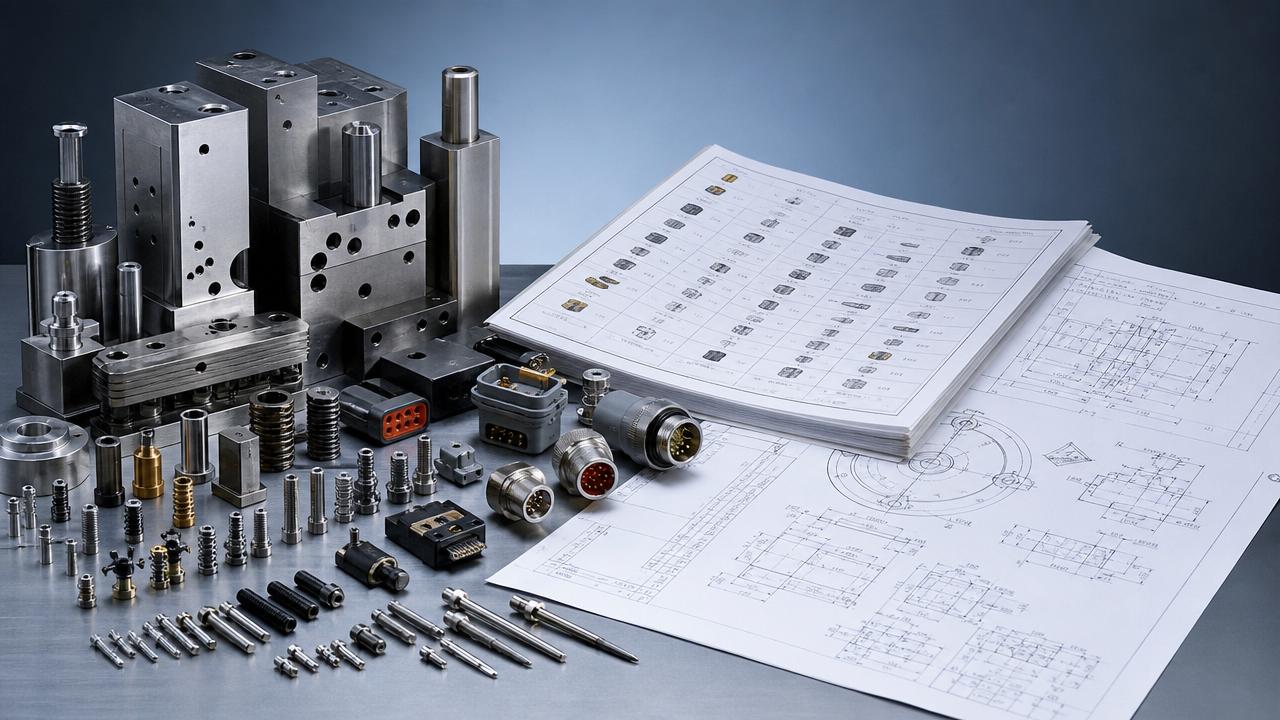
An OEM parts catalog is designed to make sourcing easier, yet many procurement teams still face costly ordering mistakes. Outdated part numbers, unclear supersessions, regional variations, and incomplete technical details can all create hidden risks in the buying process. For purchasers managing accuracy, lead times, and supplier coordination, understanding why these errors happen is the first step toward more reliable and efficient ordering.
In industrial supply chains, a single wrong part can delay an assembly line, trigger reinspection, or force an unplanned expedite shipment. This is especially true in sectors tied to hardware, electrical systems, tooling, molds, pneumatic assemblies, and fasteners, where dimensional tolerance, material grade, thread standard, voltage rating, and mounting interface all matter. Even when a buyer relies on an OEM parts catalog, ordering accuracy is not guaranteed unless the catalog structure, data governance, and supplier communication process are equally strong.
For procurement teams, the issue is not whether an OEM parts catalog exists, but whether it can support real-world purchasing decisions across 3 critical pressures: technical correctness, delivery timing, and cross-border coordination. In many organizations, errors do not come from carelessness alone. They come from data gaps, legacy numbering systems, siloed revisions, and assumptions made under time pressure. Understanding these failure points helps purchasers reduce returns, shorten approval cycles, and improve first-time order accuracy.
Why an OEM Parts Catalog Can Mislead Buyers in Practice
An OEM parts catalog often looks authoritative because it presents exploded views, part numbers, and compatibility notes. However, industrial purchasing is rarely static. A catalog may reflect a design state from 6 months ago, while the production floor is already using a revised assembly. In environments where product variants change every 1–2 quarters, even a well-built catalog can become a source of confusion rather than clarity.
1. Part Number Supersession Is Not Always Transparent
One of the most common causes of ordering mistakes is part number replacement without a clear supersession path. A fastener, insert, pneumatic valve, or mold component may be updated due to material changes, coating adjustments, compliance requirements, or production rationalization. If the OEM parts catalog only shows the latest code but not the old-to-new relationship, buyers may reorder obsolete items or miss a required mating change.
This problem becomes more serious when the revised part is not form-fit-function identical. For example, a connector may retain the same envelope dimensions but shift from one plating specification to another, or a tooling insert may move from one hardness range to a tighter one. A purchaser seeing “replacement available” without technical notes may assume equivalence, even though the acceptable operating temperature, torque value, or wear life has changed by 10%–20%.
What buyers should verify
- Whether the old part number is officially obsolete, restricted, or still serviceable
- Whether the replacement requires a paired component change
- Whether compliance status changed, such as regional electrical or material restrictions
- Whether the new item has a different lead time, MOQ, or packaging quantity
2. Regional Variants Create Hidden Ordering Risk
Many OEM parts catalogs serve multiple markets at once. That creates a practical problem: one assembly may have 3–5 regional variants with small but important differences. Voltage ratings, plug types, thread standards, corrosion resistance, documentation language, and certification marks may vary by destination. If the catalog interface does not force a region selection early enough, purchasers can easily choose a technically valid part that is commercially unusable in the target market.
This is common in electrical hubs, machine peripherals, and tooling systems shipped across Europe, North America, Southeast Asia, and the Middle East. A catalog entry may look identical at first glance, but one version may be intended for 50 Hz systems while another is optimized for 60 Hz applications. In mechanical hardware, the same issue appears in inch-versus-metric standards, sealing materials, or environmental coatings for humidity above 85%.
The table below highlights where regional complexity often turns an OEM parts catalog into a source of mistakes instead of a control tool.
For buyers, the lesson is simple: a valid part number is not enough. The OEM parts catalog must be checked against destination region, operating environment, and assembly standard. Without these filters, the chance of selecting a “correct but wrong” part rises sharply.
3. Incomplete Technical Fields Encourage Assumptions
Another weakness appears when the OEM parts catalog contains only commercial descriptions such as “seal kit,” “adapter,” or “tool holder,” but lacks measurable specifications. Procurement teams often need at least 6 core data points before issuing a purchase order: material, size, tolerance, surface treatment, interface standard, and operating range. If even 1 or 2 of these fields are missing, the buyer may rely on historical memory or a supplier shortcut, both of which increase risk.
In mold manufacturing and precision tooling, small omissions have outsized impact. A bushing listed without hardness range, a cutting insert listed without substrate detail, or a pneumatic fitting listed without pressure class can lead to line stoppages that cost far more than the original part value. This is why catalog quality should be judged not by page count, but by engineering completeness.
Where Ordering Errors Usually Enter the Procurement Workflow
Most ordering errors happen before the purchase order is issued, not after. The OEM parts catalog is only one layer in a broader workflow that includes internal requests, approval routing, supplier quotation, technical review, and receiving inspection. If any handoff is weak, the catalog cannot prevent mistakes on its own.
1. Request Intake Is Too Generic
A typical internal request may say “need 20 replacement clamps” or “reorder valve set for line 2.” That level of detail is insufficient in a mixed industrial environment. A purchaser may then open the OEM parts catalog and choose the closest-looking item, especially when production is asking for delivery within 48–72 hours. The problem is not the catalog alone; it is that the request did not specify revision, machine serial range, or operating condition.
Minimum request data before catalog lookup
- Equipment model and serial range
- Assembly location or exploded diagram reference
- Required quantity and package multiple
- Operating environment, such as heat, dust, moisture, or chemical exposure
- Needed date and acceptable lead time window, such as 7 days or 21 days
2. Supplier Quotations Can Normalize the Wrong Item
Once a part request reaches external suppliers, an incorrect interpretation can quickly become embedded in the quotation process. If a distributor maps an obsolete part number to a similar item, the buyer may assume the mapping is approved. In reality, the supplier may be solving for availability rather than engineering match. This happens often when lead times stretch from 2 weeks to 8 weeks and the commercial team pushes for substitutes.
A reliable procurement process therefore needs two checkpoints: commercial equivalence and technical equivalence. The first asks whether price, MOQ, and delivery are acceptable. The second asks whether dimensions, materials, ratings, and compliance attributes still match the original need. Many companies perform the first check consistently but skip the second under schedule pressure.
The following matrix shows how common workflow gaps turn a usable OEM parts catalog into an unreliable ordering tool.
This type of control matrix is especially useful in distributed procurement teams where engineering, sourcing, and receiving sit in different locations. It reduces reliance on memory and lowers the number of preventable mismatches during urgent buys.
3. Unit of Measure and Packaging Logic Are Overlooked
In industrial components, quantity errors are as damaging as specification errors. Some parts are sold per piece, others per set, per meter, per box, or per matched pair. An OEM parts catalog may identify the item correctly yet still create confusion if packaging logic is not obvious. Ordering 50 pieces instead of 50 sets can double or halve usable inventory overnight.
This issue commonly affects fasteners, shims, seal kits, electrical contact blocks, and wear inserts. A catalog line may show one drawing number, but the commercial unit may be a bag of 100, a kit of 4, or a left-right mirrored pair. Procurement teams should treat UOM verification as one of the final 3 checks before PO release.
How Procurement Teams Can Use an OEM Parts Catalog More Safely
The goal is not to abandon the OEM parts catalog, but to strengthen the way it is used. Buyers can improve accuracy significantly by combining catalog data with a documented review process. In many industrial categories, a 4-step validation routine is enough to prevent the majority of avoidable ordering errors.
Build a 4-Step Catalog Validation Routine
Step 1: Confirm identity
Match the OEM parts catalog entry to the exact machine model, serial range, and assembly position. If the part supports multiple revisions, record which revision is currently installed. This first step can eliminate many wrong-fit orders before pricing even begins.
Step 2: Confirm technical equivalence
Check measurable fields such as dimensions, thread type, pressure class, hardness, voltage range, coating, or thermal limit. For precision hardware and tooling, even a tolerance shift of ±0.1 mm can matter. If the OEM parts catalog lacks these details, request supporting documentation before proceeding.
Step 3: Confirm commercial conditions
Validate MOQ, pack quantity, quoted lead time, and approved Incoterms or logistics mode. A technically correct part with a 10-week delivery may still fail the purchasing objective if the required downtime window is only 14 days.
Step 4: Confirm change traceability
Keep a record of who approved supersession, substitution, or regional variant selection. This trace is essential when the same part is reordered 3 months later by another buyer or another plant. Without traceability, the OEM parts catalog becomes a static reference while the organization keeps relearning the same lessons.
Use a Short Procurement Checklist Before Every PO
A simple checklist can outperform a complex system when buyers are under time pressure. The checklist below is suitable for industrial parts, electrical modules, tooling components, and mold-related accessories.
- Is the part number current, and is there any supersession note?
- Does the OEM parts catalog show the correct region or compliance variant?
- Are 6 key technical fields available and reviewed?
- Is the unit of measure piece, set, box, or pair?
- Has engineering approved any substitute or alternate source?
- Does the delivery window fit the production schedule by at least 2–3 buffer days?
What Better Catalog Governance Looks Like for Industrial Supply Chains
From a broader supply chain perspective, ordering accuracy improves when catalog governance is treated as an operational discipline rather than an IT archive. For platforms and knowledge networks serving industrial buyers, the most useful OEM parts catalog is one that links commercial data with engineering context.
Features That Reduce Buyer Error
In practice, buyers benefit most from 5 catalog features: revision history, supersession mapping, regional filtering, document attachment, and packaging visibility. These are more valuable than visual design alone because they reduce interpretation risk. A catalog that clearly shows “obsolete after date,” “replacement requires bracket B,” or “sold in carton of 25” is far more procurement-friendly than one with only a detailed exploded diagram.
For industrial components with long life cycles, especially molds, tooling, electromechanical modules, and maintenance spares, governance should also include review intervals. A practical interval is every 6–12 months for standard parts and every quarter for high-usage or compliance-sensitive items. That cadence helps keep the OEM parts catalog aligned with production reality.
Why This Matters for Buyers Working Across Multiple Suppliers
Procurement teams increasingly source through layered channels: OEMs, authorized distributors, contract manufacturers, and regional stockists. In that environment, a weak OEM parts catalog creates duplicated clarification work across every supplier touchpoint. A stronger catalog reduces RFQ cycles, lowers exception handling, and gives buyers a cleaner basis for comparing lead times, service levels, and total landed cost.
For organizations managing hundreds or thousands of industrial SKUs, even a modest reduction in error rate can free up substantial time. Fewer returns, fewer emergency shipments, and fewer technical escalations mean procurement can spend more effort on supplier strategy, localization, and cost control rather than correcting avoidable mistakes.
Common Buyer Questions
Can a distributor cross-reference replace the OEM record?
It can support sourcing, but it should not automatically replace the OEM parts catalog unless technical equivalence is documented. Cross-references are useful starting points, not final proof.
How often should catalog-linked parts be revalidated?
For critical components, every reorder cycle is ideal. For stable items, a review every 6–12 months is common. If the part is tied to electrical compliance, safety, or aggressive environments, more frequent review may be warranted.
What is the fastest way to cut ordering mistakes?
Standardize the request form, verify supersession, confirm UOM, and require one technical approval for substitutes. These 4 controls usually provide the highest immediate return with minimal process burden.
An OEM parts catalog remains a valuable sourcing tool, but it is not a fail-safe mechanism on its own. Buyers in hardware, electrical, tooling, mold, and industrial component sectors still face ordering errors when catalog data is outdated, incomplete, regionally mixed, or disconnected from workflow controls. The most effective procurement teams treat catalog use as part of a disciplined validation process that combines technical review, commercial checks, and change traceability.
For organizations looking to improve purchasing accuracy across complex industrial parts, better catalog interpretation and stronger sourcing governance can reduce delays, rework, and supply risk. If you want deeper guidance on industrial component selection, sourcing logic, or cross-border parts intelligence, contact GHTN to explore tailored solutions, review product details, and learn more about reliable procurement strategies.
Related News