
Vietnam Extends BEV Fee Waiver to 2030

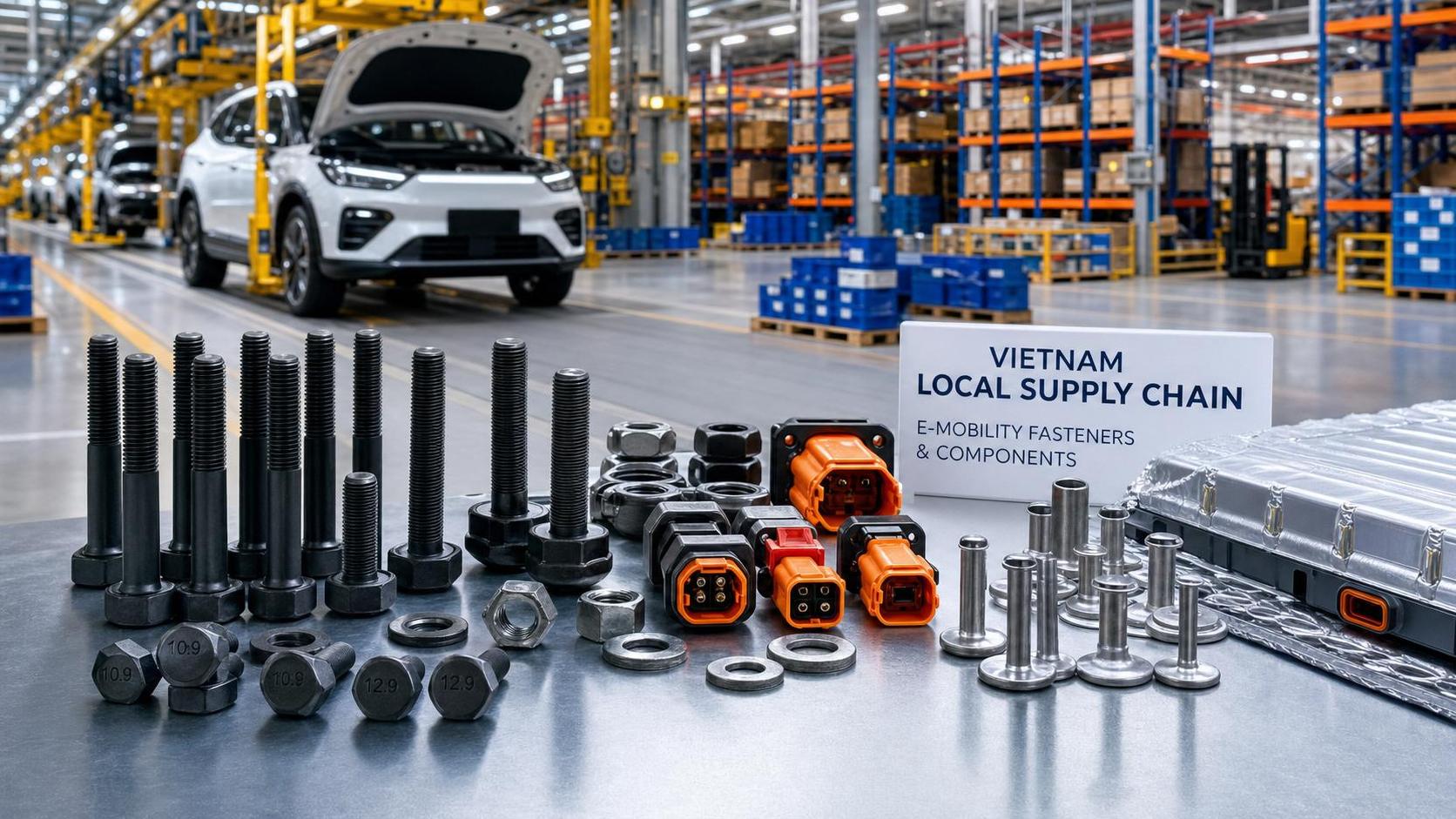
On June 15, 2026, Vietnam’s Ministry of Industry and Trade and Ministry of Finance signaled a clear policy continuation by extending the first registration fee exemption for battery electric vehicles through the end of 2030. For the market, this is not only a consumer-side incentive measure; it also matters to vehicle assembly planning, local sourcing arrangements, and supplier positioning around high-strength automotive fasteners in 10.9/12.9 grades, high-voltage connectors, and battery pack sealing rivets. The development deserves attention because it directly connects a policy extension with practical changes in procurement direction, delivery organization, and local service expectations.
A policy extension with direct sourcing implications
The confirmed facts are limited but commercially significant. On June 15, 2026, Vietnam’s Ministry of Industry and Trade and Ministry of Finance announced that the first registration fee exemption for BEVs would be extended until the end of 2030. According to the provided event summary, this is accelerating capacity expansion by local vehicle manufacturers and increasing localized purchasing demand for high-strength automotive fasteners in 10.9/12.9 grades, high-voltage connectors, and battery pack sealing rivets. The same summary also indicates that Chinese supporting suppliers are intensively setting up local warehouses and technical service centers in Hanoi and Hai Phong.
Where the change may be felt first in the supply chain
Vehicle assembly programs move closer to local sourcing
From an industry perspective, local vehicle manufacturers may be affected first because a longer fee exemption period can support more stable planning assumptions for BEV production and assembly. The main impact is likely to appear in supplier nomination, parts localization rhythm, and technical alignment for components that sit close to safety, electrical connection, and battery sealing functions. What deserves closer attention is whether procurement documents, technical specifications, and supplier qualification requirements begin to reflect stronger local support expectations.
Fastener, connector, and rivet suppliers face a shorter response window
For manufacturers and exporters of 10.9/12.9 grade automotive fasteners, high-voltage connectors, and battery pack sealing rivets, the likely impact is not limited to higher inquiry volume. Analysis shows that response speed, technical document readiness, and the ability to support localized delivery may become more important in actual sourcing decisions. Companies in these categories should pay attention to specification matching, product traceability materials, test records, and any customer-side requirements related to local warehousing or technical support.
Local distribution and service functions gain operational importance
Supply chain service providers and channel operators may also see a shift in role. The event summary points to local warehouse and technical service center deployment in Hanoi and Hai Phong, which suggests that delivery assurance and after-sales technical response are becoming part of supplier competitiveness. Observably, the operational impact may fall on inventory placement, order fulfillment coordination, sample support, and quality issue handling rather than on simple cross-border shipment alone.
What companies should monitor now
Watch for the execution language behind the policy extension
Analysis shows that the headline policy direction is clear, but companies should still monitor how the extension is reflected in downstream procurement practice. It is prudent to follow any later official wording, customer notices, or tender documentation that may define how the longer exemption period shapes sourcing priorities and project schedules.
Prepare technical and quality documents for localized procurement
Suppliers targeting these BEV-related categories should be ready with complete technical files, product specifications, and quality records that can support buyer review. This does not mean new requirements have already been formally imposed in the provided information, but it is more appropriate to understand document readiness as a near-term commercial necessity if localized sourcing accelerates.
Reassess delivery models and support capability
What deserves closer attention is the shift from product supply alone to supply plus local execution. Companies may need to review whether their current delivery lead times, warehouse arrangements, and on-site technical service models are sufficient for customers that are expanding local assembly. Where local presence is being used competitively, service responsiveness can matter alongside price and specification compliance.
Keep trade and after-sales risks visible
For exporters and service-linked suppliers, it remains important to monitor quality traceability, complaint handling procedures, and replacement support for critical parts tied to vehicle assembly and battery systems. The provided information does not define new compliance rules in these areas, but market execution often becomes stricter when sourcing moves closer to local production and service expectations.
Why this looks like an execution signal, not just a headline
Observably, this development is better read as a concrete execution signal than as a generic policy headline. The confirmed policy extension runs to the end of 2030, and the provided summary already links that extension to local capacity expansion and to specific categories of components. At the same time, it is still too early to treat every commercial consequence as fully settled. Analysis shows that the market should continue watching for customer qualification criteria, sourcing language, service expectations, and feedback from actual procurement activity before drawing broader conclusions.
How the market may best interpret the development
The immediate significance of this event lies in the connection between a policy incentive and a more localized BEV supply chain response. For companies involved in automotive fasteners, connectors, rivets, warehousing, and technical support, the message is not that all rules have changed at once, but that procurement behavior and delivery expectations may be moving in that direction. It is more appropriate to understand this as a landed policy signal with practical supply-chain implications, while keeping further implementation details under observation.
Source note and follow-up points
This article is generated based on the user-provided news title, event date, and event summary. For developments of this type, commonly relevant source categories may include official government announcements, releases from regulatory authorities, trade or customs-related notices, industry association updates, standard-setting documents, and reporting by authoritative media. No specific official source link was provided in the input, so the exact official publication path still requires further verification. Follow-up observation should focus on later policy details, execution wording, certification or qualification expectations, tender document changes, industry feedback, and how companies implement local warehousing and technical service arrangements in practice.