
China-Europe Railway Express Surpasses 130,000 Trains

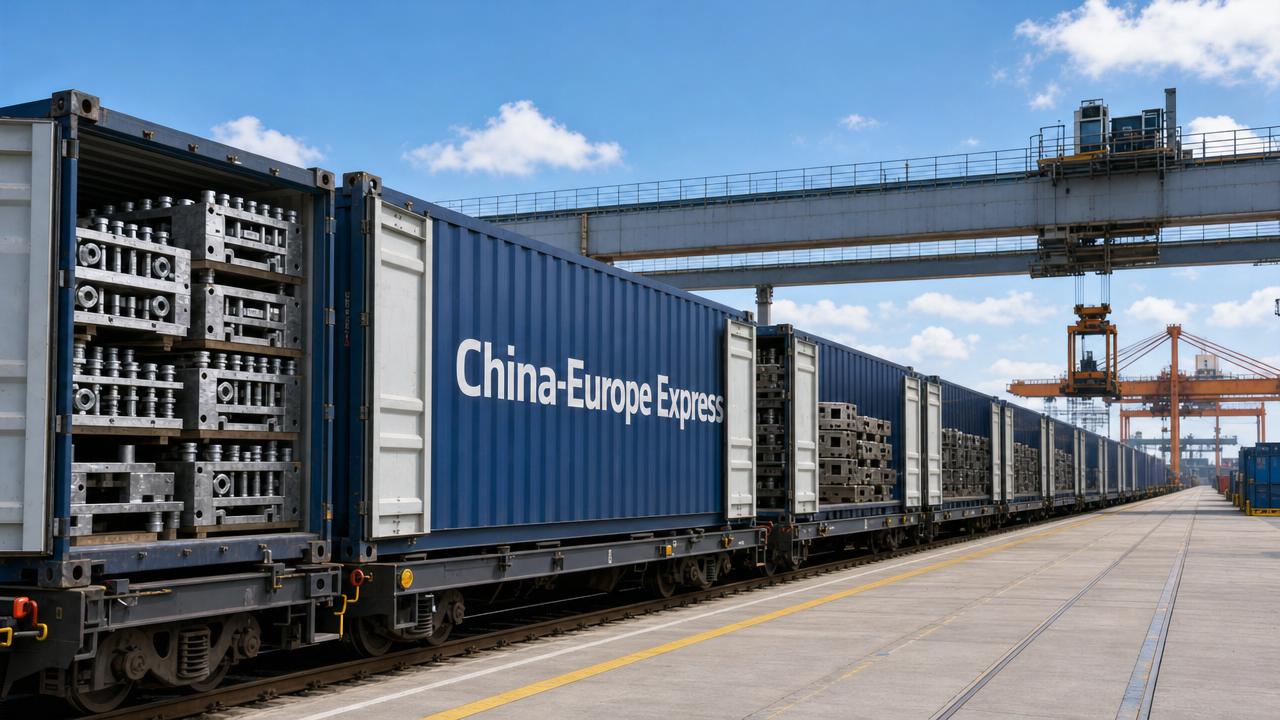
As of May 9, 2026, the China-Europe Railway Express has exceeded 130,000 total departures, with cargo value surpassing USD 520 billion. This milestone is particularly relevant for enterprises involved in fast-moving, high-value industrial components—especially those exporting bolts, screws, and injection molds to Europe—due to newly enhanced rail delivery reliability and lead time predictability.
Event Overview
According to official data released on May 9, 2026, the cumulative number of China-Europe Railway Express trains reached over 130,000. Total shipped cargo value exceeded USD 520 billion. Key hub stations—including Zhengzhou, Xi’an, and Chongqing—have launched dedicated fast-track services labeled ‘Express Freight Trains + Bonded Distribution’ for categories such as ‘Bolts & Screws’ and ‘Injection Molds’. Average overland transit time is now 14 days—22 days faster than maritime shipping—and unaffected by Red Sea rerouting disruptions.
Industries Affected
Direct Exporters (SMEs manufacturing precision fasteners or mold components)
These companies benefit directly from improved schedule certainty and reduced exposure to maritime volatility. The 14-day rail window enables tighter order-to-delivery cycles and supports just-in-time replenishment models in European distribution networks.
Contract Manufacturers & Tier-2 Suppliers
Manufacturers fulfilling OEM or ODM orders for European clients face lower pressure to hold extended safety stock. Shorter, more predictable lead times allow for leaner production planning—particularly for low-volume, high-mix product families common in tooling and assembly hardware.
Distribution & Logistics Service Providers
Firms offering end-to-end cross-border fulfillment—including customs clearance, bonded warehousing, and last-mile coordination—see increased demand for integrated rail-based solutions. The ‘Express Freight + Bonded Distribution’ model requires synchronized handling across origin, transit hubs, and EU entry points.
Importers & Procurement Teams in Europe
European buyers of Chinese-made small-batch industrial parts report strengthened confidence in supply continuity. Reduced dependency on sea freight mitigates risk from geopolitical or environmental disruptions affecting traditional Suez-based routes.
What Enterprises and Practitioners Should Monitor and Do Now
Track official service expansions beyond current hubs
While Zhengzhou, Xi’an, and Chongqing are confirmed as launch points, no public information confirms whether other inland terminals (e.g., Wuhan, Chengdu, or Yiwu) will adopt similar dedicated protocols. Monitoring announcements from China State Railway Group and EU rail operators (e.g., DB Cargo, CFR Marfă) is advisable.
Validate eligibility criteria for ‘Express Freight + Bonded Distribution’ access
The announcement references specific product categories (‘Bolts & Screws’, ‘Injection Molds’) but does not define technical thresholds—such as HS code ranges, minimum shipment size, or certification requirements. Exporters should consult local customs authorities or designated logistics partners before committing to rail-first strategies.
Distinguish between policy rollout and operational readiness
Although the 14-day average is cited, actual transit times may vary depending on border crossing frequency, terminal congestion, or seasonal capacity constraints. Early adopters should treat initial performance metrics as indicative—not guaranteed—and maintain dual-mode contingency plans during Q3–Q4 2026.
Align internal procurement and inventory systems with new lead time benchmarks
ERP and MRP configurations built around 35–45 day sea freight windows may require recalibration. Updating reorder triggers, safety stock formulas, and supplier scorecards to reflect a 14-day rail baseline supports smoother integration without overcommitting to untested throughput.
Editorial Perspective / Industry Observation
Observably, this milestone reflects maturation—not just expansion—of the China-Europe rail network: it signals a shift from volume-driven freight consolidation toward service-differentiated, category-specific solutions. Analysis shows the ‘Express Freight + Bonded Distribution’ model is less about replacing maritime capacity and more about enabling strategic resilience for time-sensitive, low-bulk industrial goods. From an industry perspective, this development is best understood as an emerging capability—not yet a fully scaled infrastructure—whose utility depends heavily on consistent execution at key handoff points. Continued attention is warranted because operational stability, not headline train counts, determines real-world adoption by mid-tier manufacturers and regional importers.
Conclusion: The 130,000-train milestone marks a threshold in service refinement rather than raw growth. For stakeholders in precision component trade, it represents a tangible improvement in land-based delivery predictability—but one that remains conditional on sustained coordination among Chinese and European rail, customs, and warehousing entities. It is more accurately interpreted as a strengthening signal of infrastructure maturity than as an immediate wholesale shift in global logistics behavior.
Information Source: Official statistics released by China State Railway Group Co., Ltd., dated May 9, 2026. Note: Expansion scope beyond Zhengzhou/Xi’an/Chongqing hubs, eligibility definitions for ‘Express Freight + Bonded Distribution’, and long-term reliability metrics remain subject to ongoing observation.
Related News
- Greening components or lower cost materials: which wins long termTime : Apr 29, 2026
- China-UAE Open Direct Sea Route, Cutting Export Lead Times for Industrial Fasteners and Pneumatic Parts by 7-10 DaysTime : Aug 16, 2026
- What Defines Precision Fastener Technology in High-Tolerance Industrial Assembly?Time : Aug 11, 2026