
EU Battery Label Rule Hits Battery-Equipped Exports

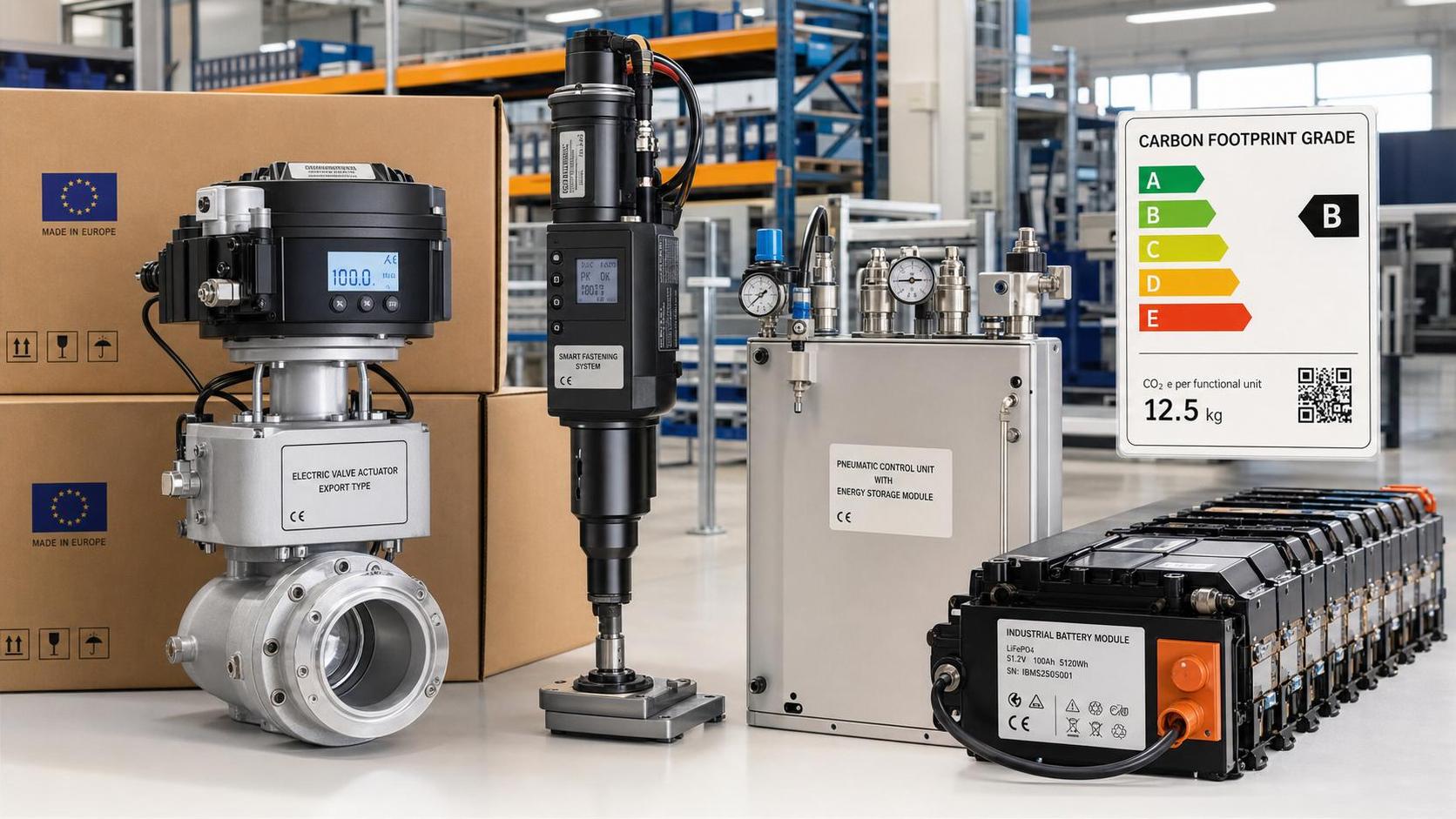
On August 18, 2026, the EU will start enforcing a carbon footprint performance grade label requirement for rechargeable industrial batteries above 2kWh under Regulation (EU) 2023/1542. For exporters, this is not limited to standalone batteries: it directly matters for smart fastening systems, electric valve actuators, and pneumatic control units with energy storage modules, making compliance readiness a market-access issue rather than a documentation detail.
What the rule now requires
According to the provided information, from August 18, 2026, rechargeable industrial batteries with a capacity above 2kWh must carry a carbon footprint performance grade label under the EU Battery and Waste Battery Regulation (EU) 2023/1542. The requirement directly affects products that include battery modules, including smart fastening systems, electric valve actuators, and pneumatic control units with energy storage functions. Products that do not comply will not be able to enter the EU market. Exporting companies are therefore required to begin data collection, LCA calculation, and preparation for a digital battery passport.
Where the pressure will appear across the chain
Exporters of integrated equipment face an immediate access threshold
From an industry perspective, the most direct impact falls on companies shipping finished equipment into the EU when that equipment includes a battery module within the stated scope. The pressure is likely to show up first in shipment qualification, customer acceptance, and pre-export compliance checks, because non-compliant products are described as unable to enter the EU market.
Manufacturing teams will need product-level data discipline
Analysis shows that manufacturers of smart fastening systems, electric valve actuators, and energy-storage-enabled pneumatic control units may need closer coordination between product design, battery sourcing, and compliance documentation. What deserves closer attention is that the issue is not only whether a battery is present, but whether the required carbon footprint-related information can be assembled and translated into the required labeling and passport preparation workflow.
Supply-chain and service partners may be pulled into documentation work
Observably, suppliers and compliance service providers linked to battery modules may also feel the effect through requests for upstream data, LCA inputs, and supporting documentation. Even where they are not the final exporter, their role can become critical if missing data delays labeling readiness or weakens delivery certainty for EU-bound orders.
What companies should focus on now
Confirm which exported products fall within scope
Companies should first identify whether their EU-bound products include rechargeable industrial batteries above 2kWh, especially where the battery is embedded in equipment rather than sold separately. This is the starting point for deciding which product lines need immediate compliance preparation.
Start data collection before customer deadlines tighten
Based on the provided information, data collection is already a practical priority. For companies that rely on multiple component and battery suppliers, the key issue is whether the necessary inputs for carbon footprint assessment can be gathered in time to support labeling and related documentation.
Treat LCA work and passport preparation as linked tasks
Analysis shows that LCA calculation and digital battery passport preparation should not be treated as isolated paperwork. In practice, both are tied to whether a product can move smoothly through customer review, compliance confirmation, and export delivery planning for the EU market.
Prepare for customer and supplier communication gaps
What deserves closer attention is the operational gap between a policy requirement and day-to-day order execution. Companies may need to review what they can already provide to customers, what must still be obtained from suppliers, and where missing documentation could affect lead times or contract performance.
Why this matters beyond a single label
Observably, this development is more appropriate to understand as an active compliance change with immediate trade consequences, not as a distant policy signal. At the same time, it should also be read as a longer-term indication that embedded battery modules in industrial equipment are drawing closer regulatory scrutiny, especially where market access depends on verifiable environmental data.
Analysis shows that the significance of this update lies in how it shifts responsibility upstream and across product categories. For affected exporters, the challenge is not only legal awareness but the ability to connect product configuration, supplier data, LCA calculation, labeling, and passport preparation into one workable process.
How to read the current signal
At this stage, the clearest takeaway is that the August 18, 2026 enforcement date creates a concrete compliance checkpoint for battery-equipped industrial products entering the EU. It is more appropriate to understand this as both a short-term execution issue for exporters and a longer-term signal that battery-related traceability and carbon information are becoming part of normal market-entry expectations.
About the basis of this article
This article is generated from the user-provided news title, event date, and event summary. The analysis is limited to the confirmed information provided in that input. For this type of development, relevant source categories typically include official regulatory notices, company disclosures, industry association updates, authoritative media coverage, and standard-setting documents. A specific official source link was not provided in the input, so further verification remains necessary. Ongoing attention should focus on any subsequent official wording, implementation clarifications, and practical compliance expectations affecting covered export products.
Related News