
Mold design for injection molding that lowers scrap

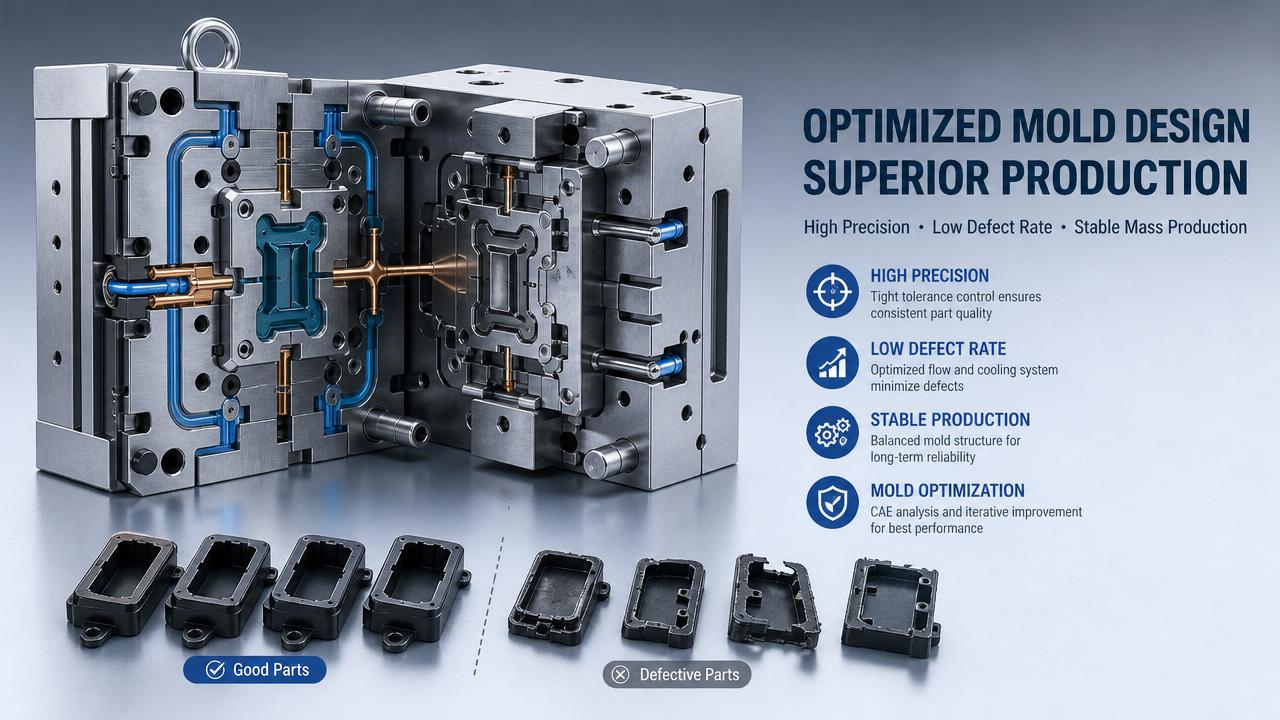
For project execution, mold design for injection molding shapes scrap, cycle stability, and launch risk from the first trial onward.
A stronger mold strategy reduces rejected parts, protects material yield, and improves repeatability across production volumes.
In industrial supply chains, this directly supports cost control, delivery confidence, and downstream assembly quality.
This article explains how mold design for injection molding should change across real production scenarios to lower scrap effectively.
Why scrap reduction depends on the production scenario
Not every part fails for the same reason, so mold design for injection molding cannot rely on a single checklist.
Thin-wall housings, cosmetic covers, technical inserts, and multi-cavity components each create different scrap patterns.
Some projects lose yield through warpage and sink marks. Others lose yield through short shots, flash, burn marks, or dimension drift.
The best scrap reduction plan starts by matching gate style, cooling layout, venting, steel selection, and ejection to the actual application.
That scenario-based approach is especially important in broad industrial sectors, where part geometry and resin behavior vary widely.
When cosmetic surfaces matter, mold balance becomes the first scrap filter
For visible covers, bezels, and consumer-facing hardware, surface defects often create the highest scrap risk.
In this scenario, mold design for injection molding must prioritize balanced filling and stable packing pressure.
Unbalanced runners create weld lines, hesitation marks, and gloss variation that may still pass dimensions but fail appearance standards.
Gate location should push flow away from show surfaces when possible. Submarine or edge gates may work better than direct gating.
Vent placement also matters. Trapped gas near the final fill area can cause burns or silver streaks that raise reject rates.
Core judgment points for cosmetic parts
- Is the gate hidden from the main viewing face?
- Does runner balance keep cavity pressure consistent?
- Are vents placed at last-fill zones and rib ends?
- Does cooling prevent local gloss or shrink variation?
When dimensional accuracy dominates, cooling design decides scrap levels
For connector bodies, tool interfaces, and assembly-critical parts, dimensional variation drives most scrap.
Here, mold design for injection molding should focus first on thermal uniformity rather than only filling speed.
Uneven cooling creates differential shrinkage, which leads to warpage, ovality, and tolerance failure across batch runs.
Cooling channels should follow the geometry closely, especially around bosses, thick sections, and precision interfaces.
Baffles, bubblers, or conformal cooling may be justified when scrap costs exceed tooling complexity.
Steel movement and parting line support should also be reviewed because mold deflection can mimic process instability.
Signals that cooling is the hidden scrap driver
- Parts measure differently between cavities.
- Dimensions drift after startup or long runs.
- Flatness changes despite stable machine settings.
- Cycle time increases to control warpage.
When thin walls or complex flow paths appear, gate and vent choices lower scrap fastest
Technical housings and lightweight components often suffer from short shots, jetting, or weak weld zones.
In this case, mold design for injection molding should reduce flow resistance before raising processing pressure.
A poor gate position can force the melt through long, narrow paths that cool too quickly.
Adding a second gate, changing gate thickness, or shortening the flow path may cut scrap more than machine-side tuning.
Adequate vent depth near thin ribs and end-of-fill areas helps avoid trapped gas and incomplete filling.
Moldflow analysis is useful here, but it should be checked against actual resin grade behavior and achievable vent maintenance.
When filled resins or abrasive materials are used, tool durability protects long-term yield
Glass-filled polymers and flame-retardant compounds can increase wear, corrosion, and sticking over time.
For these applications, mold design for injection molding should be evaluated over lifecycle yield, not only first-sample approval.
If gate edges erode or vents foul quickly, scrap rises gradually through flash, burrs, and unstable dimensions.
Appropriate tool steel, surface treatment, and replaceable wear inserts help keep cavity condition stable.
Draft angles and ejection contact must also account for higher friction from reinforced materials.
Practical decisions for high-wear resin scenarios
- Use durable steel grades at gates, sliders, and shut-offs.
- Design inserts for rapid maintenance replacement.
- Keep vent cleaning access simple and repeatable.
- Avoid marginal draft on textured or reinforced parts.
How different scenarios change mold design for injection molding priorities
Scenario-fit recommendations that reduce scrap before tool release
A practical review before tool kickoff can prevent expensive late-stage changes and recurring quality escapes.
- Define the real scrap mode expected in production, not only the design intent.
- Rank critical features by appearance, fit, sealing, strength, and throughput impact.
- Align gate, vent, cooling, and ejection with those ranked risks.
- Check whether maintenance access supports stable yield after thousands of cycles.
- Validate cavity balance and shrink assumptions with the final material grade.
- Review tolerance stack effects alongside mold steel safety and adjustability.
This process makes mold design for injection molding a yield-driven engineering decision rather than a drawing-only exercise.
Common misjudgments that keep scrap high
One common mistake is blaming the machine when the mold creates the instability.
Another is selecting gate style based on convenience instead of part function and visual requirements.
Teams also underestimate vent maintenance, especially on complex cavities or filled resin projects.
Some tools pass early trials but fail later because wear zones were not designed for replacement.
A further issue is ignoring ejection marks, drag, or deformation, which quietly add scrap after cycle optimization.
Strong mold design for injection molding considers launch conditions and sustained production reality together.
Turning mold design for injection molding into the next practical step
The most effective next step is to audit current scrap by failure mode and connect each loss to a mold feature.
That means reviewing gate balance, venting, cooling uniformity, steel wear exposure, and ejection support in one framework.
For organizations tracking industrial tooling trends, this approach aligns with the deeper manufacturing intelligence promoted by GHTN.
Better mold design for injection molding lowers scrap not by one adjustment, but by matching tool architecture to the production scenario.
When that match is accurate, part quality improves, waste falls, and scaling becomes more predictable.
Related News