
Why niche manufacturing can outperform larger suppliers

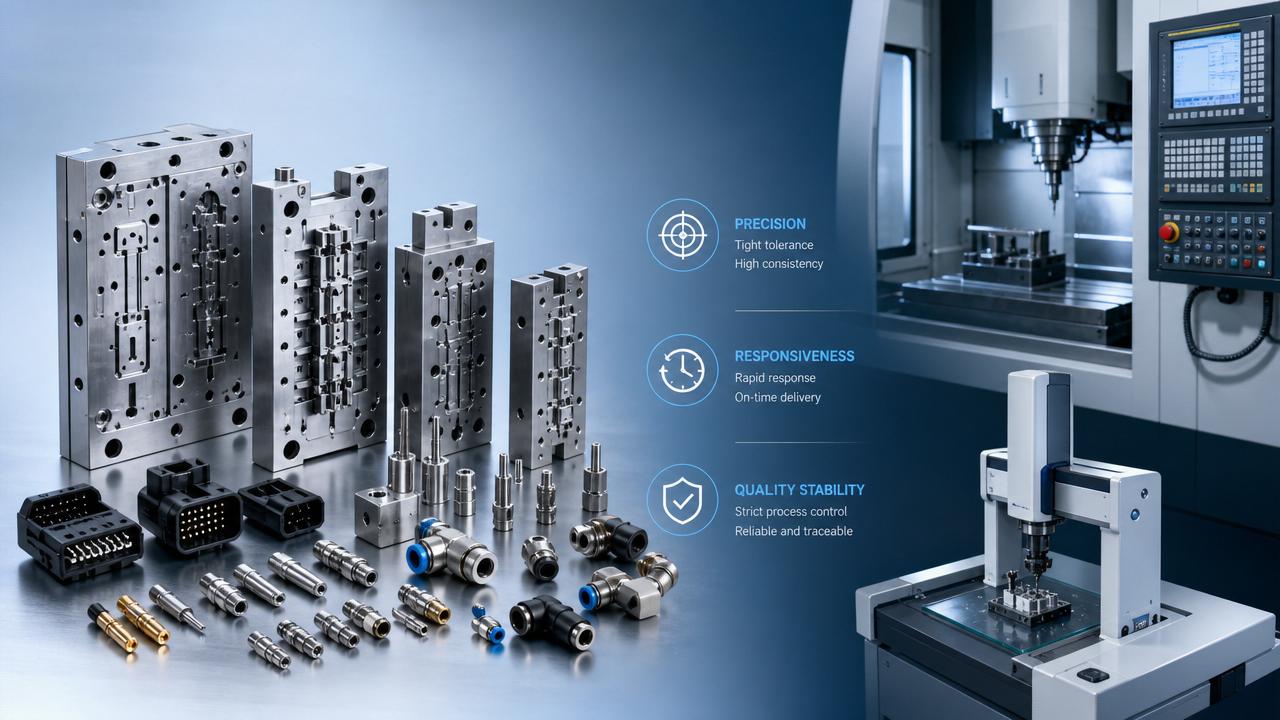
In an era of supply chain volatility and rising quality expectations, niche manufacturing is proving that specialization can outperform scale. For business decision-makers, the real advantage often lies not in size, but in precision, agility, and deep technical expertise. This article explores why focused manufacturers can deliver stronger value, faster innovation, and more resilient partnerships than many larger suppliers.
What niche manufacturing means in today’s industrial landscape
Niche manufacturing refers to the production of highly specific components, tools, assemblies, or process capabilities designed for a narrow set of technical requirements or industry applications. Instead of competing on sheer output volume, a niche manufacturer competes on process mastery, engineering depth, quality consistency, and application knowledge. In sectors connected to hardware, electrical systems, tooling, molds, fasteners, and precision components, this model has become increasingly relevant.
For decision-makers, the importance of niche manufacturing is not only operational but strategic. A specialized supplier may understand tolerance behavior, material performance, regulatory constraints, and production risks far better than a broad-line supplier serving dozens of categories at once. That expertise can reduce failure rates, shorten development cycles, and improve long-term supply chain stability.
This is especially visible in the industrial parts ecosystem highlighted by GHTN. In modern manufacturing, the “small” elements often carry the largest system impact: a fastener used in corrosive conditions, a mold insert affecting cycle time, a pneumatic fitting influencing automation uptime, or an electrical connector that must comply with multiple standards. In such contexts, specialization is not a niche weakness. It is often the source of durable competitive advantage.
Why the market is paying more attention to specialized suppliers
Several market forces explain why niche manufacturing has gained traction. First, supply chains are more complex and less forgiving than they were a decade ago. Larger suppliers may offer scale, but they can also introduce rigidity, longer approval chains, and slower adaptation when specifications change. By contrast, specialized manufacturers tend to be built around focused production cells, technical consultation, and closer customer communication.
Second, product requirements are becoming more demanding. OEMs now expect better dimensional accuracy, stronger traceability, cleaner documentation, and more reliable performance in harsh environments. In fields such as mold manufacturing, electrical hardware, and mechanical tooling, these expectations are difficult to meet through generalized production models alone.
Third, many enterprises are rethinking supplier value beyond unit price. The lowest quote can become the highest total cost if it leads to defects, line stoppages, delayed certifications, or frequent engineering changes. Niche manufacturing becomes attractive because it can support better outcomes across the full lifecycle: design input, prototyping, process validation, production repeatability, and after-sales improvement.
Where niche manufacturing often outperforms larger suppliers
The advantage of niche manufacturing is most evident when complexity matters more than volume. Large suppliers remain valuable in many categories, especially standardized, price-sensitive products. However, once performance conditions become more demanding, specialization often wins in practical business terms.
This does not mean every small manufacturer is superior, nor that every large supplier is inflexible. The point is that niche manufacturing tends to be structurally aligned with high-complexity, high-precision, or high-accountability work. That alignment can create measurable business value.
The business value for enterprise decision-makers
Lower hidden cost across the supply chain
The purchase price of a component is only one part of its economic impact. Decision-makers increasingly evaluate total cost of ownership, including scrap, downtime, warranty exposure, rework, logistics disruption, and engineering overhead. Niche manufacturing often reduces these hidden costs because the supplier is more likely to understand the failure modes of the application before production begins.
Faster innovation and practical development input
Focused manufacturers are often involved earlier in product development, especially when custom tooling, mold design, or performance-critical parts are involved. Their teams can suggest material alternatives, tighter process controls, design-for-manufacturability changes, and more realistic tolerance strategies. This shortens the path from concept to stable production.
Better resilience through specialization
Resilience is not only about having multiple suppliers. It is also about having the right supplier for the right risk. A niche manufacturing partner that deeply understands one category can often recover faster from technical issues, qualify alternatives more efficiently, and maintain stronger process discipline than a supplier spread thin across many unrelated product families.
Higher credibility in premium markets
For companies targeting premium OEMs, regulated markets, or export-driven segments, specialist suppliers can enhance commercial credibility. Buyers in advanced sectors often want evidence of process capability, material traceability, test discipline, and continuous improvement. Niche manufacturing is well positioned to support this level of scrutiny because its business model is built around proving performance, not just shipping volume.
Typical industrial scenarios where specialization matters most
In the broader industrial ecosystem, niche manufacturing tends to create the strongest advantage in scenarios where precision, compliance, or harsh-use reliability is central to performance.
These are the kinds of areas where GHTN’s industry lens becomes useful. Decision-makers need more than supplier catalogs; they need insight into material behavior, production logic, tooling evolution, and trade realities. Niche manufacturing is easier to evaluate when technical trends and application context are clearly understood.
How to evaluate whether a niche manufacturer is the right fit
Choosing a specialist supplier requires a disciplined evaluation process. Because niche manufacturing creates value through depth rather than breadth, buyers should look beyond company size and ask whether the supplier’s expertise fits the commercial objective.
- Review process capability, not only product samples. Ask how tolerances are controlled, how variation is monitored, and how corrective action is documented.
- Assess application knowledge. A strong niche manufacturing partner should understand your use case, environmental risks, and downstream performance requirements.
- Examine material and compliance discipline. This is critical in electrical, mechanical, and mold-related sectors where standards and durability are non-negotiable.
- Evaluate communication speed and technical clarity. Specialist value often depends on rapid iteration and honest engineering feedback.
- Confirm scalability within the niche. A focused manufacturer does not need to be huge, but it must be able to grow with your demand and maintain consistency.
For enterprise teams, the best outcome is often a balanced supplier portfolio: large suppliers for stable, commodity-driven categories and niche manufacturing partners for technically sensitive or strategically differentiating components. This hybrid approach improves both cost control and operational resilience.
Common misconceptions about niche manufacturing
One common misconception is that specialized manufacturers are only suitable for small orders. In reality, many niche manufacturers are highly capable in medium-scale production, especially when they control a critical process or component family. Their advantage is not low volume alone; it is controlled complexity.
Another misconception is that larger suppliers are always safer. Scale can support capacity and global reach, but it does not automatically guarantee fit, speed, or technical precision. Safety in sourcing comes from alignment between supplier capability and application risk.
A third misconception is that specialization limits innovation. Often the opposite is true. Niche manufacturing teams see recurring technical patterns within a narrow domain, allowing them to refine methods, reduce waste, and improve performance faster than organizations managing too many unrelated priorities.
Practical recommendations for procurement and strategy leaders
If your business depends on high-performance parts, precise tooling, or application-specific assemblies, treat niche manufacturing as a strategic lever rather than a fallback option. Start by mapping which purchased items have the greatest effect on uptime, compliance, product quality, or customer perception. Those are often the categories where specialist suppliers can create disproportionate value.
Next, improve cross-functional evaluation. Procurement, engineering, quality, and operations should jointly define what “supplier fit” means. This prevents sourcing decisions from being driven only by short-term price comparisons. In many industrial settings, a technically aligned niche manufacturer will outperform a larger supplier once lifecycle cost and risk are included.
Finally, use trusted market intelligence to identify hidden champions. Platforms and networks that track manufacturing trends, process evolution, compliance shifts, and specialist capabilities can shorten the supplier discovery cycle. This is where GHTN’s mission is particularly relevant: linking precision-focused enterprises with high-end market demand and helping decision-makers see value where the broader market may only see company size.
Conclusion
Niche manufacturing outperforms larger suppliers when technical depth, agility, and process accountability matter more than broad-scale output alone. For business leaders, the question is no longer whether specialization has a place in the supply chain, but where it can deliver the highest return. In precision tools, molds, fasteners, electrical systems, and other industrial core components, specialist manufacturers often create better outcomes through focused expertise and closer collaboration.
As competitive pressure grows, enterprises that understand the real value of niche manufacturing will be better positioned to build resilient supply networks, accelerate product improvement, and capture premium opportunities. The smartest sourcing strategy is rarely about choosing size over specialization. It is about matching the right capability to the right industrial challenge.
Related News