

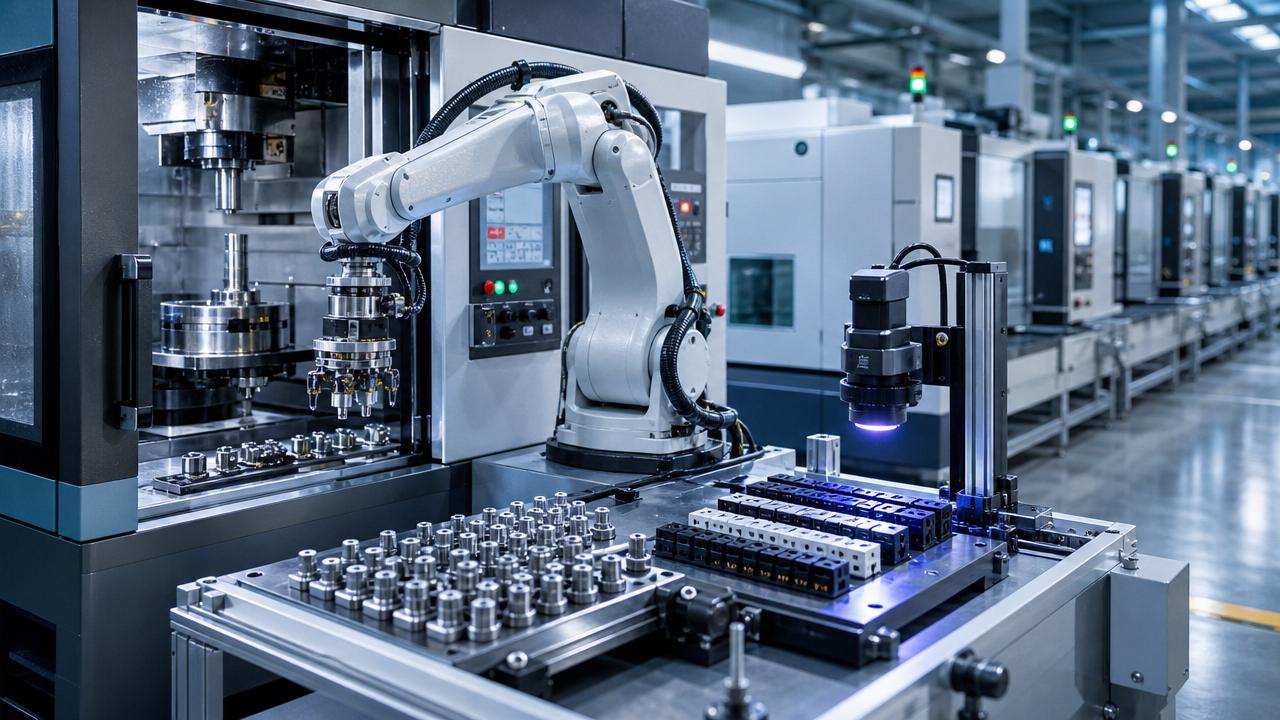
Are Industrial Automation Solutions Worth the Cost?
For business decision-makers, the real question is not whether industrial automation solutions are expensive, but whether the cost of staying manual is even higher.
From precision tooling and fastener production to electrical systems and mold manufacturing, automation can reshape productivity, quality control, and long-term competitiveness.
This article examines where automation delivers measurable value, when the investment may be justified, and how companies can evaluate ROI practically.
The Short Answer: Yes, When Automation Solves a Business Constraint
Industrial automation solutions are worth the cost when they remove a bottleneck that directly affects output, quality, safety, or competitiveness.
They are less convincing when purchased as a technology upgrade without a defined production problem, measurable target, or integration plan.
For decision-makers, the strongest automation cases usually start with capacity limits, inconsistent quality, labor shortages, or rising compliance requirements.
A robotic cell, automated inspection system, or smart control platform should not be judged only by its purchase price.
The better question is whether it lowers total operating cost, protects margins, or enables work that manual processes cannot sustain.
What Business Leaders Actually Need to Measure
The value of automation is rarely captured by labor savings alone, although reduced manual dependency often appears in ROI calculations.
In industrial components, tooling, electrical assemblies, and mold-related production, hidden savings can be more important than headcount reduction.
These savings include lower scrap rates, fewer rework loops, shorter changeovers, better traceability, and more stable production scheduling.
For example, a fastener manufacturer may gain more from consistent torque control than from simply replacing manual loading.
A mold shop may benefit most from automated measurement feedback that prevents micron-level deviations from becoming expensive downstream defects.
Decision-makers should calculate automation value across throughput, quality, downtime, energy use, safety incidents, and customer retention.
Where Industrial Automation Solutions Deliver the Fastest Payback
Automation typically delivers the fastest payback in repetitive, high-volume, quality-sensitive, or ergonomically difficult operations.
These are environments where human variation, fatigue, or manual handling creates measurable cost, delay, or safety exposure.
In precision manufacturing, automated feeding, sorting, CNC loading, and inspection systems often create immediate improvements in consistency.
For electrical component production, automated testing and labeling can reduce compliance risks while improving documentation accuracy.
In mold manufacturing, automated machining support and digital inspection help maintain dimensional stability across long production runs.
Pneumatic and motion-control automation also improves timing reliability in assembly lines where small delays multiply across stations.
The strongest opportunities are usually not the most futuristic; they are the most repetitive and measurable.
The Real Cost Is More Than Equipment Price
Many companies underestimate automation cost because they focus on equipment quotes rather than total implementation requirements.
A realistic budget includes machinery, tooling modifications, sensors, software, programming, installation, training, guarding, and maintenance support.
Integration with existing machines, legacy control systems, and plant layouts can also add engineering complexity.
For smaller manufacturers, production disruption during installation may be one of the most important hidden costs.
There may also be qualification costs if customers require process validation, sample approval, or documentation updates.
However, these costs do not automatically weaken the investment case; they simply need to be included honestly.
A low-price automation project that fails integration is more expensive than a higher-quality system designed around real operating conditions.
How to Build a Practical ROI Case
A strong ROI case begins with a baseline, not with a supplier presentation or technology trend report.
Companies should document current cycle time, defect rate, labor hours, downtime, energy consumption, and maintenance interruptions.
They should also quantify customer-related impacts, including late delivery penalties, lost orders, and quality claim costs.
Once the baseline is clear, decision-makers can compare expected gains against total project cost and implementation risk.
A useful ROI model should include best-case, expected-case, and conservative-case scenarios for productivity and savings.
Payback period matters, but it should not be the only metric used for industrial automation solutions.
Net present value, margin protection, capacity expansion, and strategic customer access may be more relevant for long-term planning.
When Automation Is Not Yet Worth the Cost
Automation is not automatically the right answer for every plant, product line, or market position.
If demand is unstable, product designs change frequently, or production volumes are too low, full automation may reduce flexibility.
Companies with poor process discipline may also automate problems instead of solving them.
If fixtures are inconsistent, materials vary widely, or operators rely on undocumented adjustments, automation may expose deeper weaknesses.
In these cases, the better first step may be process standardization, tooling improvement, operator training, or data collection.
Semi-automation can also be a smarter entry point than a fully automated line.
Business leaders should avoid treating automation as a symbol of modernization rather than a tool for measurable operational improvement.
Automation and Labor: Replacement Is Not the Whole Story
Executives often frame automation as a labor replacement decision, but this view is too narrow for modern manufacturing.
In many regions, the bigger issue is not labor cost, but labor availability and skill consistency.
Automation can stabilize production when experienced operators retire, hiring pipelines shrink, or training cycles become too long.
It can also move employees away from repetitive, hazardous, or low-value tasks into supervision, maintenance, inspection, and improvement roles.
This shift matters because automated factories still need skilled technicians, process engineers, and quality specialists.
The companies that gain most usually combine equipment investment with workforce development, not workforce neglect.
For decision-makers, the labor question should focus on capability, resilience, and productivity per employee.
Quality, Traceability, and Compliance Are Strategic Benefits
For many industrial suppliers, quality performance determines whether they can enter higher-value supply chains.
Industrial automation solutions can provide process stability that manual inspection alone cannot guarantee.
Automated measurement, machine vision, torque monitoring, and sensor-based feedback help detect deviations before they reach customers.
Traceability is increasingly important in electrical components, safety-critical fasteners, aerospace tooling, and automotive supply chains.
Automated data capture can support audits, root-cause analysis, and compliance documentation with less manual paperwork.
This value is difficult to measure only through short-term savings, but it can determine market access.
A supplier that proves consistent quality often gains stronger customer confidence and better pricing power.
Scalability: Paying for the Future Without Overbuilding
One of the hardest decisions is whether to automate for today’s volume or tomorrow’s growth.
Overbuilding creates financial pressure, while underbuilding may force another investment sooner than expected.
The best approach is usually modular automation that can expand as demand becomes more predictable.
Examples include adding robotic loading to existing CNC equipment, introducing automated inspection before full line integration, or upgrading controls gradually.
Modular systems allow companies to learn, train teams, and refine data models before making larger commitments.
This is especially useful for small and medium manufacturers entering global supply chains with changing customer requirements.
Scalable automation reduces risk while still creating a path toward higher productivity and technical maturity.
Supplier Selection Can Determine Whether ROI Becomes Real
The right supplier is not merely the one offering the most advanced equipment or lowest quotation.
Decision-makers should evaluate whether the supplier understands the process, materials, tolerances, maintenance realities, and production environment.
For tooling, fasteners, electrical systems, and mold-related applications, small engineering details can decide success or failure.
A capable partner should provide clear cycle-time assumptions, integration drawings, service expectations, and training responsibilities.
They should also explain what the system cannot do, which is often a sign of professional maturity.
Companies should request references from similar applications, not only from impressive but unrelated automation showcases.
The goal is not to buy automation; it is to buy a reliable production outcome.
Risk Management Before Implementation
Automation projects fail most often because business, engineering, and operations teams are not aligned early enough.
Before approval, leaders should identify technical risks, process risks, financial risks, and organizational risks.
A pilot project or staged commissioning plan can reduce uncertainty before a full production rollout.
It is also important to define ownership for maintenance, troubleshooting, spare parts, and software updates.
Cybersecurity should not be ignored when automated systems connect with plant networks or production data platforms.
Clear acceptance criteria help prevent disputes over whether the system has achieved contracted performance.
Good risk planning does not slow automation; it protects the investment from avoidable failure.
A Decision Framework for Business Leaders
Decision-makers can use a simple framework before committing capital to industrial automation solutions.
First, define the business constraint: capacity, quality, labor, safety, compliance, delivery reliability, or strategic market access.
Second, quantify the current cost of that constraint using operational and commercial data.
Third, identify whether automation is the best solution compared with process improvement, tooling upgrades, or workforce changes.
Fourth, calculate total cost, including integration, downtime, training, service, and future expansion.
Fifth, test the investment against conservative assumptions, not only optimistic vendor projections.
If the project still protects margins, improves reliability, or opens higher-value customers, the case becomes much stronger.
What This Means for Precision Manufacturing and Industrial Components
In the hardware, tooling, electrical, and mold sectors, automation is closely tied to precision and repeatability.
A single unstable fastening process, incorrect electrical test, or mold dimensional drift can create expensive downstream effects.
Industrial automation solutions help manufacturers control these variables with greater consistency and better data visibility.
For OEMs and distributors, this can mean more reliable suppliers, fewer quality disputes, and improved delivery confidence.
For component manufacturers, it can support premium positioning rather than competing only on price.
The value is especially strong where customers demand documentation, repeatability, and compliance across international markets.
Automation becomes not only a factory investment, but a commercial capability.
Conclusion: Worth the Cost When Linked to Measurable Value
Industrial automation solutions are worth the cost when they are tied to a clear operational constraint and measurable business value.
They can improve productivity, quality, traceability, safety, and competitiveness, especially in precision-driven manufacturing environments.
However, automation is not a shortcut for weak processes, unstable demand, or unclear strategy.
The strongest investment cases combine accurate baseline data, realistic ROI modeling, careful supplier selection, and staged implementation.
For business leaders, the central question is not whether automation is expensive, but whether manual limitations are already costing more.
When that cost is visible, automation often becomes less of a capital burden and more of a strategic growth decision.