
Greening Industrial Components Without Raising Failure Risk

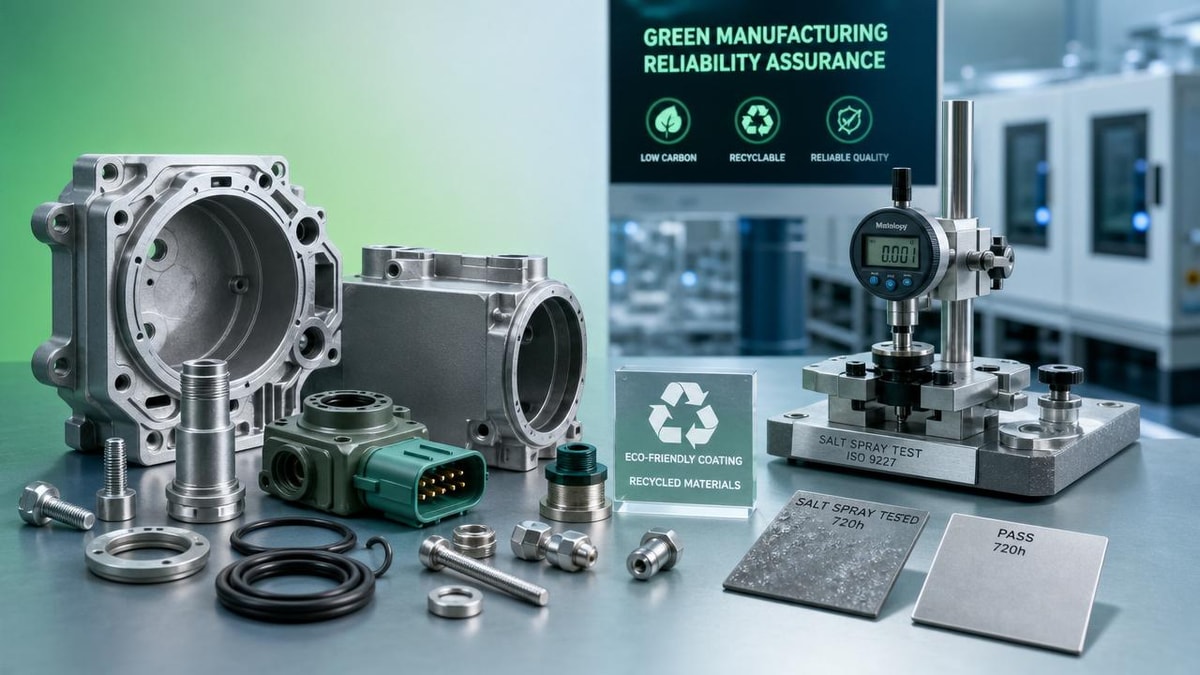
Greening industrial components is no longer just a sustainability goal—it is a quality and risk-control challenge. For quality control and safety managers, the key question is how to reduce environmental impact without introducing performance drift, compliance issues, or premature failure. This article examines practical ways to balance greener materials, process changes, and reliability requirements in demanding industrial applications.
Why greening industrial components has become a live operational issue
Across the broader industrial supply chain, greening industrial components has shifted from a branding initiative to a direct production and compliance issue. The change is visible in material declarations, customer audits, procurement scorecards, and new expectations around traceability. OEMs are no longer asking only whether a fastener, housing, seal, connector, or mold insert performs to specification. They are also asking what it is made of, how it was processed, whether restricted substances were avoided, and whether lower-impact alternatives can be introduced without weakening reliability.
For quality control and safety teams, this shift matters because component failures rarely announce themselves as “green failures.” They appear as torque loss, stress cracking, thermal drift, corrosion, outgassing, insulation breakdown, tool wear, dimensional instability, or inconsistent cycle life. In other words, sustainability-related changes often enter the factory through material substitutions or process adjustments, but they show up later as quality escapes or safety incidents if validation is weak.
That is why greening industrial components now sits at the intersection of environmental expectations, product assurance, and industrial risk management. The strategic question is not whether greener components will be adopted, but how quickly teams can evaluate them without creating hidden failure modes.
The strongest trend signals quality and safety managers should watch
Several market signals explain why this topic is accelerating. First, customers increasingly expect lifecycle visibility, especially in export-oriented industries where environmental documentation supports supplier approval. Second, manufacturers are under pressure to reduce energy use, emissions, waste, and hazardous chemistry inside their production systems. Third, component buyers are learning that greener options are not all equal: some reduce impact with little technical disruption, while others require extensive redesign, retesting, or new controls.
A practical trend is emerging. Companies are no longer treating all green substitutions as simple “drop-in” replacements. Instead, they are separating low-risk optimization from high-risk change. This is a useful mindset for greening industrial components, because it recognizes a basic truth of industrial reliability: even a minor coating change can alter friction behavior, assembly torque, corrosion resistance, or electrical contact stability.
What is driving the shift beyond sustainability messaging
The push toward greening industrial components is being driven by four practical forces. The first is customer qualification pressure. Large buyers increasingly integrate environmental criteria into supplier scorecards, especially for hardware, electrical parts, molded components, and tooling used in global manufacturing programs. The second is regulatory exposure. Even when a component itself is small, its chemistry, recyclability, and production route may affect market access. The third is cost volatility. Energy-intensive processes, waste treatment, and hazardous substance handling can become more expensive over time, making cleaner alternatives economically attractive. The fourth is engineering maturity. Better data collection now allows factories to compare greener options on failure rate, process capability, and total lifecycle impact instead of relying on assumptions.
This combination changes the decision process. Instead of asking whether a greener material or process is theoretically possible, companies now ask whether it can survive field conditions, pass compliance review, and maintain production stability. That is a more disciplined and realistic framework for quality-led adoption.
Where failure risk tends to rise during greening industrial components
Not every sustainability effort creates equal technical risk. In industrial components, the most sensitive areas are usually the interfaces where material behavior, surface condition, and operating stress interact. Safety and quality managers should pay special attention to six risk zones.
1. Material substitutions that change physical behavior
A greener resin, alloy, elastomer, or recycled input may meet nominal specification but still behave differently under heat, vibration, humidity, chemicals, or cyclic loading. Mechanical strength alone is not enough. Creep resistance, fatigue life, dimensional stability, dielectric behavior, and low-temperature brittleness can all shift.
2. Surface and coating changes that alter performance at the interface
Many industrial failures begin at the surface. Changing plating, passivation, paint, anodizing, lubrication, or pretreatment to reduce environmental impact can affect friction coefficients, corrosion barriers, wear behavior, conductivity, and assembly repeatability. For fasteners and connectors especially, this is a high-alert zone.
3. Process changes that quietly shift quality windows
Lower-energy curing, revised molding cycles, modified heat treatment, dry machining, or different cleaning chemistry may appear beneficial, but they can narrow process margins. A greener process is only truly successful if Cp, Cpk, defect escape rates, and long-term stability remain controlled.
4. Supply-chain variability in greener inputs
Alternative materials are sometimes sourced from newer or less mature supply bases. Variability in recycled content, impurity levels, batch consistency, or additive packages can produce irregular field performance unless incoming inspection and supplier qualification are strengthened.
5. Documentation gaps
Greening industrial components often involves a documentation burden: declarations, process records, test reports, and revision history. When paperwork lags behind engineering change, quality teams lose traceability and root-cause resolution becomes slower.
6. Misaligned validation plans
One of the most common mistakes is using old validation logic for a new material or process. If the risk profile changes, the test plan must change too. Passing legacy tests does not guarantee that newly introduced environmental or durability sensitivities have been covered.
Who is most affected by the shift
The impact of greening industrial components is uneven. Some functions face direct technical consequences, while others see procurement, audit, or market pressure first. Cross-functional alignment is therefore becoming a competitive advantage.
The new decision standard: greener only counts if reliability is measurable
A major industry change is the move from narrative-based sustainability claims to evidence-based qualification. For industrial components, that means “greener” must be supported by measurable reliability outcomes. Quality and safety leaders are increasingly expected to ask tougher questions: What changed at the material or process level? Which failure modes could become more likely? Has accelerated testing been updated? Were field-relevant loads considered? Is supplier process capability stable enough for serial production?
This evidence-first approach benefits both sustainability and product assurance. It prevents overreaction to green claims, but it also prevents unnecessary resistance to improvements that can reduce impact without raising failure risk. In many cases, better lubrication control, lower-waste machining, cleaner surface treatment, higher-yield molding, or improved scrap recovery can support greening industrial components with minimal technical disruption—if the process is monitored correctly.
How to judge whether a greener change is low risk or high risk
A practical evaluation model is to classify proposed changes by their proximity to critical performance functions. Low-risk changes are typically those that do not alter load paths, thermal behavior, insulation performance, dimensional stability, or key interfaces. High-risk changes are those that touch exactly these areas.
For example, switching to recycled packaging around components may have limited direct product risk. By contrast, changing a corrosion-protection coating on a fastener used in vibration-heavy, outdoor, or safety-critical applications is a high-risk move that demands expanded testing. Likewise, introducing a bio-based polymer into a housing near heat sources or electrical stress should not be treated as a routine material update.
The best internal question is simple: does this green change affect the component’s function, interface, environment, or process window? If yes, it deserves formal review under change control, FMEA updates, and application-specific validation.
What companies should focus on over the next 12 to 24 months
The next phase of greening industrial components will likely be less about broad promises and more about selective execution. Companies that perform well will focus on disciplined transition, not symbolic substitution. Three priorities stand out.
First, build a ranked map of component criticality. Not every part deserves the same validation intensity. Components linked to structural integrity, electrical safety, pressure handling, sealing, precision movement, or long service life should be screened first and treated conservatively.
Second, improve supplier-level visibility. In sectors covered by GHTN’s industrial matrix—mechanical tools, electrical systems, molds, fasteners, pneumatic parts, and precision manufacturing inputs—real progress depends on understanding not just finished-part claims but the upstream process logic behind them.
Third, treat validation as continuous rather than one-time. A greener component that passes initial qualification may still drift later if feedstock mix, coating chemistry, tooling wear, or process settings evolve. Ongoing monitoring matters as much as launch approval.
Practical judgment criteria for QC and safety teams
To manage greening industrial components without raising failure risk, teams should apply a tighter set of judgment criteria during review:
- Confirm whether the change affects critical-to-quality or critical-to-safety characteristics.
- Check if the supplier can demonstrate process consistency, not just one successful batch.
- Require test conditions that reflect actual service environments: heat, chemicals, vibration, moisture, cycling, and assembly stress.
- Review documentation completeness, including composition, process revision history, and deviation management.
- Track early production signals such as scrap rate, rework, torque scatter, leakage, surface defects, or electrical drift.
- Define clear rollback criteria if field or pilot data indicates unexpected degradation.
Conclusion: the winning approach is controlled greening, not unchecked substitution
The industrial direction is clear: greening industrial components will continue, and the pressure will broaden across materials, tooling, electrical parts, molds, and production processes. But the real dividing line in the market will not be between companies that talk about sustainability and those that do not. It will be between companies that can prove reliability during greener transitions and those that cannot.
For quality control and safety managers, the most valuable response is disciplined skepticism paired with structured action. Treat every green change as a potential technical change. Separate low-risk improvements from high-risk substitutions. Ask for evidence, not slogans. And if your organization wants to judge how this trend affects its own operations, start by confirming five points: which components are function-critical, what exactly is changing, which failure modes could shift, whether the supplier can control variation, and how validation will reflect real-world use. That is the most reliable path to greener outcomes without higher failure risk.
Related News