
Industrial Trends Worth Watching Before Capacity Expansion

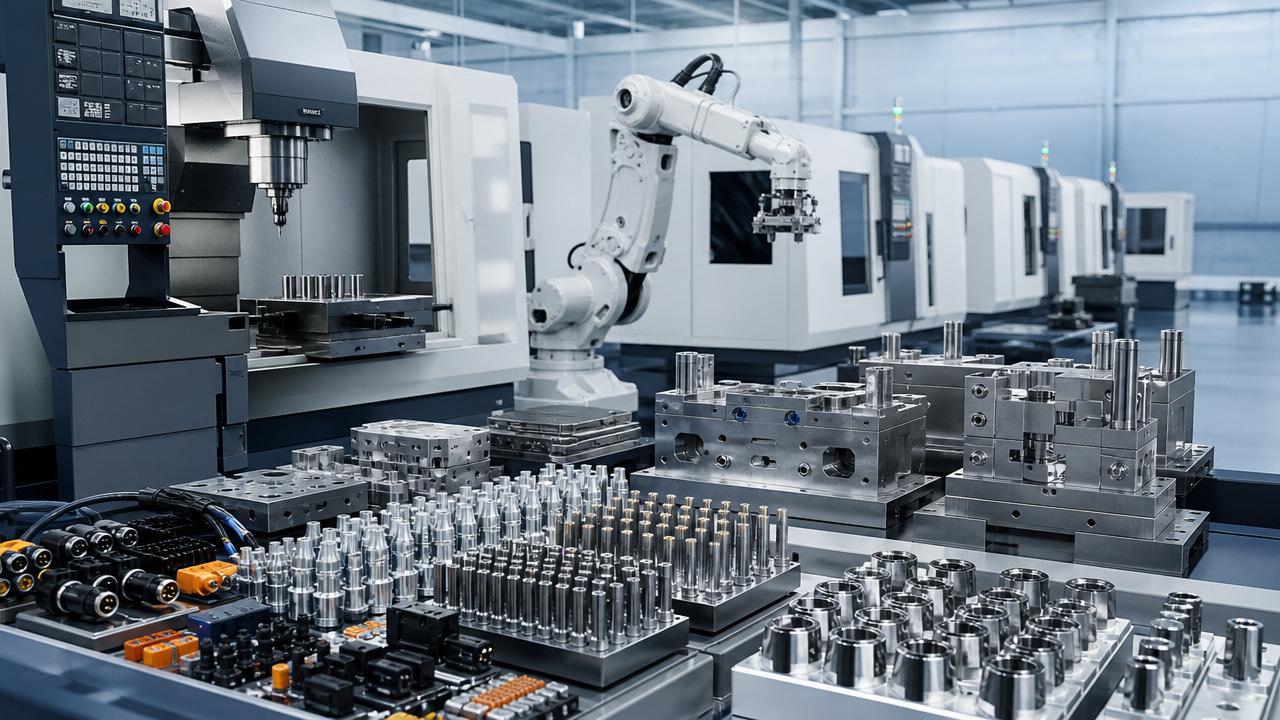
Before committing capital to new lines, facilities, or tooling, business leaders need a clear view of the industrial trends reshaping cost structures, supply resilience, compliance, and technology adoption. For decision-makers planning capacity expansion, understanding these signals can reduce risk, sharpen investment timing, and uncover competitive advantages in an increasingly complex global manufacturing landscape.
For manufacturers, OEMs, distributors, and industrial investors, expansion is no longer a simple question of adding square meters or increasing machine count. It now involves evaluating supplier concentration, lead-time volatility, electrical compliance, automation readiness, mold precision requirements, and the ability to sustain quality at higher throughput. In the hardware, electrical, fastening, pneumatic, and mold-related sectors covered by GHTN, these industrial trends are especially important because small component decisions often create large downstream effects.
A new die-casting cell, a second fastener line, or an upgraded machining center may look attractive on paper, but expansion becomes far more effective when guided by clear operational thresholds. Typical questions include whether incoming demand is stable for 12–24 months, whether critical parts can be dual-sourced within 2–3 regions, and whether the added capacity will meet tolerance, compliance, and cost targets without creating hidden maintenance or energy burdens. The sections below outline the industrial trends worth watching before capital is deployed.
Supply Chain Regionalization Is Changing Expansion Logic
One of the most visible industrial trends is the shift from single-region sourcing toward multi-node supply networks. In practical terms, many industrial buyers now prefer 2-source or 3-source strategies for key inputs such as tool steel, electrical connectors, bearings, mold bases, pneumatic fittings, and specialty fasteners. Capacity expansion plans that depend on one country, one freight route, or one tooling partner face a higher risk of delay.
This matters because expansion often increases exposure before resilience improves. A plant that doubles output from 50,000 to 100,000 units per month may also double its dependence on specific inserts, copper parts, resins, castings, or precision components. If replenishment cycles move from 3 weeks to 8 weeks during a disruption, the financial cost of idle assets can quickly exceed the original savings from concentrated sourcing.
Why regional resilience now affects capital timing
For decision-makers, the key issue is not whether globalization is ending, but whether the current supplier structure can support higher output with acceptable risk. In many industrial categories, common lead times still range from 2–6 weeks for standard items and 8–16 weeks for custom molds, electrical assemblies, or hardened tooling. When expansion shortens inventory cover from 45 days to 20 days without a backup supply plan, the business may be scaling fragility instead of capability.
Key signals to monitor before adding capacity
- Supplier concentration above 40% for any critical component family
- Imported tooling or electrical parts with replenishment cycles longer than 10 weeks
- No approved substitute material or secondary mold source within 1–2 quarters
- Freight cost volatility affecting landed cost by more than 5%–8%
The following table helps frame how different sourcing conditions should influence an expansion decision in industrial components and tooling environments.
The main takeaway is that supply resilience should be treated as a precondition for growth, not a post-expansion fix. Companies that secure alternate supply paths before installation typically preserve better launch timing, stronger customer confidence, and fewer emergency purchases after ramp-up.
Automation and Precision Are Raising the Entry Bar for New Capacity
Another of the most important industrial trends is the convergence of automation, process control, and tighter dimensional expectations. In sectors involving mold manufacturing, cutting tools, fastening systems, and pneumatic controls, new capacity is increasingly judged not just by output per hour, but by repeatability, scrap rate, setup time, and digital traceability.
A legacy production line may still produce acceptable parts at lower volume, but scaling it can reveal hidden weaknesses. For example, a process with a 3% scrap rate at 10,000 pieces may become economically unacceptable at 100,000 pieces if material costs, labor for rework, and missed delivery windows rise together. Precision expansion requires better process capability, not just more equipment.
The shift from machine count to process capability
Executives evaluating new capacity should look closely at tolerance bands, cycle consistency, tool wear rates, and maintenance intervals. In mold-based or machining-intensive operations, a difference between ±0.05 mm and ±0.02 mm can determine whether added throughput supports automotive, electrical enclosure, industrial appliance, or export-grade applications. Likewise, a cutter lasting 1,200 cycles instead of 800 cycles may materially improve labor planning and uptime.
What to validate before approving automation-led expansion
- Current OEE baseline across 3–6 months, not just one high-performing week
- Stable tooling life data under production load, including wear in heat, dust, or vibration conditions
- Control system compatibility with sensors, pneumatic logic, and future MES integration
- Availability of maintenance technicians within the first 90 days after start-up
The practical value of this approach is that it prevents under-specified investments. A lower-cost line may appear attractive during budgeting, but if changeovers take 45 minutes instead of 15, or if unplanned maintenance occurs every 2 weeks rather than every 6–8 weeks, the capacity gain can erode rapidly.
Compliance, Energy, and Material Efficiency Now Shape Long-Term Returns
Among current industrial trends, one of the most underestimated is the growing financial importance of compliance and resource efficiency. For capacity expansion in electrical systems, metalworking, mold production, and industrial component assembly, energy profile, emissions exposure, material yield, and product standardization can significantly influence long-term margin performance.
This is especially relevant for exporters and suppliers serving multiple end markets. Expansion decisions made today may need to support different voltage conventions, material declarations, packaging rules, and quality documentation for the next 5–10 years. A line that is technically capable but poorly aligned with compliance expectations may create redesign costs, approval delays, or reduced market access later.
Where energy and compliance affect payback
In many industrial settings, energy-intensive processes such as heat treatment, injection molding, die-casting support, compressed air generation, and CNC operation should be reviewed with actual utilization assumptions. Even a 6%–12% difference in energy consumption per unit can change the economics of a 3-year payback model. The same applies to scrap reduction: lowering material loss from 4% to 2.5% may outperform a smaller labor-saving initiative.
The table below shows how common compliance and efficiency factors should be incorporated into expansion planning for industrial components and tooling operations.
The broader lesson is that capacity should not be measured only by installed volume. It should also be measured by how efficiently that volume can be converted into compliant, saleable output. This is where detailed component knowledge, such as the type of connector, valve, fastener coating, or mold steel selected, can influence profitability far beyond the purchase price.
Standardization creates expansion flexibility
Standardization is one of the quieter industrial trends, but it often determines whether a company can scale smoothly. Using too many custom parts, local-only specifications, or non-interchangeable tooling systems increases inventory complexity and slows response time. By contrast, standardized interfaces, modular fixtures, and documented maintenance routines can shorten onboarding, simplify spare stocking, and improve uptime across multiple shifts.
For many companies, even reducing active part variation by 15%–20% before expansion can improve planning accuracy. This is particularly valuable in hardware and tooling networks where procurement, machining, assembly, and aftermarket service all depend on clean technical data and part consistency.
How Decision-Makers Can Build a Practical Expansion Readiness Framework
Watching industrial trends is useful only if they are translated into a decision framework. Before signing off on a new line, factory extension, or tooling package, executives should evaluate readiness across commercial demand, process maturity, supplier support, compliance fit, and maintenance capability. In most cases, this can be organized into a 5-step review completed within 3–6 weeks.
A five-step review before capital deployment
- Confirm demand quality: verify whether forecast visibility supports 12 months of stable utilization.
- Stress-test supply: identify single-point dependencies in tooling, electrical parts, and critical materials.
- Measure process capability: review scrap, downtime, tool life, and tolerance control under actual operating conditions.
- Validate compliance and energy assumptions: check export requirements and model resource use at multiple load levels.
- Prepare ramp-up support: define spare parts, maintenance intervals, training needs, and quality checkpoints for the first 90 days.
Common expansion mistakes to avoid
- Approving equipment based only on nameplate output instead of effective output after changeovers and maintenance
- Ignoring tooling revision time for molds, dies, or fixtures during product mix changes
- Underestimating the role of electrical compatibility and documentation when entering new markets
- Expanding before standardizing components, resulting in excessive SKU complexity and spare-part burden
For B2B decision-makers, the best expansion decisions usually come from connecting market demand with engineering reality. That is why intelligence from industrial components, precision tools, mold performance, pneumatic logic, and compliance monitoring matters so much. A line is only as scalable as the underlying parts, materials, and process controls that sustain it.
GHTN’s perspective is especially useful in this context because capacity expansion is rarely just a factory problem. It is a network problem involving suppliers, standards, machines, maintenance, and market access. When those variables are evaluated together, expansion becomes less speculative and more strategic.
The industrial trends worth watching before capacity expansion are clear: regionalized supply planning, automation tied to real process capability, and compliance-driven efficiency are now central to investment success. Companies that assess these factors early are better positioned to control lead times, reduce ramp-up risk, and convert installed capacity into durable commercial performance.
If your team is evaluating new industrial capacity in hardware, electrical systems, tooling, molds, or related component supply chains, GHTN can help you map the technical and market signals that matter most. Contact us to discuss your sourcing structure, expansion assumptions, or component strategy, and explore a more informed path to scalable manufacturing growth.
Related News