
China Enacts Mandatory PV Module Standards Affecting Global Fastener & Connector Compliance
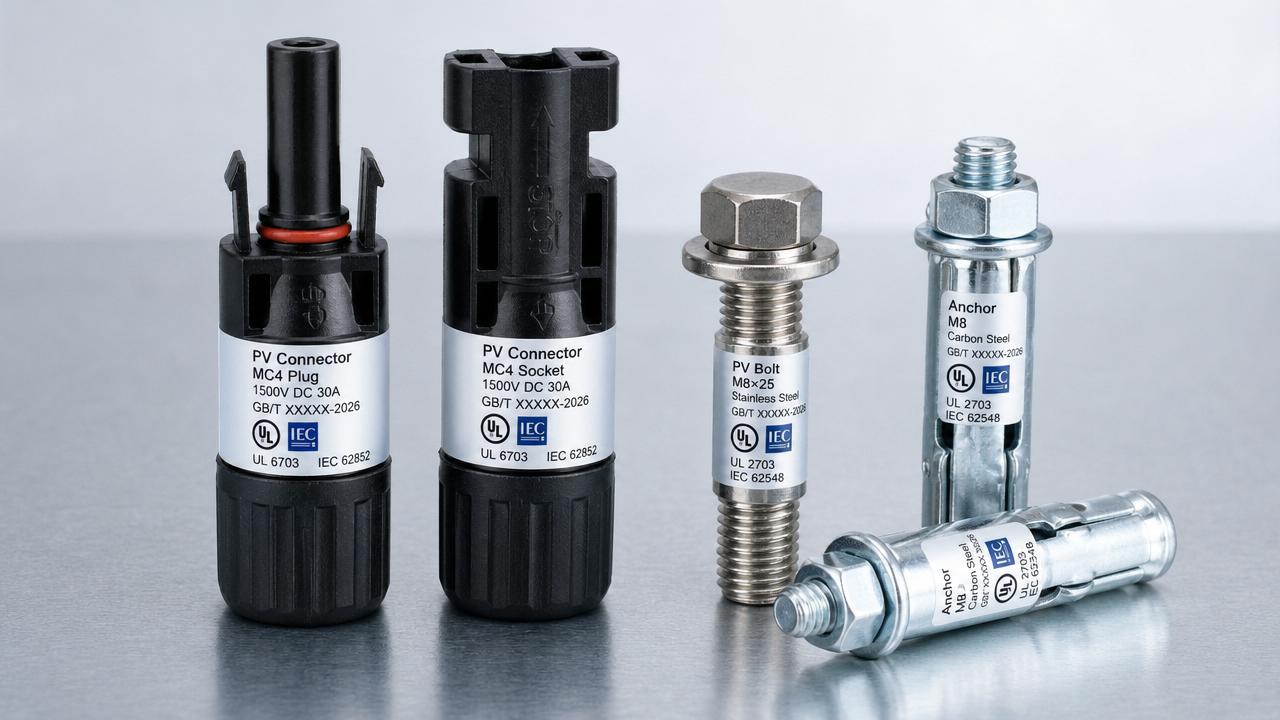
On May 25, 2026, China’s State Administration for Market Regulation approved two mandatory national standards: General Safety Requirements for Photovoltaic Modules and Labeling Requirements for Photovoltaic Module Nameplates. Effective June 1, 2027, these standards impose binding requirements on electrical safety, fire resistance classification, material flame retardancy, and power rating tolerance—directly impacting global exporters of photovoltaic mounting system components, including bolts, screws, anchors, and connectors. Stakeholders in fastener manufacturing, connector assembly, export compliance services, and solar supply chain management should monitor implications for material certification, fire testing alignment, and nameplate labeling across key markets.
Event Overview
On May 25, 2026, China’s State Administration for Market Regulation officially approved GB/T XXXXX–2026 General Safety Requirements for Photovoltaic Modules and GB/T XXXXX–2026 Labeling Requirements for Photovoltaic Module Nameplates as mandatory national standards. Both standards are scheduled to take effect on June 1, 2027. The documents specify hard requirements for electrical insulation, creepage and clearance distances, flammability classification (e.g., UL 94 V-0 or equivalent), flame spread performance per EN 62930 / GB/T 31364, and permissible power output tolerance (±3% under STC). They also mandate standardized nameplate content—including bilingual Chinese–English labeling, traceable manufacturer identification, and certified test references—for all PV modules sold in China.
Industries Affected
Fastener & Anchor Manufacturers (Bolts, Screws, Anchors): These components must meet revised material certification pathways aligned with PV module safety validation—particularly where metallic or polymer-based fasteners interface directly with grounded mounting structures or fire-rated roofing substrates. Certification bodies may now require evidence of compatibility testing under IEC 61730–1/2 or UL 61730, not only for the module but also for mechanical attachment systems.
Electrical Connector Producers (MC4-type, PV-specific junction boxes): Connectors used in PV arrays must demonstrate flame propagation resistance consistent with the module’s rated fire class. This may trigger retesting under EN 62930 or GB/T 31364, especially for connectors supplied into China-sourced module production lines or exported alongside Chinese modules.
Export Compliance & Certification Service Providers: Third-party labs and certification agencies face increased demand for cross-referenced test reports—e.g., verifying that a UL-listed connector also satisfies GB/T 31364 flame spread criteria, or that a CE-marked bolt meets the mechanical and corrosion resistance provisions implied by the new module standard’s grounding and durability clauses.
OEMs & Tier-1 Solar Integrators Sourcing Globally: Companies integrating Chinese-made PV modules into downstream systems (e.g., utility-scale trackers, rooftop EPC packages) must now verify that all associated mechanical and electrical interconnect components comply with the module’s certified configuration—potentially affecting warranty validity and insurance acceptance in EU, Australia, and Middle Eastern markets, where procurement teams have initiated supply chain traceability reviews.
Key Focus Areas and Recommended Actions
Monitor official implementation guidance and technical interpretations
The final published GB numbers and accompanying explanatory notes—expected by Q4 2026—are critical. Until then, alignment between clause-level requirements (e.g., ‘flame retardancy’) and existing international test methods remains subject to interpretation. Stakeholders should track announcements from the Standardization Administration of China (SAC) and CNCA.
Verify component-level certification scope against module-level claims
Many fasteners and connectors currently carry UL/IEC certifications issued for standalone performance. Under the new regime, their use may be conditional on inclusion in the module manufacturer’s validated system test report. Exporters should request written confirmation from module OEMs regarding approved part numbers and test conditions—and retain documentation for customs and end-market audits.
Distinguish regulatory signal from immediate enforcement
While the standards become mandatory on June 1, 2027, enforcement timelines for legacy inventory, transitional batches, and third-country exports are not yet defined. Analysis shows authorities typically allow 6–12 months post-effective date for conformity assessment infrastructure to scale; however, early-mover buyers (e.g., EU utilities with strict ESG procurement policies) may apply the requirements ahead of schedule.
Update labeling, documentation, and supplier communication protocols
Manufacturers supplying components into Chinese module supply chains must ensure English–Chinese bilingual nameplates (where applicable), updated test report references, and traceable batch-level documentation. Internal quality control checklists and supplier questionnaires should explicitly reference compliance with GB/T XXXXX–2026 clauses related to fire performance and marking permanence.
Editorial Observation / Industry Perspective
Observably, this development is less a sudden regulatory shock and more a formalization of de facto expectations already emerging in high-compliance solar markets. The linkage between module-level safety certification and ancillary hardware performance has been tightening globally—most notably through revisions to IEC 61730 and UL 61730. What distinguishes the Chinese move is its binding legal status and explicit requirement for harmonized fire testing across subsystems. From an industry perspective, it signals a shift toward system-level conformity—not just component-level listing—as the baseline for market access. Current attention should focus less on whether compliance is needed, and more on how certification pathways will be interpreted and enforced across multi-tier supply chains.
This is not yet a finalized compliance endpoint, but rather a marker of accelerating convergence in global PV safety governance. Its practical impact will unfold over the next 12–18 months, depending on how certification bodies, customs authorities, and overseas buyers operationalize the new framework.
Conclusion
The issuance of China’s mandatory PV module safety and labeling standards marks a structural inflection point for global suppliers of mechanical and electrical interconnection hardware. It does not introduce wholly novel technical thresholds—but rather codifies and enforces system-level accountability previously managed through voluntary specifications or buyer-led audits. For affected enterprises, the priority is not reactive adaptation, but proactive mapping: aligning current certifications with anticipated test scopes, documenting hardware–module integration evidence, and preparing for upstream and downstream traceability requests. This regulation is best understood not as a discrete compliance hurdle, but as a catalyst for tighter, more transparent, and technically coherent PV supply chain governance.
Source Attribution
Main source: Official announcement issued by China’s State Administration for Market Regulation (SAMR), dated May 25, 2026. Final GB document numbers and full texts remain pending publication by the Standardization Administration of China (SAC). Ongoing monitoring is recommended for SAC technical bulletins and CNCA enforcement notices, which are expected through 2026–2027.