
WF6 Price Surge Extends Lead Times for Pneumatic Seals

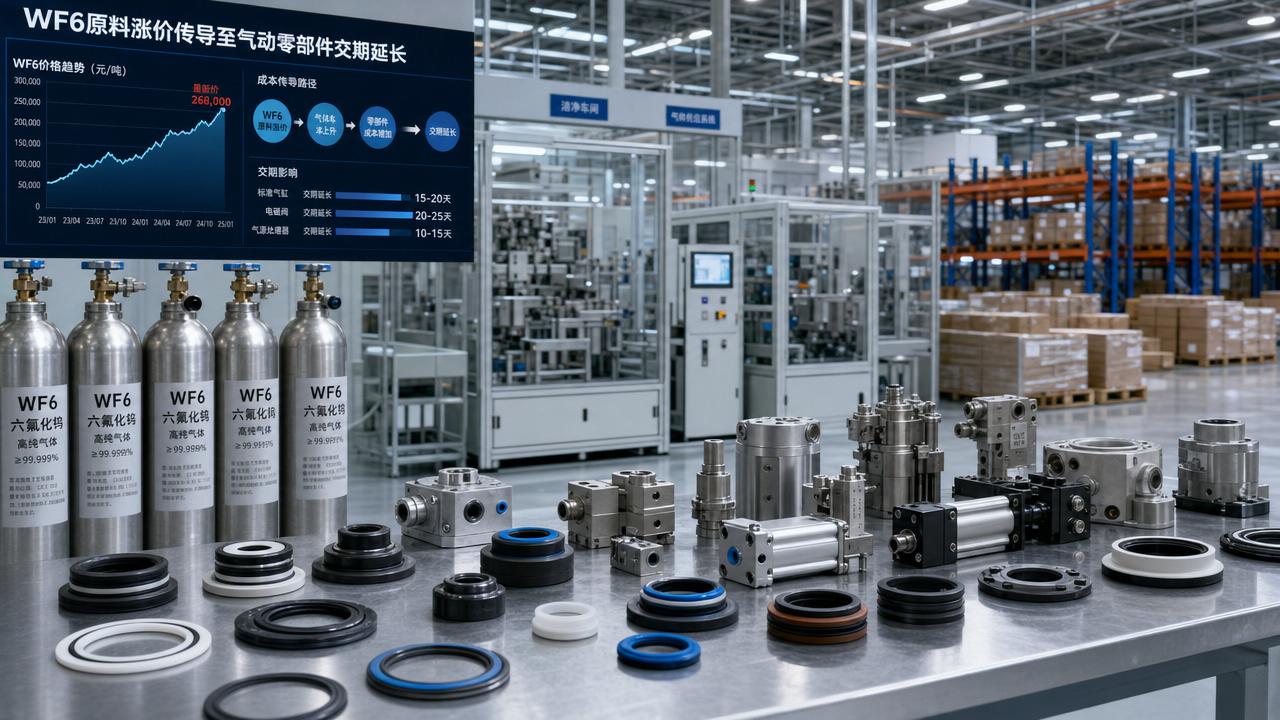
On 2026-04-03, market attention shifted from a raw-material price move to a trade-control signal: after tighter Chinese controls on tungsten powder exports to Japan, China’s average export price for tungsten hexafluoride (WF6) reached USD 150 per kilogram in April 2026, up 204% year on year. Because WF6 is a key input for semiconductor-grade sealing parts used in high-end valves and compressors, as well as for vacuum coating chamber cleaning processes, the change matters not only to gas suppliers but also to exporters, importers, component manufacturers, procurement teams, and delivery planning across the pneumatic supply chain.
What has been confirmed so far
The confirmed facts are limited but commercially significant. Following the upgrade of Chinese controls on tungsten powder exports to Japan, the average export price of WF6 from China reached USD 150/kg in April 2026, representing a year-on-year increase of 204%.
WF6 is identified in the input information as a critical raw material for semiconductor-grade sealing components used in high-end pneumatic valves and compressors, and for chamber cleaning in vacuum coating processes.
The same input states that Kanto Denka and Central Glass in Japan have informed Korean companies of production cuts for the second half of the year. Against that backdrop, tight global WF6 supply is already pushing lead times for core pneumatic components out to 14 to 18 weeks.
For Chinese export-oriented pneumatic component manufacturers, the input states that upstream supply has been secured through domestic substitution, allowing them to maintain stable delivery to overseas customers. For importers, the stated practical response is to lock in orders six months in advance and assess alternative sealing materials.
Why the pressure is spreading beyond one material
Procurement risk is moving closer to finished components
For companies buying special seals, valve internals, or compressor-related precision parts, the issue is no longer confined to WF6 as a specialty gas. The supply tightness described in the input is affecting the availability and lead time of core pneumatic parts, meaning procurement teams may need to revisit purchase timing, supplier confirmation cycles, and delivery commitments tied to export contracts or maintenance schedules.
Export manufacturers face a delivery and credibility test
For export-oriented pneumatic manufacturers, the key issue is whether upstream locking arrangements are strong enough to support shipment promises. The input indicates that some Chinese manufacturers have already secured supply through domestic substitution, which may reduce immediate disruption to overseas deliveries. From a business execution perspective, what deserves closer attention is whether technical documents, order confirmations, and delivery schedules remain aligned with the actual availability of sealing-related materials and components.
Importers need to treat lead time as a compliance and contract issue
For importers, the six-month forward-order suggestion in the input is not just a purchasing adjustment. It also affects contract timing, inventory planning, customer communication, and material approval workflows. If alternative sealing materials are being evaluated, buyers may need to check whether product specifications, qualification files, test records, or customer acceptance conditions require updates before substitutions can be used in delivered equipment.
Supply-chain service providers may see documentation pressure increase
Logistics coordinators, distributors, and other supply-chain service providers may be affected indirectly as lead times lengthen and order windows move forward. In practical terms, they need to pay closer attention to order locking dates, shipment sequencing, and any document changes linked to material substitutions or revised production plans, especially where export delivery commitments depend on consistent part traceability.
What companies should monitor now
Watch for changes in execution language, not only in price
Analysis shows that the most important signal in this case is the linkage between export control tightening and downstream component supply. Companies should therefore monitor not only price movements, but also any later clarification in trade-control execution, supply allocation, or customer-facing delivery language that could affect order acceptance and production scheduling.
Check whether material substitution changes technical files
If sealing material alternatives are being evaluated, companies should review whether existing technical files, internal specifications, testing records, or bid documents assume a fixed material route. Observably, substitution decisions can become commercial or compliance issues if documentation and delivered configuration no longer match customer requirements.
Rebuild procurement timelines around longer cycles
The reported 14 to 18 week extension in lead time means procurement calendars may need to be reset. Importers, distributors, and project buyers should assess whether current reorder points and confirmation cycles still match actual supply conditions, particularly where late material decisions could affect delivery promises or after-sales support readiness.
Confirm supplier resilience, not only supplier price
From an industry perspective, supplier qualification now needs to include continuity questions as well as quotation terms. For exporters that say they have secured domestic substitution, the practical issue is whether that arrangement is durable enough to support stable overseas fulfillment over the coming order cycle.
How this signal should be read
Analysis shows that this development is better understood as an execution signal rather than a standalone commodity price story. The confirmed facts point to a rule-linked supply transmission path: export-control tightening at the upstream level is showing up in a specialty gas price jump, then in reduced output notifications, and then in longer lead times for downstream pneumatic components.
At the same time, it is still more appropriate to treat some of the broader market implications as ongoing developments to monitor rather than fixed outcomes. The input confirms supply tension, production-cut notices, and longer lead times, but it does not provide full detail on future rule implementation, broader procurement behavior, or how widely substitution strategies will be accepted across end markets.
A practical reading for the market
The industry significance of this event lies in how a trade-control change is being transmitted into delivery planning for high-end pneumatic parts. It is not simply a question of WF6 becoming more expensive; it is a sign that sourcing conditions, component availability, and technical substitution decisions may increasingly affect lead times and customer commitments.
For now, it is more appropriate to understand this as a live execution signal with immediate procurement and delivery implications, while reserving judgment on longer-term market restructuring until more evidence emerges from implementation, customer acceptance, and supplier performance.
Basis of this article
This article is generated from the user-provided news title, event date, and event summary. No specific official source link was provided in the input, so any official notices, regulator releases, customs or trade authority information, industry association updates, standards documents, or authoritative media reporting related to this type of event still need to be verified on an ongoing basis.
Further observation should focus on any later clarification of control implementation, material substitution acceptance, changes in bidding or technical documentation, industry feedback on lead-time pressure, and how companies execute delivery commitments under tighter WF6 supply conditions.
Related News